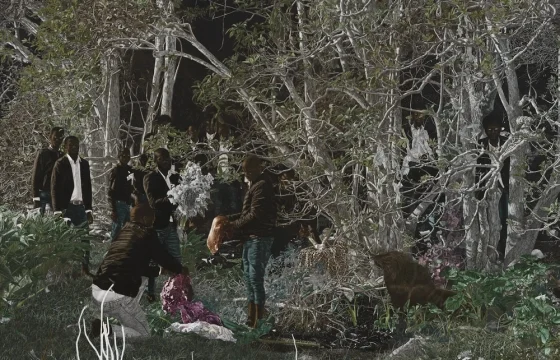
In the hushed, cavernous spaces of the contemporary gallery, where the frantic pace of the digital age usually dictates the rhythm of engagement, South African artist Cinga Samson invites a radical deceleration. His latest exhibition, titled Ukuphuthelwa, is not merely a collection of oil paintings; it is a profound meditation on the act of looking, the instability of language, and the persistent, haunting allure of the spiritual sublime. Running through April 18, 2026, the exhibition marks a significant evolution in Samson’s career, moving deeper into the occluded, twilight realms that have become his signature.
The Essence of ‘Ukuphuthelwa’
The title of the exhibition, Ukuphuthelwa, is drawn from the artist’s native isiXhosa. While it translates colloquially to "unable to sleep," the term escapes the clinical, often pejorative, implications of the English word "insomnia." For Samson, sleeplessness is not a pathology to be treated with pharmaceutical intervention, but a heightened state of spiritual vigilance. It is a sensitivity that matures in the absence of light—a nocturnal awareness that permits the artist to perceive the world not as a series of static objects, but as a vast, vibrating reality in constant, unseen motion.
Samson’s palette remains steadfastly committed to his signature deep-toned aesthetic: carbon blacks, dense Prussian blues, and shadows that seem to swallow the light rather than reflect it. Within these atmospheric compositions, we encounter recurring motifs—figures with unpainted eyes, vigilant dogs prowling through untamed flora, and landscapes that feel both intimately South African and cosmically indifferent.
Chronology of a Vision: The Path to 2026
Samson’s trajectory as an artist has consistently been marked by a move away from figurative portraiture toward a more conceptual, existential inquiry.
- Early Career (2015–2019): Samson gained international recognition for his haunting, velvet-textured portraits that defied traditional representational norms, often placing his subjects in opulent yet claustrophobic settings.
- The Mid-Career Shift (2020–2023): The artist began to experiment with "occluded" lighting, where subjects appeared to emerge from or recede into deep darkness, reflecting his preoccupation with the boundary between the seen and the unseen.
- The Present Moment (2024–2026): With Ukuphuthelwa, Samson has fully embraced the "symbolic dilemma." He has largely abandoned the attempt to represent the "whole truth" of reality, focusing instead on the gap between the painted image and the lived experience. The works produced for this exhibition—such as Umlindo (Watcher), Imfihlo (Secret), and Intsingiselo (Meaning)—represent the culmination of a decade spent interrogating how one paints the "unnameable."
Supporting Data: The Anatomy of the Image
The technical mastery on display in Ukuphuthelwa is not merely for aesthetic pleasure; it is a mechanism for exploring the failure of representation. Samson treats his canvases as battlegrounds between the static signifier and the fluid signified.
The Physics of the "Magic Trick"
Samson describes his manipulation of light as a "magic trick." By leaving sections of his under-drawing visible, he creates a flicker of transparency that suggests his figures are not fixed, but are in a constant state of becoming. The most striking element of his technique is the treatment of the eyes. By leaving the pupils unpainted, Samson ensures his figures do not gaze at the viewer. Instead, they remain "porous," enmeshed with the landscape, acting as conduits for the light that circulates through the entire composition.
Linguistic Interstices
The use of isiXhosa titles is central to the viewer’s experience. Samson acknowledges that words like Intsingiselo (meaning) or Isiganeko (event) carry a weight in his native language that English translations fail to capture. This semantic slippage mirrors the slippage of the image itself. Just as a word can never fully embody a concept, a painting can never fully replicate the reality it purports to capture. This is the "gulf" the artist refers to: the distance between the sign and the truth, a distance that no amount of technical skill can bridge.
Official Perspectives and Philosophical Intent
In discussions surrounding the exhibition, Samson has been explicit about the purpose of his work. He does not view his role as a painter of subjects, but as a facilitator of an encounter.
"The ritual itself is not the important thing," Samson noted in a recent artist statement regarding the piece Umlindo (Watcher), which depicts figures gathering with bouquets and fabric in a forest clearing. "It’s an opening to what exists beyond."
For the artist, the aesthetics of ritual are merely a visual grammar used to navigate a collective human need for orientation. He posits that the divine is not an external force residing in a distant heaven, but something present in the "vernacular of all things"—in the rocky crag of Sithini ngelilitye, in the moonwashed clouds of Tshee, and in the very darkness that defines his palette.
The Implications of the Sublime
The implications of Ukuphuthelwa extend far beyond the gallery walls. By inviting viewers to contemplate the "unnameable," Samson is challenging the contemporary art market’s tendency to treat paintings as commodities to be consumed and categorized.
A Challenge to Subjectivity
Samson’s work demands an active, perhaps even uncomfortable, form of looking. Because his symbols—such as the dog in Intsingiselo II—are open-ended, the viewer’s interpretation is colored by their own cultural and personal baggage. A Western viewer might see a dog as a symbol of domestic loyalty; an amaXhosa viewer might see it as a spiritual guide or an ancestral protector. By refusing to clarify these symbols, Samson forces the viewer to acknowledge that their interpretation is subjective, incomplete, and fundamentally relative.
The Return of the Sacred
Perhaps the most significant implication of this exhibition is its unapologetic engagement with the sublime. In an era often defined by irony, skepticism, and the hyper-mediated nature of digital life, Samson’s work argues for the existence of an "immanent magic" in the ordinary world.
He argues that the "darkness" of his paintings is not a source of fear, but a source of potential. When he states, "The sky can be so friendly, but sometimes so heavy, dark, so scary," he is describing the dual nature of existence itself. His work suggests that if we are "awake" enough—if we possess the hypersensitivity of Ukuphuthelwa—we might find that wonder and terror are merely different forms of the same existential energy.
Conclusion: The Horizon of the Known
As Ukuphuthelwa remains on view through the spring of 2026, it stands as a testament to the endurance of the painted image in an age of technological reproducibility. Cinga Samson does not seek to capture the world in its entirety; he seeks to point toward the vast, untamable reality that lies just beyond the edges of our perception.
By laying bare the "trick" of his own brushwork, he invites the viewer into a space of humility. We are not meant to master these paintings, nor are we meant to fully "understand" them in the analytical sense. Instead, we are invited to exist within the interstice—the space between the paint and the spirit, the word and the meaning, the darkness and the light. In this space, as Samson suggests, we find that the divine is not found elsewhere; it is found in the very act of looking at the world, and realizing how much of it remains, mercifully, beyond our reach.