

In the high-stakes world of modern digital animation, where hyper-realistic computer-generated imagery (CGI) often dictates the visual landscape, a surprising secret lies hidden in the eighth episode of Star Wars: Maul – Shadow Lord. During a pivotal scene, as the casino-owner Rheena Sul makes a desperate, destructive stand against the Empire, the cargo ship occupying the frame feels tactile, weighted, and hauntingly real. That sense of presence is no accident; it is the result of a deliberate, old-school cinematic choice made by Joel Aron, Lucasfilm Animation’s Director of Lighting, Cinematography, and Visual Effects.
While the vessel meets an explosive end, its brief life on screen serves as a bridge between the pioneering practical effects of the original Star Wars trilogy and the cutting-edge digital pipelines of the Disney+ era.
The Philosophy of the Practical
Joel Aron’s journey toward this project began nearly seven years ago, during an impromptu invitation from John Knoll, the legendary Executive Creative Director and Senior Visual Effects Supervisor at Industrial Light & Magic (ILM).
"John comes in and says, ‘Come here, real quick,’" Aron recalls. "He rushes me downstairs to show me a motion-control rig and the miniature Razor Crest. He said, ‘I’ve built this rig and John Goodson built the model, and we are shooting it for The Mandalorian.’ From that moment on, I felt that we shouldn’t just treat animation like animation."
For Aron, who spent his formative years as a digital artist at ILM wandering the workshop bays and admiring the work of model-making titans like Bill George and John Goodson, the integration of miniatures is more than a cost-saving measure—it is a moral imperative to keep the soul of the franchise alive. This commitment to "tactile authenticity" has slowly permeated Lucasfilm Animation, manifesting in everything from subtle atmospheric layers to complex, physical architectural models.
A Chronology of Construction: From Concept to Composite
The creation of the cargo ship for Maul – Shadow Lord was born from necessity. Faced with a looming deadline and the limitations of existing digital assets, the production team found themselves in a creative bind. In the initial storyboards, the team had utilized a Black Sun vessel as a proxy, but as the episode entered production, it became clear that the ship was too recognizable to the audience.
Phase 1: The "Joking" Solution
"We didn’t have the time to build it in CG," notes Art Director Andre Kirk. The team needed a vessel that felt utilitarian—a "commercial freighter" that could believably occupy a landing pad in a backwater spaceport. It was during this high-pressure meeting that Aron jokingly suggested, "What if we just built one? We could build a miniature and shoot it."
The joke quickly solidified into a strategy. By opting for a physical build, the team bypassed the bottleneck of complex digital rigging and texturing, relying instead on the "kit-bashing" techniques popularized in the 1970s.
Phase 2: The Month-Long Build
Aron spent the next month obsessed with the "pinched wanton" shape of the freighter. He wanted the ship to look organic, functional, and weary. The build was a masterclass in recycling:
- The Skeleton: The core was carved from foam, providing a lightweight yet sturdy base.
- The Scavenged History: Aron integrated resin-printed parts originally designed for a Rebel snowspeeder, alongside base plates from a Gundam model kit.
- The Greeblies: To add surface complexity, he 3D-printed components from the shared ILM/Lucasfilm library, including scans of pieces used on the original Millennium Falcon and Imperial Star Destroyer models.
- The Unexpected Find: In a moment of serendipity, Aron utilized parts from the Virago, the iconic ship of Prince Xizor from the Shadows of the Empire multimedia project. While the wings didn’t fit the curve of his design, the body pieces acted as the perfect geometric "greeblies" to bridge the snowspeeder components.
Phase 3: Texturing and Illumination
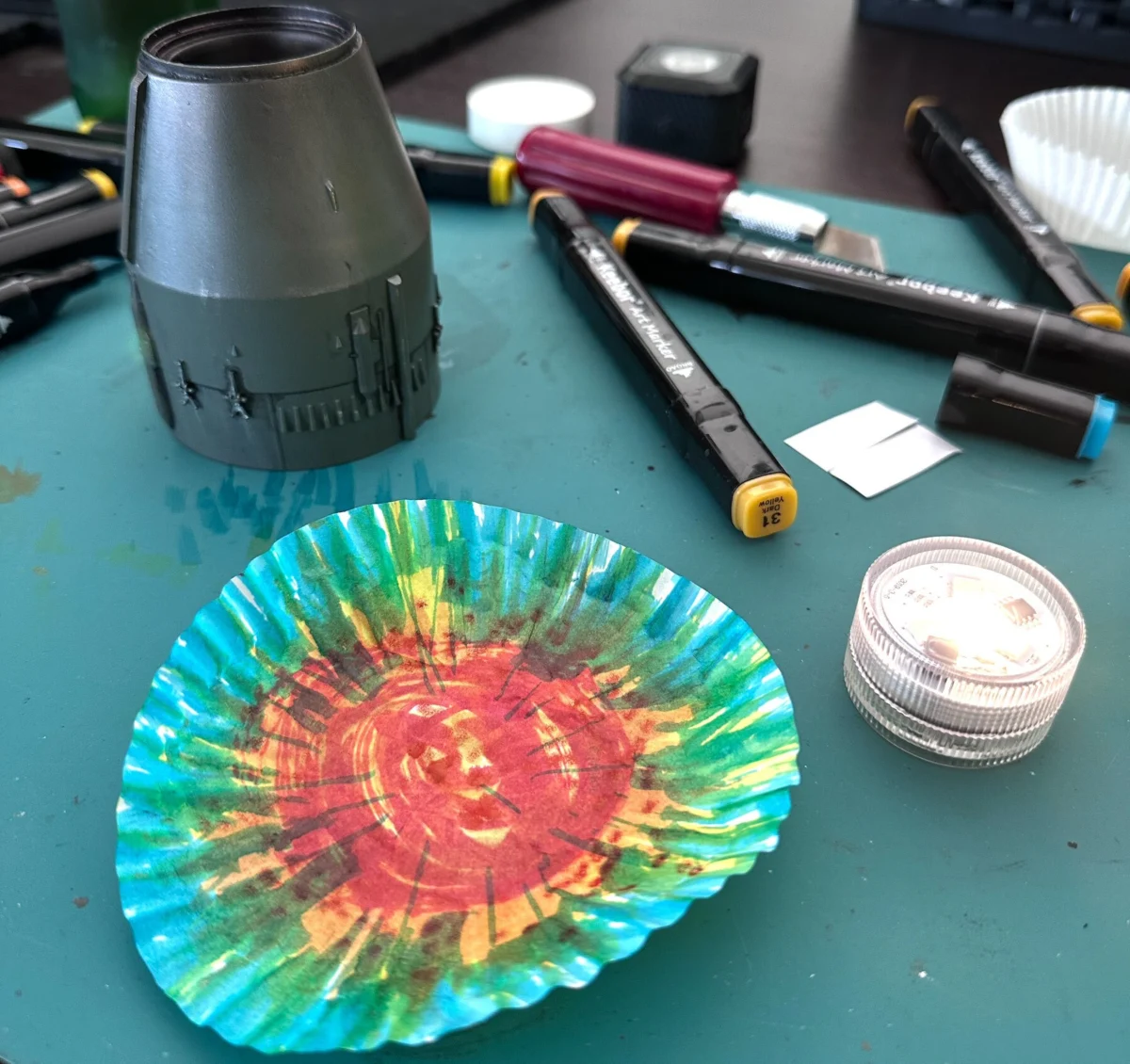
Once the structural assembly was complete, the artistry shifted to finishing. Aron primed the ship in a soft grey acrylic, then employed a technique learned from Bill George: using a graphite block to create realistic metallic chips and wear. To achieve the "burned metal" look near the engine rims, he used unconventional materials, including eye shadow, to simulate heat stress.
The lighting, arguably the most important element, was achieved through "baking" fiber optics and LED components into the model. Aron repurposed paper cupcake cups, colored with resin, to serve as engine diffusers, creating a soft, retro-futuristic glow that digital shaders often struggle to replicate with the same warmth.
Supporting Data: The Efficiency of the Analog
While purists might view miniatures as a step backward in technology, the production data suggests otherwise. The decision to build a physical model was not merely for aesthetic satisfaction; it was a pragmatic response to the show’s scheduling constraints.
- Cost-Efficiency: The hybrid approach—building the model physically but performing final texturing digitally—saved significant man-hours. Andre Kirk noted that by performing the "paintover" in post-production, the team avoided the tedious process of painting physical surfaces that might not even be captured by the camera’s focal depth.
- Workflow Optimization: Because the ship was captured on a "tabletop soundstage" in Aron’s home, the team avoided the queue for massive studio motion-control rigs. The entire process of lighting, exposure, and compositing was handled in-house, allowing for rapid iteration that would have been impossible with a full-scale CG build.
Official Responses: The Collaborative Spirit
The project is being hailed within Lucasfilm as a triumph of cross-departmental collaboration. Andre Kirk emphasized that the success of the miniature was a "group effort," with designers providing constant feedback on the silhouette and scale of the vessel as it evolved.
"It was like a controlled crash landing down to the day when I needed to have it done," Aron admits. Despite the pressure, the process fostered a sense of camaraderie that is often lost in purely digital workflows. By inviting the art department to contribute to the physical build, Aron demystified the process, allowing the entire team to see the "magic" in action.
Implications for the Future of Star Wars Animation
The inclusion of this miniature in Maul – Shadow Lord carries significant implications for the future of the Lucasfilm Animation pipeline. It signals a shift in philosophy: the recognition that "digital" does not have to mean "entirely synthetic."
1. The "Hybrid" Standard
Aron’s success proves that hybrid pipelines—combining physical models with digital compositing—can produce results that are visually superior to pure CG while remaining cost-effective. We can expect to see more of this in future series, as the studio seeks to replicate the "lived-in" aesthetic of the Original Trilogy.
2. Mentorship and Preservation
By involving younger artists in the miniature-building process, Aron is effectively training the next generation of visual effects supervisors in the art of traditional craftsmanship. This ensures that the "visual language" of Star Wars—which is so inextricably linked to the physical models of the 70s and 80s—remains part of the studio’s DNA.
3. A Return to "Painting with Light"
Aron’s emphasis on "painting with light"—using long exposures and multiple lighting passes on a static model—offers a level of atmospheric depth that computer-generated light sources often lack. This methodology, borrowed from the masters at ILM, is now a proven tool in the animation arsenal, ready to be deployed whenever a scene calls for that elusive, tangible "Star Wars" feel.
As the Maul – Shadow Lord series continues to captivate audiences on Disney+, the cargo ship serves as a silent ambassador for a more integrated, thoughtful approach to filmmaking. It is a reminder that in a galaxy far, far away, sometimes the most futuristic technology is the one that sits on a desk, built with glue, resin, and a deep respect for the craft of the past.










No comments yet. Be the first to join the conversation!