

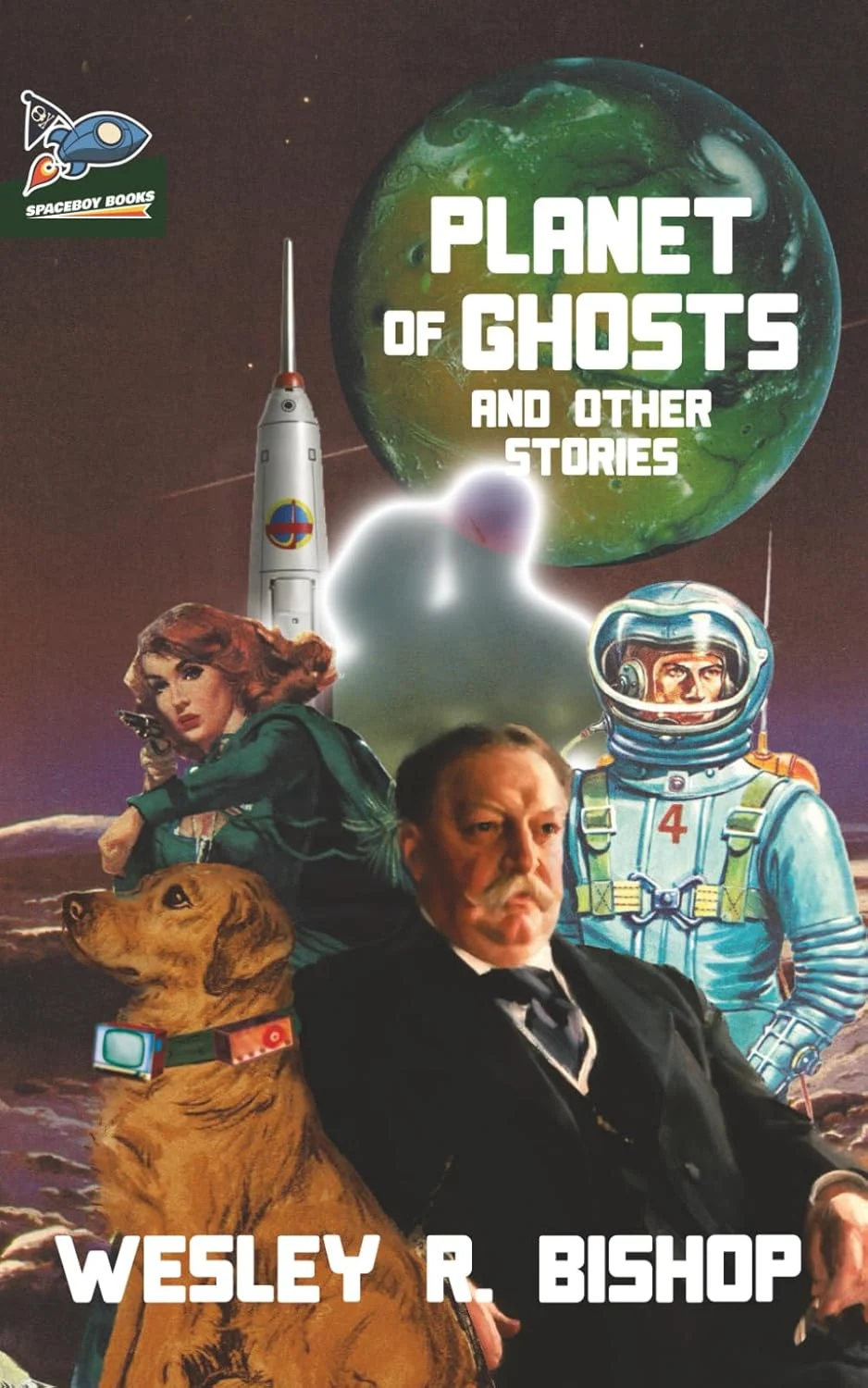
Introduction: The Dystopian Mirror
It began with a nostalgic impulse—a teacher’s summer sabbatical spent revisiting the 1979 cult classic Buck Rogers in the 25th Century. What was once perceived through the wide-eyed lens of childhood as a flashy space opera revealed itself to an adult viewer as something far more unsettling: a hollowed-out, dystopian nightmare. The sterile, AI-managed cities, the reliance on off-planet slave states for sustenance, and the protagonist’s oblivious, blustering bravado suggested a world far more broken than the campy aesthetics of the era let on.
This realization—that our most beloved science fiction tropes often mask a rot at the foundation of civilization—serves as the thematic heartbeat for Wesley R. Bishop’s latest short story collection, Planet of Ghosts. Bishop does not merely inhabit the dystopian genre; he deconstructs it, offering a sprawling, fractured vision of a future where humanity’s technological reach has far exceeded its grasp on survival.
The Chronology of Collapse: A Universe in Disarray
Planet of Ghosts is not a linear novel, but rather a mosaic of decay. Bishop constructs his narrative across a vast, non-linear timeline, moving from the recognizable ecological crises of our present day to the terminal end-stages of the universe.
The chronology of the "Wesleyverse" is defined by a series of cascading failures:
- The Ecological Pivot: The early stories ground the reader in a familiar, modern anxiety—a world suffering from the slow-motion collapse of its biosphere.
- The Great Unraveling: As the narrative progresses, the ecological crisis is superseded by a deeper, more systemic human error—a fundamental flaw in the fabric of existence that threatens to tear the planet apart at the seams.
- The Diaspora: Facing an inevitable end, humanity fractures. Some retreat into the comforting, delusional embrace of "The Cathedral," a pervasive cult movement; others pin their hopes on the perilous lottery of off-planet colonization; and still others cling to increasingly absurd, fringe "escape hatches."
- The Terminal Epoch: In the book’s later segments, we are presented with glimpses of the far future, where the remnants of humanity—and, quite bizarrely, historical figures like William Howard Taft—grapple with the indignities of a reality where time travel and advanced technology have rendered existence a chaotic, "enshittified" landscape.
Supporting Data: The Mechanics of a Broken Future
Bishop’s work is characterized by a dense, layered world-building style. He does not offer the reader an exposition dump; instead, he forces them to piece together the mechanics of this broken future through the lens of disparate characters.
Technology as a Malignant Force
In Bishop’s world, technology is not a tool of liberation, but a source of persistent, low-level misery. The "enshittification" of tech—a term that perfectly encapsulates the current zeitgeist of digital decay—is central to the collection. Characters are consistently forced to adopt new, unrefined, and often predatory technologies simply because the ground is crumbling beneath them. When a new device appears, it is met not with excitement, but with the weary recognition that life is about to become marginally more complicated and significantly more dangerous.
The Role of Time and Narrative
The collection utilizes a sophisticated narrative structure. While the stories are independent, they are tethered to the central setting of "New Gem City." This allows Bishop to play with the concept of "simultaneity." By featuring characters who are affected by time travel, Bishop creates a sense that the beginning, middle, and end of the world are happening concurrently.
"The Man Who Saved the Dead," a standout story concerning the digital preservation of consciousness, acts as the collection’s linchpin. It provides the reader with the context necessary to understand the stakes of other stories, transforming the book from a series of vignettes into a cohesive, interconnected epic.
Official Analysis and Thematic Implications
While many dystopian writers are viewed as modern-day Cassandras—prophets of doom warning the populace of an impending catastrophe—Bishop resists this classification. As both a professional history professor and a creative writer, one might expect Bishop to offer a clear, academic diagnosis of societal failure. However, he refuses to provide the reader with a neat, pedagogical conclusion.
The Refusal of Hope
There are no "pep talks" in Planet of Ghosts. Bishop rejects the traditional dystopian arc that promises either a return to normalcy or a revolutionary rebirth. Instead, he posits that hope is not found in grand gestures or political solutions, but in the micro-level tenacity of individual characters.
The collection suggests that the human spirit is defined by its refusal to stop acting, even when the context of that action is entirely futile. This is best summarized by the recurring sentiment that "every problem humanity faces is always only one generation away from a solution." This is not a promise of salvation, but a testament to the persistent, perhaps irrational, human drive to continue trying.
The Cult of Survival
Bishop treats his characters with a profound, if melancholic, kindness. Whether they are followers of a doomsday cult or desperate, ill-informed colonists, Bishop acknowledges that in the face of inevitable death, all coping strategies are equally valid. By treating these deluded individuals with empathy rather than ridicule, he forces the reader to confront their own anxieties regarding how they might behave if they were truly staring into the abyss.
The Literary Significance of the Short-Form Epic
At a brisk 185 pages, Planet of Ghosts serves as a sharp, efficient critique of the "bloated novel" trend. Bishop’s economy of language is intentional, reflecting the thematic urgency of his subject matter: time is running out.
The collection’s power lies in its ambiguity. Because Bishop refuses to hand the reader a "tidy package" of answers, the onus of interpretation is placed on the reader. We are tasked with scouring the various timelines, hoping to find evidence that our favorite characters have reached a place of safety. This makes the act of reading feel like an act of archeology; we are digging through the ruins of Bishop’s world, looking for meaning in the debris.
Conclusion: A Mirror to Our Own Uncertainty
Planet of Ghosts is a challenging, lurid, and deeply resonant work. It succeeds because it refuses to look away from the darkest aspects of our current technological and social trajectory. By synthesizing the "lurid jumble" of our own internet-age anxieties with the tropes of classic science fiction, Wesley R. Bishop has created a work that feels both ancient and alarmingly current.
For readers seeking a comfortable, optimistic vision of the future, this collection will provide little solace. But for those who recognize that we are living in a moment of rapid, directionless innovation and systemic fragility, Planet of Ghosts is essential reading. It is a reminder that even when the planet is dying, and the ghosts of our past are literal and metaphorical, the act of surviving—and the act of trying to make things just a little bit better—remains the only truly defiant, human thing we have left.










No comments yet. Be the first to join the conversation!