

Introduction: A Haunting Debut
Harper’s is proud to announce Prussian Blue, the inaugural solo exhibition by New York-based artist Sophia Huitema. Spanning seven new oil paintings, the collection invites viewers into a nocturnal, atmospheric world defined by its restricted palette and a palpable sense of psychological suspense. The exhibition, which remains on view through April 25, 2026, marks a significant milestone in Huitema’s burgeoning career, signaling her emergence as a painter capable of synthesizing historical art movements with a distinctly contemporary, cinematic sensibility.
At the heart of the show is the eponymous pigment, Prussian Blue—a color historically rooted in both industrial utility and chemical toxicity. For Huitema, this pigment acts as a metaphorical anchor, binding together a cast of watchful, enigmatic female figures who inhabit the hazy, dreamlike interiors of her canvases.
Main Facts: The Anatomy of an Exhibition
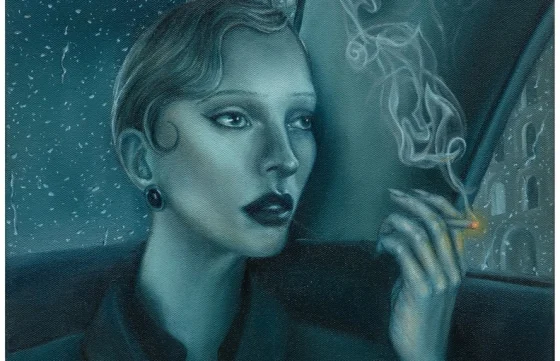
The exhibition is a study in restrained intensity. By limiting her color range to a spectrum of deep blues and cooling greens, Huitema forces the viewer to focus on the interplay between form, shadow, and gesture.
- The Medium: Oil on canvas.
- The Palette: Dominated by Prussian Blue, a synthetic pigment with a complex history.
- The Subjects: Elongated, stylized female figures characterized by slender necks, exaggerated limbs, and an air of detached, calculated poise.
- The Setting: Opulent, Gatsby-era interiors and film-noir-inspired landscapes.
- Duration: The exhibition will remain open to the public through April 25, 2026.
The works on display do not merely depict a scene; they construct a narrative space where the viewer feels like an interloper. The women depicted are not passive subjects; they possess a confrontational gaze that suggests they are as aware of the viewer as the viewer is of them.
Chronology: The Evolution of a Visual Language
While Prussian Blue represents Huitema’s first solo presentation at Harper’s, the exhibition is the culmination of years of sustained, self-directed studio practice. Unlike many contemporary artists who follow the traditional MFA path, Huitema has cultivated her aesthetic through an intensive, iterative process of close observation and experimentation.
Early Inspirations
Huitema’s artistic development was heavily influenced by the visual shorthand of early 20th-century fashion illustration and Art Deco design. The attenuated proportions seen in her figures echo the work of Erté, whose streamlined, elegant aesthetic defined an era of interwar couture.
The Shift Toward Narrative
Over the last several years, Huitema’s work has pivoted from static, decorative compositions toward increasingly narrative, theatrical arrangements. This shift is evident in the current exhibition, where the "Gatsby-era" decadence—complete with pearl necklaces and jewel-studded headdresses—serves as a backdrop for a more sinister, psychological drama.
The Current Moment: Prussian Blue
The current exhibition represents the solidification of these influences. The paintings in Prussian Blue demonstrate a mature command of space and tension, marking a transition from stylistic mimicry to the creation of a proprietary visual language that is uniquely Huitema’s own.
Supporting Data: The Dual Nature of the Pigment
To understand the emotional core of the exhibition, one must look at the pigment itself. Prussian Blue, discovered by accident in Berlin in 1704, occupies a unique place in the history of chemistry.
Chemical Duality
- The Toxicity: The pigment is derived from chemical processes that are historically linked to cyanide, a lethal compound.
- The Antidote: Ironically, Prussian Blue is also used medicinally as an antidote to certain forms of heavy metal poisoning.
Huitema utilizes this "toxic/protective" duality as the conceptual backbone of her show. Just as the pigment can either kill or cure, her female subjects embody a similar contradiction. They are draped in the luxury of the elite—silk, pearls, and opulent gowns—yet they wield their beauty as a form of armor. In her paintings, elegance is never purely decorative; it is a defensive posture.
Critical Analysis: The Cinematic Thriller on Canvas
Perhaps no work better encapsulates the tension of the exhibition than Sleeper Car. In this piece, a woman in a backless evening gown leans against a train coach, her body language oscillating between vulnerability and aggression.
The Compositional Tension
The painting utilizes classic noir elements:
- The Environment: Rain-streaked windows and narrow, stretching aisles create an atmosphere of claustrophobic uncertainty.
- The Gesture: While the woman’s head is tilted in a pose of relaxed, coy amusement, her hand is braced, suggesting she is prepared to strike.
- The Psychological Hook: By placing the viewer in the position of a bystander in a high-stakes moment, Huitema forces a confrontation with the "femme fatale" archetype. Is she the predator, or is she protecting herself from a danger lurking just outside the frame?
This cinematic approach aligns Huitema with the traditions of Surrealist and Symbolist painting. In these schools of thought, interiors are not meant to be geographically accurate; they are psychological landscapes. By compressing the depth of her rooms, Huitema forces the figures into the foreground, ensuring that the viewer cannot escape their piercing, watchful eyes.
Official Responses and Curatorial Context
Harper’s has positioned this exhibition as a dialogue between art history and contemporary image-making. The gallery notes that Huitema’s work functions as a synthesis of disparate influences—from the theatricality of stage design to the nuanced, shallow spaces found in the works of 20th-century masters.
"Huitema creates a world that exists in the space between the page of a fashion magazine and the frame of a suspense film," a gallery representative noted. The choice of Prussian Blue as the title of the show is deliberate, serving as both a chromatic throughline for the seven paintings and a conceptual map for the viewer to navigate the themes of toxicity, protection, and beauty.
Implications: A New Voice in Contemporary Figurative Painting
The implications of Huitema’s work for the broader contemporary art scene are profound. In an era where figurative painting is often dominated by either hyper-realism or aggressive abstraction, Huitema carves out a third space: the stylized, narrative, and deeply psychological.
Redefining the Femme Fatale
Huitema’s work engages with the "femme fatale" trope but strips away the male-gaze-centric tropes of mid-century cinema. Her women are not merely objects of desire; they are autonomous agents within their own dramas. Their "cunning" is not just for the sake of seduction, but for the sake of survival in a world that is clearly, and consistently, menacing.
The Persistence of Historical Dialogue
By grounding her work in the aesthetics of the 1920s and 30s while maintaining a contemporary perspective, Huitema demonstrates that historical styles are not static. She proves that Art Deco and Symbolism can be repurposed to speak to modern anxieties regarding vulnerability, status, and the masks we wear.
Conclusion: A Lingering Presence
As Prussian Blue continues its run at Harper’s, the exhibition stands as a testament to the power of atmosphere in painting. Sophia Huitema has succeeded in creating a series of works that do not just demand to be seen; they demand to be felt. Through her mastery of a single, complex color and her commitment to the theatricality of the human figure, she has crafted a debut that is as unsettling as it is beautiful.
Visitors to the gallery will find themselves caught in the same haze as her subjects—a blue-tinted, rain-streaked, and elegant world where the beauty of the surface is always, inevitably, guarding something much darker beneath. Whether one reads these paintings as a critique of high-society performance or as a psychological exploration of self-defense, the impact remains the same: a lingering sense of suspense that stays with the viewer long after they have left the gallery floor.
Prussian Blue is an essential exhibition for those interested in the evolution of figurative painting and the power of narrative-driven, atmospheric art. It is a bold, confident, and profoundly realized debut that establishes Sophia Huitema as an artist to watch closely in the coming years.










No comments yet. Be the first to join the conversation!