Iffa Jayyana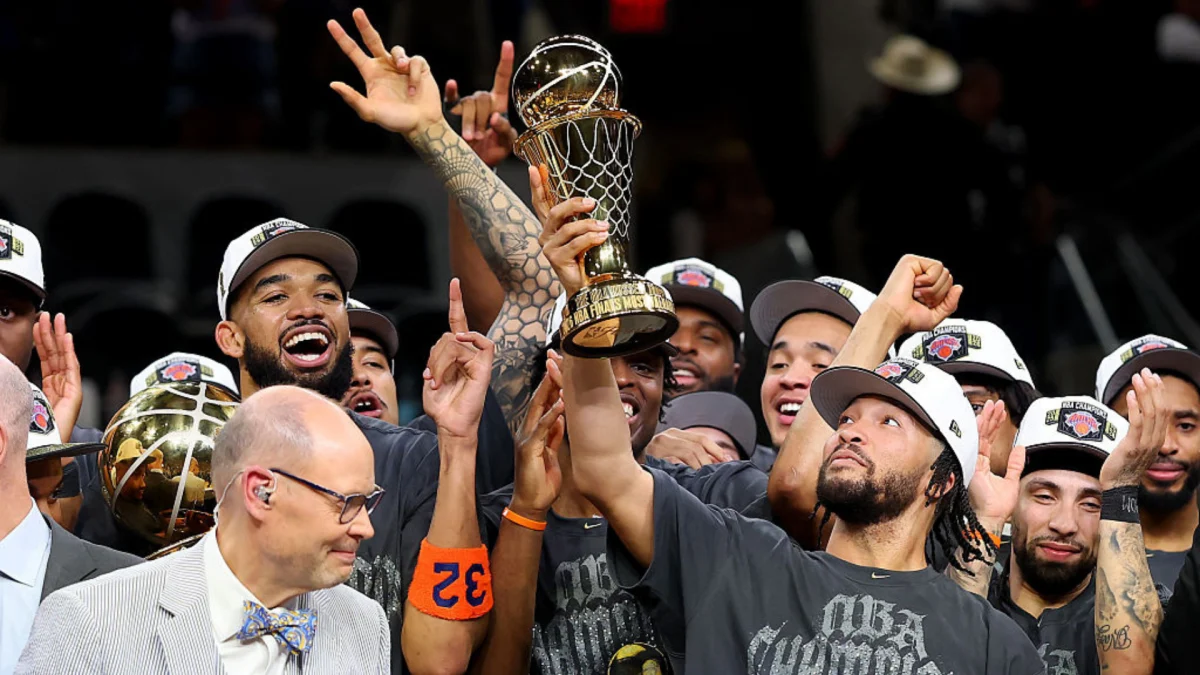
For over half a century, the New York Knicks were defined by "what if." Since their last NBA championship in 1973, the franchise became a tragic archetype of professional sports—a storied institution plagued by mismanagement, heartbreak, and a drought that spanned generations. That silence was shattered last night. With a commanding performance that capped a season of destiny, the Knicks claimed the Larry O’Brien Trophy, ending the longest title drought in the history of the franchise and rewriting the narrative of the modern NBA.
This was not merely a victory; it was a cultural phenomenon. From the neon glow of Times Square to the deepest threads of the internet, the collective exhale of a city that had waited 51 years was palpable. While the casual observer sees a basketball trophy, those who have followed the trajectory of this roster recognize something rarer: a storybook ending so improbable, so meticulously crafted, that it feels scripted by the gods of the game.
The "Nova Knicks": A Decade in the Making
The foundation of this championship rests on a bond forged in the crucible of collegiate excellence. Ten years ago, Jalen Brunson, Josh Hart, and Mikal Bridges were teammates at Villanova University. They were young, hungry, and fundamentally connected by a style of play that prioritized team chemistry over individual ego. That camaraderie proved its worth in 2016, when they led the Wildcats to an improbable 77-74 victory over a heavily favored North Carolina squad in one of the most iconic NCAA tournament games in history.
A decade later, that same core reunited in the world’s most famous arena, Madison Square Garden. This was no accident of free agency; it was a calculated, sacrificial act of will. In the summer of 2024, Jalen Brunson—the team captain and a burgeoning superstar—made a move that left the sports world stunned: he accepted a $113 million pay cut to clear the necessary salary cap space to bring his brothers together.
At the time, renowned analyst Adrian Wojnarowski labeled the move "largely unprecedented." Today, that sacrifice is viewed as the stroke of genius that built a dynasty. By prioritizing collective success over individual wealth, Brunson ensured that the Knicks were not just a collection of talent, but a brotherhood. Last night, as the final buzzer sounded, that gamble was vindicated. Brunson was crowned the King of New York, and his college teammates stood beside him as champions.
The Redemption of Karl-Anthony Towns
If the "Nova Knicks" provided the foundation, the arrival of Karl-Anthony Towns provided the missing piece of the puzzle. For years, Towns was the subject of an unfair, persistent narrative. In 2018, Minnesota Timberwolves teammate Jimmy Butler branded him "soft," a label that haunted the center for the better part of his career. Despite his undeniable offensive prowess, the "soft" tag became an anchor, overshadowing his growth as a leader and a defensive presence.
Last night, that narrative was incinerated. Throughout the playoffs, Towns was nothing short of heroic. He averaged 15 points, 11 rebounds, and 2.5 assists per game, but his true value was found in his defensive assignment: guarding Victor Wembanyama. Matching up against the 7’4" "Alien"—a player who combines center height with the agility of a guard—is a task that would break most defenders. Towns didn’t just survive; he neutralized the league’s most unique threat.
Yet, the emotional weight of his victory transcends the hardwood. In 2020, Towns suffered the devastating loss of his mother to complications from COVID-19. In a world where professional athletes are often encouraged to keep their guards up, Towns chose radical vulnerability. He shared his grief, his rituals, and his healing process with the public. In a post-game interview following Game 1 of the Finals, Towns revealed that he felt his mother’s presence in the stands—a comforting, loving energy that transformed the pressure of the Finals into a space of joy. Standing on the podium as an NBA champion, the narrative has shifted permanently. The man once called "soft" is now a champion, a survivor, and a pillar of resilience.
Brunson: Burning the Critics
The narrative arc of Jalen Brunson’s career is perhaps the most satisfying subversion of expectations in recent sports history. A 6’2" point guard, Brunson spent his early years being told he was too small to be a "1A" player—the primary engine of a championship team. In 2023, WNBA legend Becky Hammon publicly dismissed his ability to lead a contender, and media personalities like Stephen A. Smith famously labeled his signing with the Knicks a "disaster."
Brunson didn’t just ignore the noise; he used it as fuel. Averaging 32.6 points, 4.6 assists, and 4.2 rebounds per game throughout the Finals, he silenced every critic with a masterclass in poise. His 45-point performance in the close-out Game 5—played on the road, in a hostile environment—will be remembered as a legendary display of grit.
The moment was made all the more poignant by the presence of his father, Rick Brunson, an assistant coach on the team. To win the title alongside his father, a man who once donned the same Knicks jersey, added a generational layer to the triumph. Jalen Brunson has not only delivered a trophy to New York; he has redefined what it means to be a "superstar." He proved that size is secondary to heart, and that "disaster" moves are often just the seeds of greatness.
Chronology of a Championship Season
- Summer 2024: The "Brunson Sacrifice." Jalen Brunson takes a $113 million pay cut to facilitate the acquisition of key teammates, setting the foundation for the championship roster.
- Regular Season 2024-2025: The Knicks establish chemistry, with the Villanova core setting the pace and Karl-Anthony Towns anchoring the defense.
- The Playoffs: The team systematically dismantles conference opponents, demonstrating a level of tactical discipline unseen in previous eras.
- The Finals: A hard-fought series where the Knicks’ defensive adjustments—specifically regarding Towns on Wembanyama—change the momentum.
- Game 5 (The Clincher): Jalen Brunson drops 45 points in a road victory, clinching the title and securing the Finals MVP award.
Supporting Data: The Efficiency of the Knicks
The Knicks’ championship was not a product of luck; it was a product of data-driven excellence. During the playoffs, the team boasted a defensive rating that ranked among the top three in the last decade of postseason play. Their offensive efficiency was equally impressive, characterized by a low turnover rate and a high volume of assisted baskets, a testament to the "Nova" style of unselfish play.
Furthermore, the team’s rebounding margin remained positive throughout the entire postseason, even when facing significantly taller opponents. This was largely due to the collective effort of the roster, led by Towns’ rebounding dominance and the gritty perimeter defense of Josh Hart, who led the team in deflections per game.
Official Responses and Cultural Impact
The response from the city and the league has been overwhelming. Mayor Eric Adams declared the day after the win "Knicks Pride Day," with parades planned through the Canyon of Heroes. NBA Commissioner Adam Silver praised the team for "restoring the luster" to the league’s most important market.
Perhaps the most symbolic moment of the celebration was the presence of filmmaker Spike Lee. For decades, Lee has been the heartbeat of the Madison Square Garden crowd—a fixture as iconic as the parquet floor itself. However, his presence in San Antonio alongside Do the Right Thing castmates Giancarlo Esposito and John Turturro underscored the cinematic nature of this win. Lee, who has documented the struggles of New York for years, was finally able to document its ultimate triumph.
Implications for the Future
What does this championship mean for the NBA? Firstly, it serves as a massive endorsement of the "team-first" roster building model. By proving that a team of best friends who sacrifice personal income can overcome individual superstars, the Knicks have changed the incentive structure for future free agents.
Secondly, the success of this squad cements the legacy of Madison Square Garden as the premier destination for players who want to build a lasting, historic brand. The Knicks are no longer a graveyard for talent; they are a beacon.
As the confetti settles, the city of New York is left with something it hasn’t felt in 51 years: certainty. The drought is over. The "Nova Knicks" have arrived, the skeptics have been silenced, and the standard for what a championship team looks like has been raised. This wasn’t just a win—it was the correction of a historic imbalance, and the beginning of what could be a very long, very bright era for basketball in the Big Apple.

 Nana Wu
 Nana
Nana