

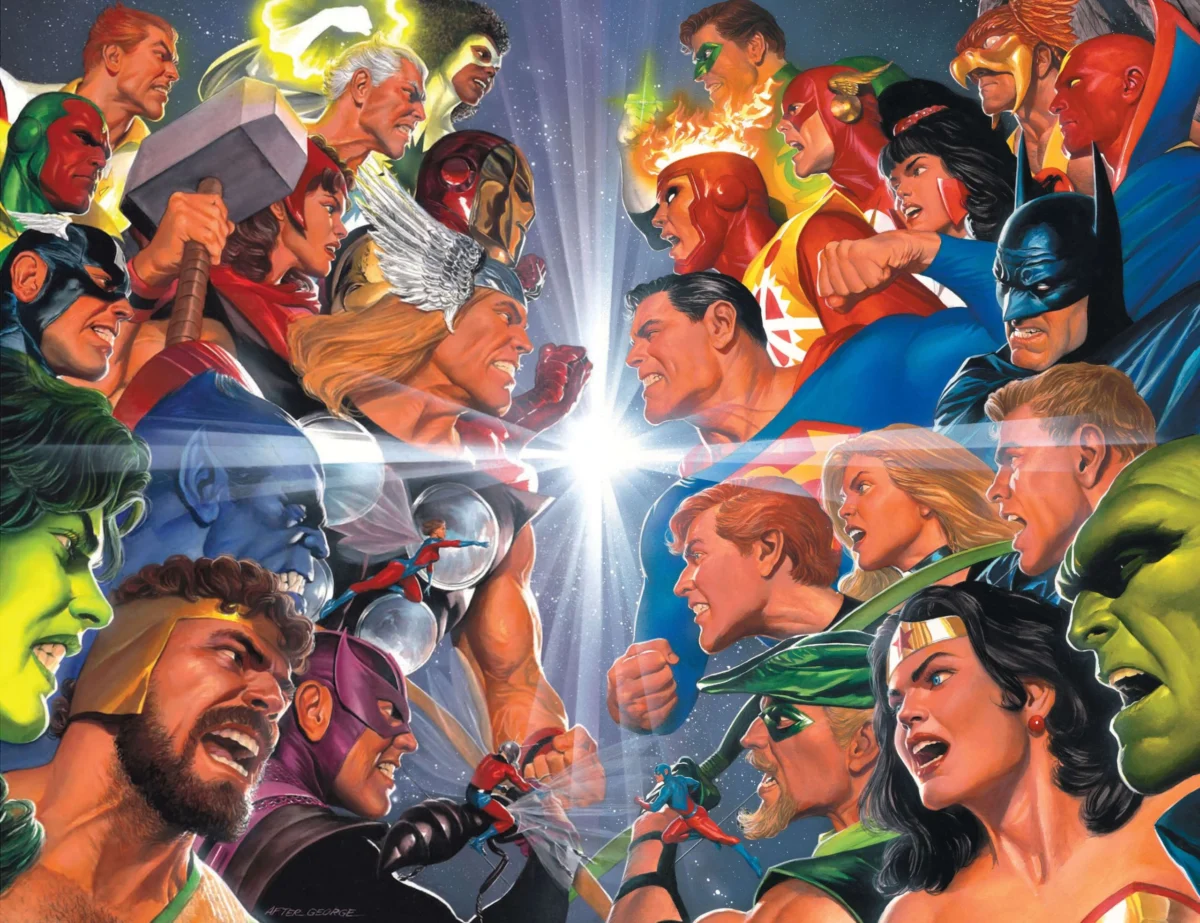
The comic book industry is currently witnessing a rare moment of historical reverence and cross-publisher celebration. As the summer of 2026 kicks into high gear, DC Comics has officially unveiled a breathtaking new connecting variant cover by legendary artist Alex Ross for the upcoming facsimile edition of Avengers/JLA #4. This reveal serves as the latest chapter in the highly anticipated return of the 2003-2004 landmark crossover series by writer Kurt Busiek and the late, great artist George Pérez—a project that remains, to this day, the definitive summit of the two largest universes in superhero fiction.
The Main Event: A Visual Homage to a Comic Book Legend
The newly revealed artwork by Alex Ross is not merely a cover; it is a profound tribute to the legacy of George Pérez. The illustration serves as the second half of a two-piece connecting image that, when unified, pits the members of the Justice League and the Avengers against one another in a classic, high-stakes standoff.
Ross, whose painted, realistic style has become synonymous with the "definitive" look of DC’s icons, has specifically crafted these covers to echo the composition of George Pérez’s original art for Comics Interview Special Edition #6, published back in 1983. By bridging the gap between the 1980s aesthetic and the modern era, Ross provides a visual bridge that honors the long, often complex history of this specific crossover.
In this distribution plan, Marvel Comics is set to publish the first half of JLA/Avengers #3 this July, which will place the focus squarely on Earth’s Mightiest Heroes. Shortly thereafter, DC will release the concluding half in Avengers/JLA #4, highlighting the Justice League. Collectors and fans who have been clamoring for a physical re-release of this seminal work will finally be able to place these covers side-by-side to complete the full, panoramic face-off between the two legendary rosters.

Chronology: A History of the Ultimate Crossover
To understand the magnitude of this reprint, one must look at the fraught and fascinating history of the JLA/Avengers series. The project was the "Holy Grail" of comic book crossovers for nearly two decades.
- The Early Attempts (1970s-1980s): The idea of a formal crossover between DC and Marvel was the subject of intense speculation and several failed editorial negotiations throughout the late 1970s and early 1980s.
- The 2003-2004 Publication: Finally, in 2003, the stars aligned. Under the creative vision of Kurt Busiek and the sheer artistic Herculean effort of George Pérez, the four-issue limited series was released. It was a massive success, both critically and commercially, effectively serving as a love letter to the history of both publishing houses.
- The "Out of Print" Era: Following the 2004 conclusion, licensing agreements between the two companies grew increasingly restrictive, leading the series to fall out of print. For years, the only way to acquire the story was through secondary markets at exorbitant prices.
- The 2026 Resurgence: The announcement of the facsimile editions—which recreate the original four-issue run with classic trade dress, wraparound cardstock covers, and the original interior content—marks the first time in over twenty years that the story has been widely accessible to a new generation of readers.
Supporting Data: Why This Crossover Matters
The JLA/Avengers series is not just a "fight comic"; it is a narrative achievement that explored the foundational differences between the two universes.
Narrative Scope
The plot, masterfully constructed by Busiek, involved the villainous Krona and the Grandmaster, forcing the Justice League to battle cosmic threats like Terminus, while the Avengers were tasked with confronting the world-devouring entity Starro. The stakes were nothing less than the continued existence of both realities.
The Pérez Factor
George Pérez, who passed away in 2022, was the perfect artist for this endeavor. His ability to render dozens of characters in a single panel without sacrificing clarity or detail made him the only choice for a story that required the inclusion of every significant hero from both the Marvel and DC pantheons. The 2026 facsimile editions serve as a posthumous celebration of his unparalleled contribution to the medium.

Facsimile Specifications
The decision to release these as "facsimile editions" is a strategic move by both publishers. By maintaining the original trade dress, the books provide an authentic "time capsule" experience. For modern collectors, these issues are not just reprints; they are archival-quality representations of the original reading experience, complete with the vintage advertisements and editorial pages that defined the 2003-2004 era.
Official Responses and Editorial Strategy
While official statements from DC and Marvel have been brief, the industry response has been overwhelmingly positive. Retailers have reported high levels of pre-order activity, indicating that the appetite for this specific crossover has not diminished in the two decades since its debut.
Industry analysts note that this collaboration is a testament to the current era of "cooperative publishing." In an age where digital distribution and streaming have made audiences more accustomed to crossover events, the print side of the industry is finally leaning into the shared history that fans have demanded for generations.
"The goal," according to industry insiders, "was to ensure that the work of Busiek and Pérez is preserved in a format that honors the original craftsmanship while allowing new readers to understand why this specific story is considered the gold standard for superhero crossovers."

Implications for the Future of Comics
The return of JLA/Avengers to shelves has wider implications for the comic book industry.
The Potential for More Collaborations
The success of this reprint series will likely be used as a barometer for future Marvel/DC interactions. If the sales figures for these facsimile editions exceed expectations, it could encourage editorial departments at both companies to explore new, limited-run collaborations, potentially moving beyond reprints into original material.
Preservation of Legacy
By prioritizing the facsimile format, DC and Marvel are setting a precedent for how "prestige" back-catalog material should be handled. Rather than modernizing the art or altering the scripts to fit current continuity, the publishers are respecting the original vision of the creators. This approach emphasizes the importance of comic books as historical artifacts.
The Role of the Local Comic Shop
The push for fans to visit their local comic shops to secure these issues is a deliberate effort to drive physical foot traffic. In an era dominated by digital subscriptions, the "event" nature of these covers—specifically the connecting Alex Ross variant—creates a tangible incentive for physical ownership, reinforcing the bond between publishers, retailers, and the collecting community.

Conclusion: A Must-Have for Every Collection
As August approaches, the excitement surrounding the release of the final issue in this facsimile run continues to build. The collaboration between Alex Ross—who stands as one of the most respected living artists in the industry—and the timeless work of Busiek and Pérez ensures that these editions will be among the most sought-after books of the year.
Whether you are a veteran collector who still remembers picking up the original issues in 2003, or a new reader discovering the wonder of the Justice League and the Avengers working in tandem for the first time, these facsimile editions offer a perfect entry point. They are a celebration of everything that makes superhero comics a unique and enduring art form: the scope, the spectacle, and the rare, magical moments when the impossible becomes real.
Be sure to check in with your local comic shop today to ensure your pre-orders are confirmed. The battle for the fate of two realities is back, and for the first time in a generation, you have a front-row seat.









No comments yet. Be the first to join the conversation!