


In an era defined by perpetual digital connectivity, the human brain is under siege. We are bombarded by a relentless stream of Slack notifications, email threads, academic papers, and ephemeral, half-formed ideas. For many, this "mental clutter" is not merely an annoyance; it is a significant contributor to cognitive fatigue, leading to missed appointments, forgotten passwords, and a persistent, low-grade anxiety that we are failing to keep up with the demands of modern life.
I recently hit a wall. Between forgetting passwords for rarely used accounts and narrowly missing critical personal deadlines, it became clear that my brain was being taxed by the sheer volume of "tiny things" I felt compelled to remember. I realized I was treating every fleeting thought like an urgent crisis. In a bid to reclaim my cognitive bandwidth, I turned to Google’s NotebookLM—not to replace my critical thinking, but to serve as an externalized, structured "second brain."
The Genesis of the Experiment: Why We Are All Overwhelmed
The modern professional environment is characterized by information density. We consume more content in a day than our predecessors did in a week. When we attempt to store this influx of data in our working memory, we inevitably experience degradation in performance. Cognitive science suggests that our "mental RAM" is limited; when we force it to juggle grocery lists, project deadlines, and complex research simultaneously, we increase the likelihood of errors and emotional burnout.
My personal breaking point was a series of small, yet telling, failures. I missed a friend’s birthday and nearly failed to secure a Mother’s Day gift, all because my focus was fractured across a dozen different digital silos. The objective of my experiment was simple: could I offload the "low-level" processing of information to an AI, thereby freeing my mind for high-level synthesis?

Chronology of a Workflow Shift
Days 1–2: The Data Dump
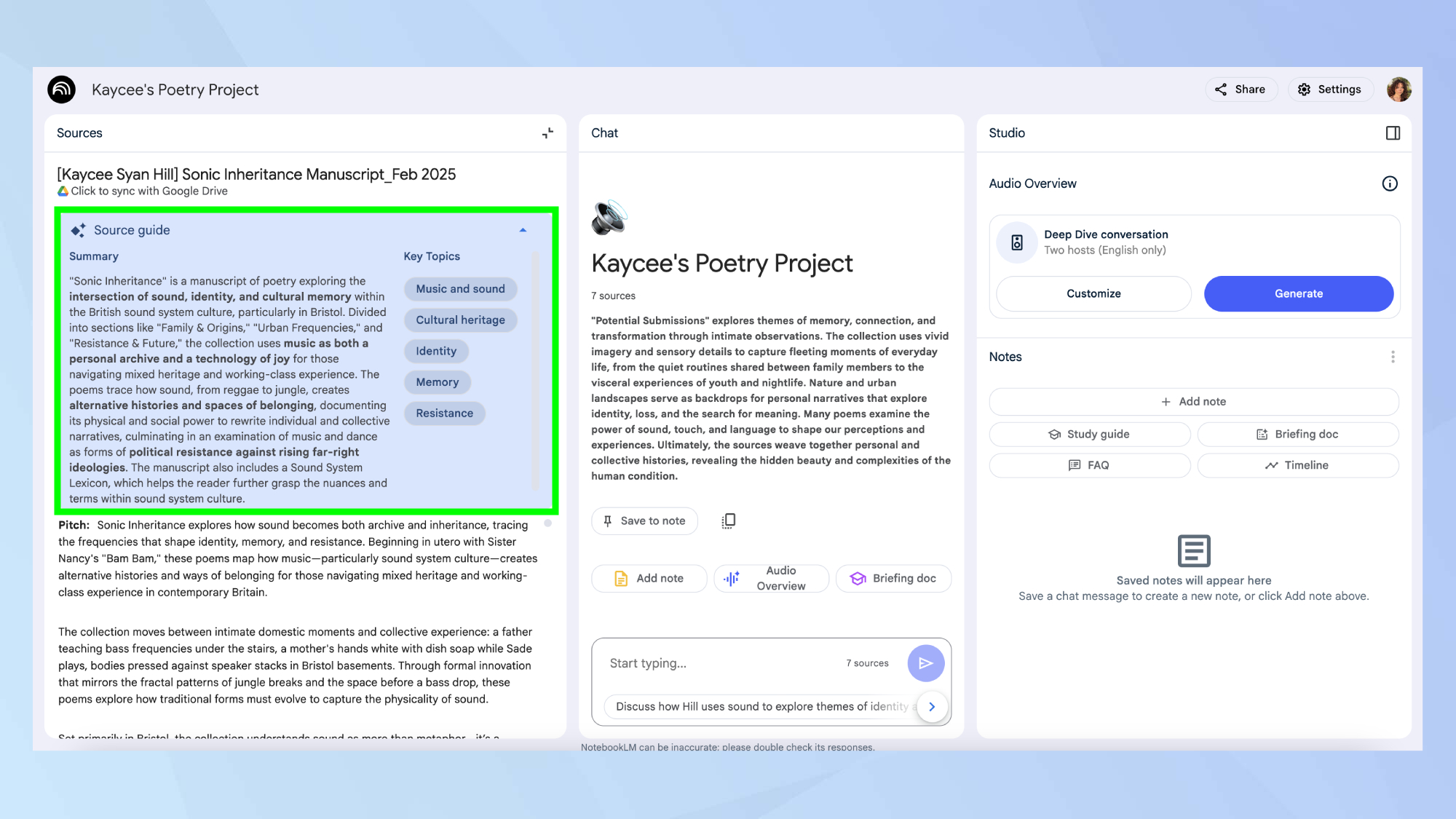
The first phase of the experiment involved centralizing my information. Rather than keeping my research in PDF folders, Slack messages, and handwritten notes, I began dumping everything into Google NotebookLM. This platform is distinct from standard generative AI because it is "source-grounded." It does not merely hallucinate answers from a vast, unverified database; it anchors its responses to the specific documents, transcripts, and URLs I provide.
Days 3–5: Building the "Mental Containers"
By the third day, I began organizing these inputs into distinct "notebooks." I created separate containers for story ideas, technical AI research, family logistics, and long-term project planning. This separation was transformative. The act of "saving" information into a categorized, AI-assisted container allowed my brain to release the "rehearsal loop"—the internal mechanism that keeps us repeating information to ourselves to avoid forgetting it.
Days 6–7: Integrating Mobile Mobility
I leveraged the Gemini AI mobile app to capture ideas on the fly. Whether I was in the grocery store or waiting at my son’s soccer game, I could dictate a stray observation into the app, which then synced to my notebooks. This eliminated the anxiety of "losing" an idea before I could get back to my desk.
Supporting Data: The Impact of Cognitive Offloading
While the personal benefits were immediate, the underlying mechanism is supported by the principles of Extended Mind Theory, which posits that our cognitive processes are not limited to our biological brains but extend into our environment—including our tools.

According to researchers in human-computer interaction, the transition from "active recall" (trying to remember where a file is) to "AI-assisted retrieval" (asking an AI to summarize the contents of a folder) can reduce stress-related biomarkers in knowledge workers. By using NotebookLM to sift through my own notes, I bypassed the "re-reading cycle." I no longer needed to reread three separate PDFs to find one specific data point; I simply asked the AI to find it for me.
Leveraging Audio Overviews for Passive Learning
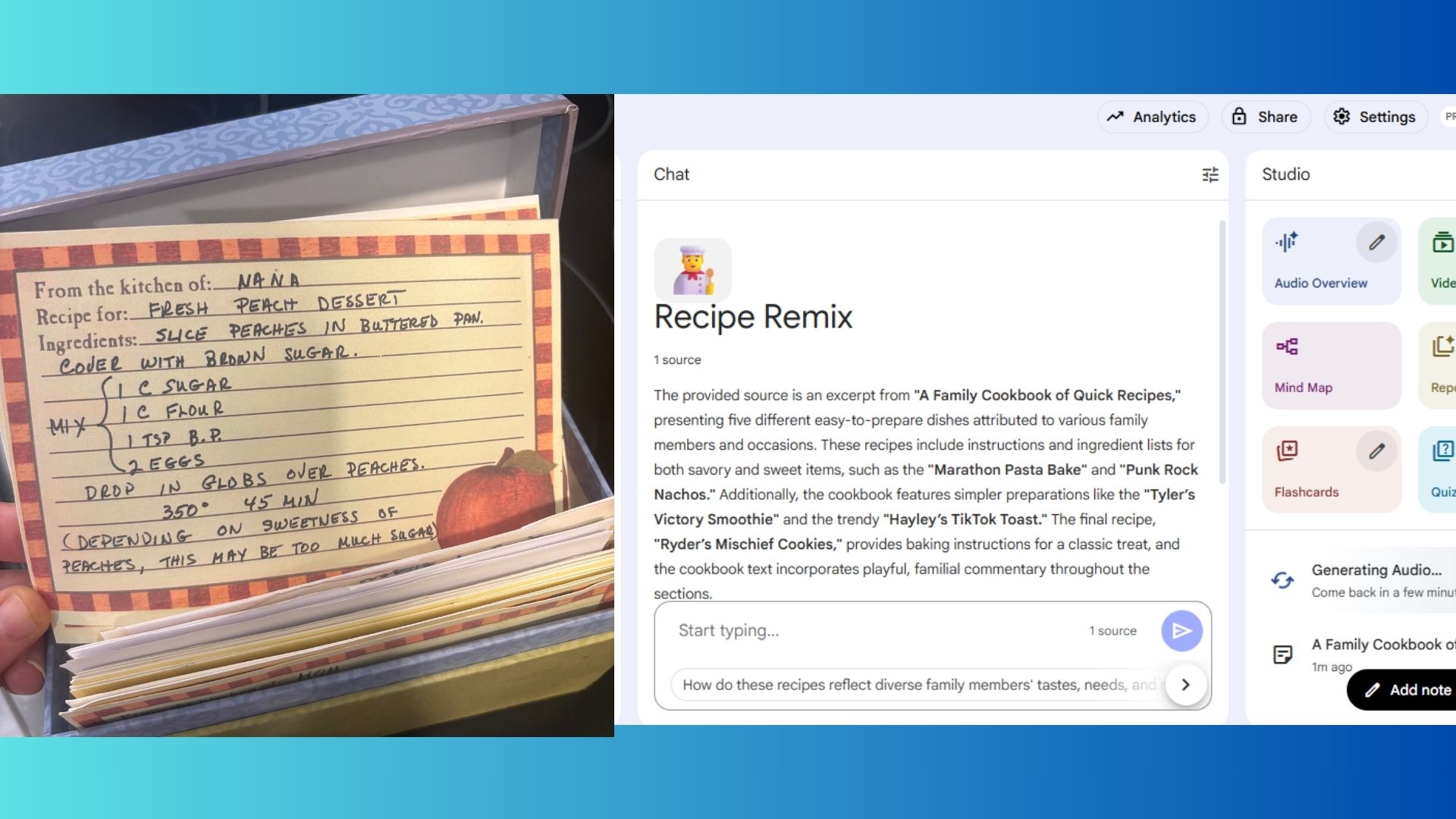
One of the most powerful features of NotebookLM is the "Audio Overview," which transforms static text into a conversational, podcast-style discussion. This feature fundamentally altered my downtime. Instead of feeling the need to "catch up" on reading during my commute or while performing household chores, I began listening to my own research notes.
The AI, acting as a conversational partner, synthesized the core themes of my uploaded documents. This provided a dual benefit: it kept me informed without requiring visual focus, and it helped me identify connections between disparate topics that I had previously missed. This is a form of passive synthesis—using AI to reframe information into a medium that fits into the gaps of a busy day.
Implications for Future Productivity
The implications of using source-grounded AI for personal management are profound. We are moving toward a future where "organization" is no longer a manual task of file naming and folder hierarchy. Instead, it is a task of "capturing."
The AI-Human Partnership
The goal of this experiment was never to automate my thinking. Critical decisions, creative strategy, and emotional intelligence remain strictly human domains. However, NotebookLM demonstrated that AI is exceptionally capable of handling the "janitorial work" of the mind:
- Pattern Recognition: Finding links between notes taken weeks apart.
- Retrieval: Eliminating the time spent hunting for specific facts.
- Synthesis: Reducing complex documents into actionable insights.
The result is a significant reduction in "invisible anxiety"—the weight of the things we know we need to do but cannot immediately locate or process.
Official Perspectives and Technical Capability
While Google has not explicitly marketed NotebookLM as a "mental health" tool, its evolution as a source-grounded research assistant aligns with the broader industry push toward "Agentic AI." By allowing users to restrict the AI to their own proprietary data, Google mitigates the risks of misinformation, making it a viable tool for professionals who require high accuracy.
Recent updates to the platform have expanded its ability to handle larger volumes of data and improved its multimodal capabilities, further cementing its role as a personal knowledge management (PKM) system. As these tools become more integrated into mobile ecosystems, the friction between having a thought and organizing it will continue to drop toward zero.
Conclusion: A Lighter Way to Work
After a week of rigorous testing, the most surprising takeaway was not the increase in output, but the decrease in internal noise. By delegating the storage and retrieval of information to an AI, I reclaimed the cognitive space previously occupied by "reminders."
I have learned that productivity is not just about doing more; it is about managing the psychological load of the work we do. NotebookLM did not make my life less busy—my responsibilities remained the same—but it did provide a reliable external structure that allowed me to approach my day with more clarity and less clutter.
In the end, AI should not be viewed as a replacement for human intellect, but as an exoskeleton for the mind. When we stop trying to store everything in our heads, we finally have the room to actually use it. By embracing tools like NotebookLM, we can stop being information hoarders and start being information architects, focusing our finite energy on what truly matters: the creative and strategic work that only humans can perform.










No comments yet. Be the first to join the conversation!