

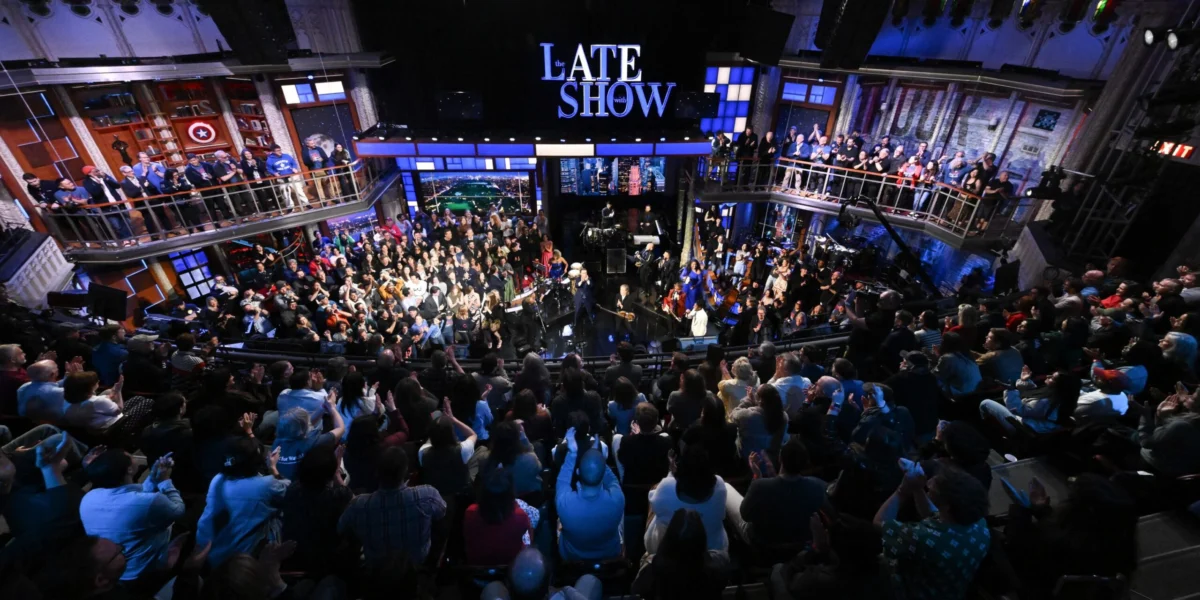
In an era defined by the rapid migration of audiences toward streaming platforms and the fragmentation of the traditional late-night landscape, Stephen Colbert has proven that the power of appointment television remains formidable. CBS’s The Late Show with Stephen Colbert concluded its near 11-year run on a triumphant note, drawing a staggering 6.74 million viewers for its final broadcast. This figure, derived from Nielsen’s preliminary live fast national ratings, cements the episode’s status as the most-watched weeknight installment in the show’s history—a rare feat in the modern media climate.
The finale was more than just a ratings success; it served as a cultural capstone, a high-octane celebration of a decade of political satire, musical innovation, and late-night community. By outperforming its own 2015 premiere, which captured 6.55 million viewers, Colbert’s exit signals a defiance of the downward trends that have plagued broadcast television for years.
Chronology of a Late-Night Legacy
Stephen Colbert stepped into the massive shoes left by David Letterman on September 8, 2015. Transitioning from the high-concept, persona-driven satire of The Colbert Report on Comedy Central to the more traditional—yet deeply personal—format of The Late Show on CBS was a transition that many critics initially questioned. However, over the course of 11 years, Colbert transformed the Ed Sullivan Theater into a hub of cultural relevance.
The trajectory of the show has been marked by several defining moments:
- The Premiere (2015): A highly anticipated debut that drew 6.55 million viewers, setting the tone for a tenure defined by sharp wit and intellectual rigor.
- The Super Bowl Peak (2016): The show achieved its all-time viewership high on February 7, 2016, capitalizing on the post-Super Bowl lead-in to pull in 20.55 million viewers.
- The Pandemic Pivot: During the COVID-19 lockdowns, Colbert’s decision to broadcast from his home—often featuring his wife, Evie—offered a rare, vulnerable intimacy that solidified his bond with a global audience.
- The Final Bow (2026): Closing the curtain on a long-running narrative, the final episode combined nostalgia with the high-production spectacle that became his trademark.
The finale itself was a meticulously crafted farewell. The broadcast featured a cavalcade of surprise celebrity cameos, emotionally resonant musical numbers, and a poignant, inclusive sing-along featuring the dedicated staff members who have powered the show behind the scenes for over a decade. The evening reached its emotional zenith when Paul McCartney, a living icon, appeared as the final surprise guest. McCartney’s live, in-studio performance of The Beatles’ classic "Hello Goodbye" served as a poetic, bittersweet conclusion to a program that has been a constant presence in American households.
Supporting Data: A Statistical Anomaly
To understand the magnitude of the finale’s viewership, one must place it within the context of contemporary television consumption. The current media landscape is defined by "cord-cutting" and the dominance of on-demand content. According to Nielsen’s national live+7-day big data ratings, The Late Show maintained an average of 2.69 million viewers during the first quarter of 2026.
The jump from an average of 2.69 million in the final quarter to 6.74 million for the finale represents a massive surge in engagement. This surge highlights a phenomenon often overlooked in the streaming age: the "eventization" of live television. When the stakes are high and the cultural moment feels irreplaceable, audiences still congregate around broadcast networks.
Comparing the finale to historical benchmarks further underscores the achievement:
- Surpassing the Premiere: The finale’s 6.74 million viewers exceeded the 6.55 million viewers from the show’s 2015 launch, suggesting that Colbert grew his audience’s loyalty rather than experiencing the gradual erosion common to long-running talk shows.
- The Super Bowl Benchmark: While the 20.55 million viewers from 2016 remains the show’s peak, it is an outlier driven by external factors (the Super Bowl). The 6.74 million figure for the finale, achieved on a standard weeknight, is a more accurate reflection of the show’s base-level influence in its final days.
- Market Share: In an age where even top-tier shows often struggle to break the one-million-viewer mark in the key 18-49 demographic, Colbert’s ability to draw nearly 7 million viewers indicates he retained a significant cross-generational appeal.
Official Responses and Industry Sentiment
While CBS and the Late Show production team have maintained a celebratory tone, industry analysts have been quick to dissect the implications of these numbers.
"What Stephen Colbert achieved in his final week is a testament to the endurance of the talk-show format when paired with a singular, authentic voice," said one media analyst. "There was a fear that the late-night format was dying, but the audience clearly responded to the sense of finality and the respect shown to the institution of the Ed Sullivan Theater."

Within the industry, the sentiment is one of reverence. Colbert’s peers, both current and retired, took to social media to acknowledge the end of his run. The consensus among critics is that Colbert succeeded in humanizing the role of the late-night host. By allowing his personal politics, his faith, and his humor to coexist on stage, he created a brand of comedy that felt essential during a period of extreme political polarization in the United States.
Implications: The Future of Late Night and CTV
The success of The Late Show finale carries profound implications for the future of Convergent TV (CTV) and traditional broadcasting.
The Resilience of Brand Fundamentals
The industry is currently grappling with a "crowded" marketplace. As streaming services and social media platforms dilute the attention span of the average consumer, the success of Colbert’s finale serves as a case study in brand fundamentals. Colbert did not chase trends; he maintained a consistent, high-quality product that leaned into the strengths of the talk-show format: live performance, topical commentary, and celebrity interaction.
For advertisers and network executives, the takeaway is clear: content that creates a genuine "water cooler" moment still carries immense weight. The ability to cut through the digital noise is not merely about algorithmic reach; it is about building a connection with an audience that transcends the device they are watching on.
The Changing Landscape of Talk Shows
As Colbert departs, the genre faces a crossroads. With younger audiences shifting away from traditional monologues toward clip-based consumption on TikTok and YouTube, the "hour-long" format may undergo further evolution. Networks are likely to look at Colbert’s success not as a sign that the old model works perfectly, but as a blueprint for how to bridge the gap between traditional linear viewing and the viral, short-form habits of Gen Z.
Strategic Lessons for Content Creators
For those looking to build a strategy designed to last in the streaming era, the Late Show finale offers three critical lessons:
- Authenticity as a Retention Tool: Colbert’s transition from a parody persona to himself allowed for a depth of engagement that kept viewers returning even when the news cycle was exhausting.
- The Power of the "Event": By turning his final week into a multi-part, star-studded experience, the production ensured that the finale was not just an episode, but a cultural event that viewers felt compelled to watch live.
- The Integration of Talent and Production: The collaboration between Colbert and his staff, highlighted by their inclusion in the final musical numbers, reminded the audience that a talk show is a collaborative, human endeavor, not just a content-generating machine.
Conclusion: An Unmatched Legacy
As the lights dim on the Ed Sullivan Theater, the legacy of Stephen Colbert’s Late Show remains firmly etched in the history of American broadcasting. He navigated the transition from a post-Letterman world into a digital-first, high-velocity media landscape without losing the warmth and intellectual curiosity that defined his work.
The 6.74 million viewers who tuned in for the finale were not just watching a show; they were acknowledging the end of a chapter in their own lives—a decade of late-night television that served as a mirror to the complexities of the world. While the format of late-night television will undoubtedly continue to evolve, the standard set by Colbert—of rigor, empathy, and impeccable comedic timing—will remain the benchmark for any host who steps into that spotlight next.
The curtain may have fallen, but the numbers prove that in the right hands, the stage remains as vital and vibrant as ever. As the industry looks forward, the lessons of Colbert’s tenure will be essential for navigating the next era of entertainment, where the line between the screen and the viewer continues to blur, and where the only thing that truly survives the noise is a story well told.












No comments yet. Be the first to join the conversation!