

Campaign Trail is our ongoing analysis of the most compelling, unconventional, and high-impact creative strategies currently defining the marketing landscape. View our full archives here.
For over two decades, the confectionery giant Skittles has maintained a singular, unwavering identity in the crowded world of snack marketing. While competitors often pivot toward focus-group-tested relatability or aspirational lifestyle imagery, Skittles has consistently leaned into the bizarre. From the infamous "cursed co-worker" to the man with a prehensile beard and the unfortunate soul battered by a piñata, the Mars-owned brand has built its equity on a foundation of surreal, humor-spiked discomfort.
This month, that signature aesthetic—often described as "surrealist tragedy"—has returned with full force. In support of the brand’s expanding Gummies line, TBWAChiatDay, the agency that originally architected the brand’s "Taste the Rainbow" ethos, has launched a new suite of spots that prove the brand’s commitment to the uncanny is as potent as ever.
The Anatomy of the Absurd: A New Creative Suite
The latest campaign is not merely a return to form; it is an escalation of the brand’s psychological warfare against the mundane. At the heart of the creative are three 15-second spots that operate on a logic that feels both dreamlike and deeply unsettling.
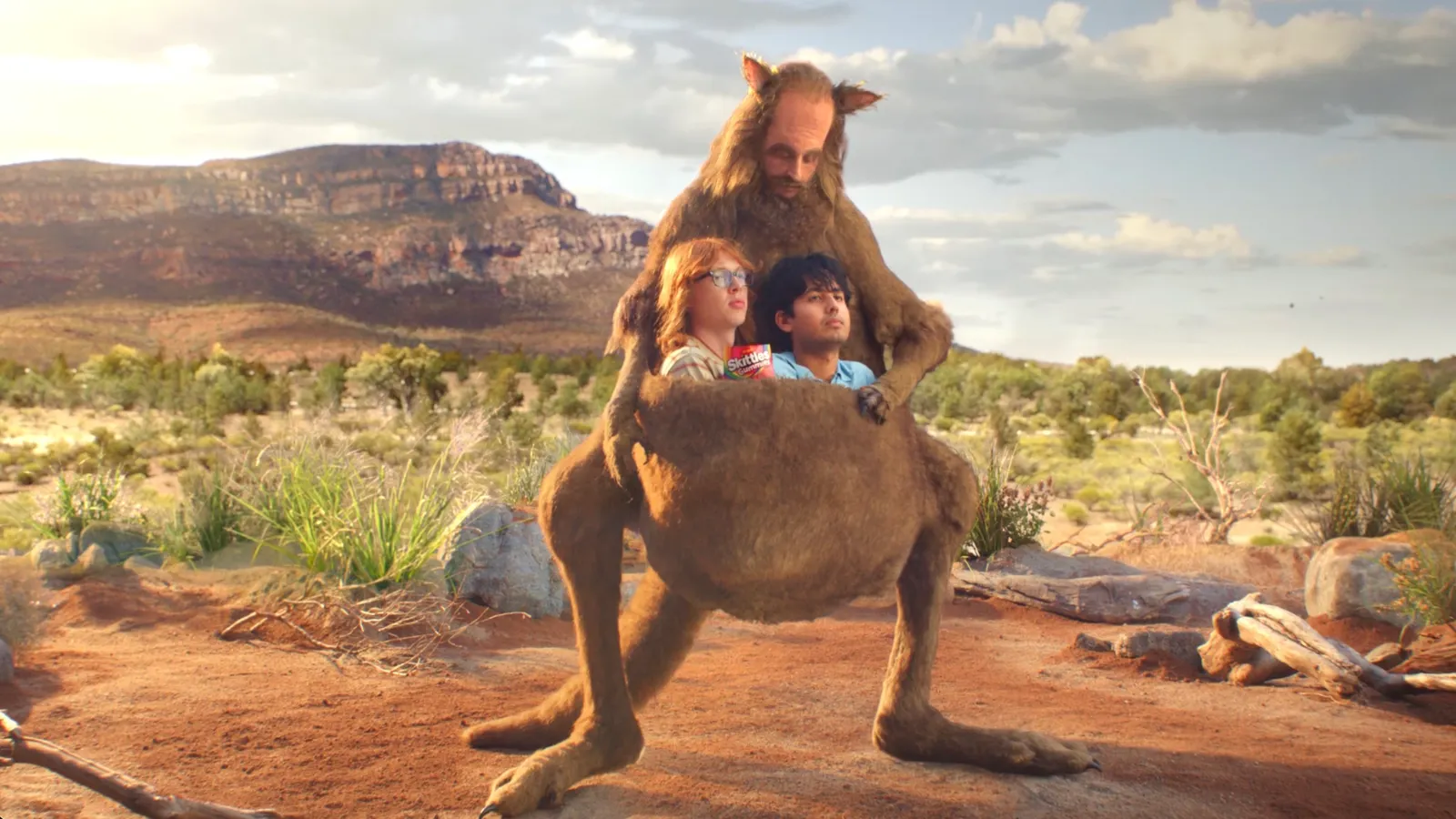
The Mangaroo
In one spot, we are introduced to the "Mangaroo," a hybrid entity—part man, part kangaroo—who speaks in a high-pitched, sing-song cadence. The creature treats his adult children to Skittles Gummies, manifesting a domestic scene that is simultaneously heartwarming and deeply claustrophobic.
The Balloon Dog
Perhaps the most visceral of the set, the "Balloon Dog" spot features a twisted, sentient party favor that scooches its rubbery, squeaky backside across a living room carpet with the intensity of a dog in need of attention. It is a masterclass in using practical effects to create a tactile sense of unease.
The Jellyfish Massage
Rounding out the trio is the "Jellyfish Massage," which delivers exactly what the title promises: an unfortunate patron receiving a therapeutic—if physically invasive—treatment from a giant, undulating jellyfish.
These spots have already gained significant traction, racking up over 5 million views on YouTube within their first weeks of release. By choosing to broadcast these across linear, connected TV, and social media, the brand is signaling that its "weird" strategy is not a niche experiment, but a primary engine for brand growth.
Chronology of an Iconic Brand Voice
To understand the current campaign, one must look at the historical trajectory of Skittles’ marketing. The brand’s identity was famously forged in the late 90s and early 2000s, primarily through the creative output of Chiat/Day New York.
- The Foundational Years: Under the leadership of agencies like DDB (which preceded the brand’s consolidation under TBWA), Skittles established its "weird" tone. It moved away from product-benefit advertising and toward "world-building," where the magic of the candy disrupts a mundane, often bleak reality.
- The Evolution of Tone: As the brand matured, the "weirdness" became more sophisticated. The humor began to incorporate a specific brand of tragedy—situations where the "magic" of the candy doesn’t quite fix the human problem at hand.
- The Gummies Expansion: The launch of Skittles Gummies provided a fresh canvas. The product, which is physically softer than the traditional hard-shelled candy, served as the functional insight for the new campaign. TBWAChiatDay took the concept of "softness" to an "uncomfortably soft" extreme, using the product’s tactile advantage to justify the surreal scenarios.
Supporting Data: The Confectionery Landscape
The decision to lean into high-concept, surrealist advertising is not being made in a vacuum. The confectionery industry is currently experiencing a period of intense growth, with Gen Z playing an outsized role in the sector’s performance.
According to data from the National Confectioners Association, the candy industry is projected to hit a valuation of $27.8 billion by 2030. Perhaps more importantly for brands like Skittles, spending on candy among Gen Z consumers surged by 47% year-over-year in 2025.
This surge suggests that despite the rapid digitization of consumer habits, the fundamental appeal of indulgence—and the brand narratives that surround it—remains as powerful as ever. The challenge for legacy brands is to maintain their authenticity while capturing a generation that is notoriously skeptical of traditional "corporate" messaging.
Official Perspectives: The Philosophy of the Uncanny
Brian Culp, group creative director at TBWA, notes that the creative process remains rooted in the original world-building philosophy that defined the brand decades ago.
"We try to stay true to the original world-building that Chiat/Day New York did back in the day," Culp explains. "You’re basically trying to add a little bit of magic to a pretty mundane world, and everyone treats that magic like it’s pretty normal. No one really acknowledges there’s anything wrong about it, and then there’s always a slight bit of tragedy where maybe the magic didn’t end up panning out like someone in the spot would have hoped."
The Importance of the "Practical"
A crucial component of this campaign’s impact is its reliance on practical effects. The agency tapped director Carl Sundemo of Epoch Films, whose work favors physical reality over digital polish. The balloon dog and the jellyfish tentacles were not merely rendered in a computer; they were operated by puppeteers who were later digitally removed from the final frame.
Katie Bero, also a group creative director at TBWA, highlights the necessity of this "realness": "The guy who was getting the massage in the jellyfish spot was genuinely uncomfortable when he got slapped by the puppet. There’s just something about the realness of truly being slapped by a jellyfish that you can’t fake."
Culp adds, "You typically feel when things are practical, and it really adds this level of surrealness and ups the unsettling nature of some of these, which I think you would lack with CG and AI."
Implications: Connecting with Gen Z
When asked about the challenge of marketing to Gen Z, the TBWA leadership team offered a refreshingly grounded perspective. Rather than attempting to "act" like a Gen Z brand, they believe the key is to maintain the brand’s own voice, trusting that the target audience will find its own entry point into the narrative.
"Gen Z is not the idea: They’re the target," Bero states. "A lot of times, people are starting with Gen Z as the idea. Skittles is the brand, and Skittles is the voice. I think it’s just finding the right stories to tell that hit for them and then delivering it in ways that will reach them, versus trying to over-index on, ‘Oh, we have to make sure it feels like this is for Gen Z.’"
The Future of Surrealist Marketing
The implications of this campaign are significant for the broader advertising industry. As AI-generated content becomes more prevalent and arguably more "perfect," the friction and discomfort found in Skittles’ practical, surrealist ads may actually become a point of differentiation.
In a media environment cluttered with high-fidelity, polished, and often sanitized content, the "uncomfortable" nature of a man-kangaroo hybrid or a jellyfish massage cuts through the noise. It forces the viewer to pause. It creates a memory trace that a standard, benefit-driven ad could never achieve.
By refusing to chase trends and instead doubling down on the brand’s core identity, Skittles is demonstrating a vital lesson in brand management: consistency, when paired with a fearless commitment to a unique voice, is the ultimate hedge against market volatility.
As the candy market continues to expand toward its $28 billion goal, the success of these spots suggests that the most effective way to reach the next generation of consumers is not to mimic their culture, but to invite them into a world that is, above all else, undeniably, authentically, and deliciously weird.












No comments yet. Be the first to join the conversation!