

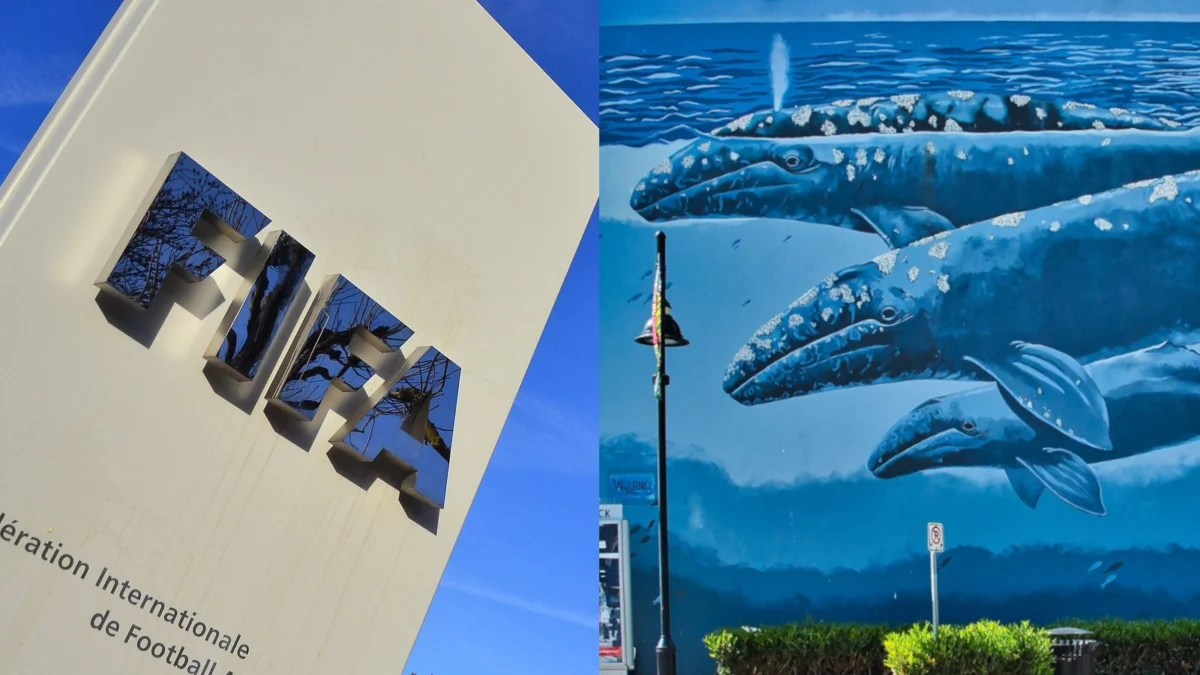
The cultural landscape of Downtown Dallas has become the unlikely epicenter of a heated legal and ethical battle between international sports governance and the preservation of public art. A celebrated "Whaling Wall" mural, a massive, evocative tribute to marine life painted by the world-renowned artist Wyland in the 1990s, has been painted over by FIFA in anticipation of the 2026 World Cup. The move has ignited widespread public outrage, particularly given that Dallas is not a host city for the tournament, and the artist has vowed to pursue aggressive legal action, citing potential violations of federal intellectual property law.
The Disappearing Whales: An Overview of the Incident
For over three decades, the side of a prominent building in Downtown Dallas served as a canvas for Wyland’s environmental message. His "Whaling Wall" was more than just a decorative feature; it was a landmark intended to foster an emotional connection between urban residents and the plight of the world’s oceans.
Earlier this month, residents were shocked to find the iconic marine scene obscured by a fresh, nondescript coat of paint, preparatory to the installation of new promotional art commissioned by FIFA. The governing body stated that the replacement work was intended to "capture the current historical moment and reflect the energy, unity, and global spirit surrounding the World Cup 2026."
The decision has been met with confusion and hostility. Beyond the aesthetic loss, the logistical rationale remains elusive. Despite the massive scale of the World Cup preparations—which include the announcement of a high-profile halftime show featuring global icons and new, subsidized transit initiatives for ticket holders—Dallas is not slated to host a single match. Consequently, many locals perceive the defacement of a permanent cultural asset for a transient, non-local sporting event as an act of corporate overreach.
A Chronology of the Conflict
The destruction of the mural did not happen in a vacuum. It was the result of a coordinated, albeit controversial, agreement between FIFA representatives and the City of Dallas.
- 1990s: Wyland completes the Dallas Whaling Wall, gifting the city a massive public installation focused on conservation and environmental awareness.
- Early 2026: FIFA identifies several high-traffic urban areas across North America for branding and "historical" art installations to promote the upcoming tournament.
- Late April 2026: Negotiations between the City of Dallas and FIFA result in the approval of the removal of the Wyland mural to make room for tournament-themed branding.
- Mid-May 2026: Without direct notification to the artist, work crews begin painting over the mural.
- May 16, 2026: Public outcry erupts on social media, spearheaded by local residents and observers like Casey Telford, who documented the destruction of the site.
- May 17, 2026: Wyland speaks publicly for the first time, labeling the act a "disgrace" and a violation of artistic integrity, signaling his intent to seek legal redress.
The Legal Landscape: VARA and Intellectual Property
At the heart of the dispute lies the Visual Artists Rights Act (VARA) of 1990. While the City of Dallas and FIFA appear to have operated under the assumption that the physical ownership of the building granted them the right to alter or remove the mural, Wyland’s legal team is preparing a challenge based on the artist’s moral rights.
VARA provides specific protections to artists, allowing them to prevent the destruction of works of "recognized stature." Wyland, whose Whaling Walls have been installed in cities globally, argues that his work constitutes such a stature. He estimates the value of the destroyed installation at approximately $15 million, taking into account the scale, the materials, and the cultural impact of the piece over its 30-year tenure.
"They picked the wrong artist," Wyland remarked in a recent interview with FOX 4. "I am going to go after them and go after them hard. If they can get away with it, then all the public art in Dallas and all the public art in America is at risk."
The absence of a formal contract protecting the specific longevity of the mural does not, according to Wyland’s supporters, absolve the city or FIFA of the responsibility to respect the artist’s integrity. The case is expected to hinge on whether the court views the mural as an integrated part of the building’s architecture—which would allow for removal—or as a protected work of art that was destroyed with malice or negligence.
Official Responses and Corporate Rationale
The silence from the City of Dallas has been as notable as the noise from the public. While FIFA has issued statements emphasizing their desire to bring the "global spirit" of the World Cup to as many communities as possible, they have largely deferred questions regarding the specific destruction of the Wyland mural to municipal authorities.
Critics argue that this is a classic example of "tournament gentrification," where the branding needs of a multi-billion dollar organization take precedence over the local cultural identity of a host country. By choosing a city that isn’t even hosting games to execute this rebranding, FIFA has inadvertently highlighted the perceived arrogance of their promotional strategy.
"It is really deep," Wyland said regarding the meaning behind the whales. "At first, it just looks like a beautiful painting of whales. It’s more than that. It is a reminder of our responsibility to the planet. By painting over it, they are erasing a legacy of stewardship for a temporary advertisement."
Implications for Public Art in the Age of Global Events
This controversy serves as a cautionary tale for municipalities entering into agreements with massive, international sporting or cultural organizations. The "World Cup Effect"—the rapid transformation of urban spaces to align with a unified brand identity—often moves faster than the due process required to protect local history.
If Wyland succeeds in his legal challenge, it could set a landmark precedent for the protection of public art in the United States. It would signal to corporations and city planners that public works cannot be treated as disposable assets, regardless of the scale of the event they are meant to support. Conversely, a defeat for the artist could embolden developers and event organizers to view existing public art as a liability that can be liquidated whenever a "fresh" look is required for marketing purposes.
Furthermore, the incident has galvanized the Dallas arts community. Groups have begun organizing to monitor other public installations in the city, vowing to prevent similar occurrences. The narrative has shifted from a simple disagreement over a painting to a broader struggle over who owns the visual history of a city: the citizens who live there, or the organizations that visit for a few weeks of competition?
As the 2026 World Cup approaches, the "Whaling Wall" incident will likely remain a persistent shadow over the tournament’s branding efforts in North America. For FIFA, the challenge will be to mitigate the public relations damage before the event officially kicks off. For Wyland, the challenge is much more personal: reclaiming the dignity of a career’s work that, for decades, represented the very best of what public art can be.
The incident has underscored a painful reality: in the rush to build a global spectacle, the local heritage that gives a city its soul is often the first thing to be painted over. Whether this becomes a turning point for artist rights or merely another forgotten casualty of corporate ambition remains to be seen, but for now, the residents of Dallas are clear—they want their whales back, and they want an explanation for why the heart of their city was traded for a temporary slogan.










No comments yet. Be the first to join the conversation!