

The foundational architecture of the internet is undergoing its most significant shift since the introduction of the search engine. For decades, the digital economy has been built on the premise of "search and click"—a user enters a query into a browser, receives a list of blue links, and navigates to a website to consume information. However, as artificial intelligence chatbots become the primary interface for information retrieval, that model is rapidly obsolescing.
The transition from traditional Search Engine Optimization (SEO) to the more complex domains of Answer Engine Optimization (AEO) and Generative Engine Optimization (GEO) is no longer a theoretical exercise; it is an economic imperative. As AI becomes the new gatekeeper of the digital experience, brands that fail to adapt their content strategies risk becoming invisible in an era of synthesized answers.
The Main Facts: The New Search Reality
The shift is driven by a fundamental change in user behavior. Users are no longer looking for a list of resources; they are looking for immediate, synthesized answers. This shift has forced search giants like Google and innovative challengers like OpenAI and Perplexity to prioritize generative results—responses crafted by AI models that aggregate information from across the web.
This change impacts the core of the digital marketing funnel. In a traditional search, a brand might capture traffic through a blog post or landing page. In an AI-driven search, that same content is used as training data or a source citation, but the user may never actually visit the website. This creates a "zero-click" environment where the discovery of information is decoupled from the consumption of content on a brand’s own domain.
Chronology: The Rapid Ascent of the AI Intermediary
The move toward an AI-first web did not happen overnight, but its acceleration has been breathtaking:
- 2023 – The Emergence: The launch of ChatGPT and subsequent integration of large language models (LLMs) into search engines signaled the start of the disruption.
- 2024 – The Habituation Phase: As tools became more robust, users began relying on AI for complex queries, moving beyond simple factual questions to research, coding assistance, and creative planning.
- 2025 – The Turning Point: According to Sensor Tower’s 2026 State of Mobile report, mobile AI usage skyrocketed, increasing by 3.6x year-over-year. The technology moved from an experimental novelty to a daily habit for millions.
- Q1 2026 – Massive Scale: ComScore’s latest intelligence report confirms the magnitude of the shift, revealing that U.S. desktop searches via AI chatbots reached a staggering 76 billion in just the first three months of the year.
- Present Day: We are now in the "Optimization Era," where the focus is shifting from "how do we rank?" to "how do we get cited by the model?"
Supporting Data: The Statistics Behind the Shift
The evidence of this paradigm shift is reflected in data across multiple sectors, confirming that the change is demographic, behavioral, and technological.
The Generative Explosion
ComScore’s Q1 2026 report serves as a wake-up call for marketers. With 76 billion AI-based searches on desktop in a single quarter, the volume of traffic flowing through generative models has reached a scale that can no longer be ignored. This volume represents a direct cannibalization of traditional search volume.
The Mobile-First Generation
Sensor Tower’s findings highlight that AI is not just a tool for professional research; it is deeply embedded in mobile usage. The 3.6x growth in mobile AI usage indicates that users are turning to their phones for quick, AI-powered answers while on the go, further cementing the role of these tools in everyday decision-making.
The Youth Demographic
Perhaps the most telling statistic comes from Pew Research, which noted that 64% of teens are now regular users of AI chatbots. This demographic is the future of the consumer market. If the next generation of buyers is bypassing traditional search engines in favor of AI, the long-term viability of standard SEO practices is effectively on a ticking clock.
Official Responses and Strategic Guidance: The SEMRush Insight
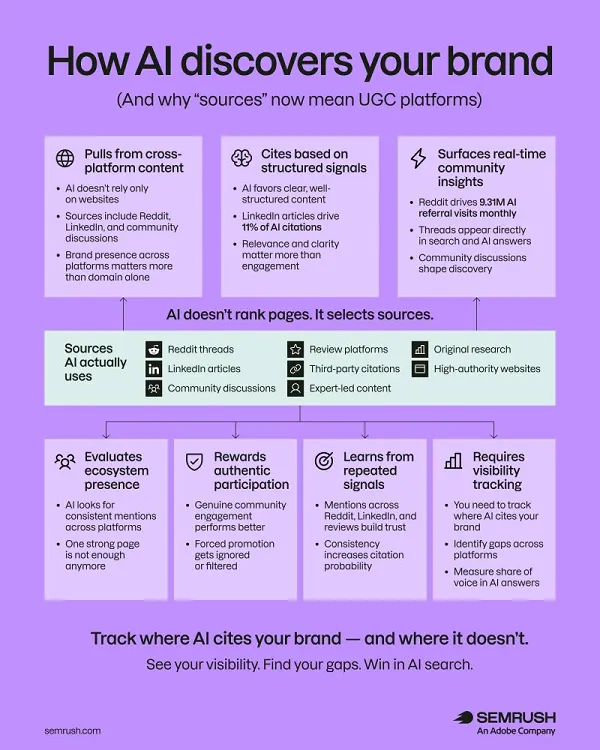
In response to these seismic shifts, industry leaders are providing frameworks to help brands navigate the transition. SEMRush, a leader in visibility and measurement, recently shared new insights via LinkedIn that serve as a blueprint for the "New SEO."
Decoding the AI "Mind"
SEMRush’s research suggests that AI tools are fundamentally different from traditional crawlers. While traditional search bots look for keywords and backlink authority, generative engines look for:
- Authority and Trust: Is the source frequently cited by other reputable entities?
- Synthesis-Ready Content: Is the information structured in a way that an LLM can easily extract and summarize?
- Topical Depth: Does the brand cover a subject comprehensively enough to be considered a primary "source of truth" by the AI?
The "Golden Thread" of Citations
SEMRush’s guidance emphasizes that marketers must shift their focus toward citation optimization. This involves ensuring that content is highly factual, well-structured, and explicitly linked to authoritative entities. The goal is to become the "Golden Thread" that the AI model reaches for when answering a query. If an AI is asked about a specific industry trend, the goal is for your brand’s white paper or research to be the primary source cited in the chatbot’s response.
Implications: A New Era for Marketing
The transition to AEO and GEO brings profound implications for businesses, marketers, and web publishers.
1. The Decline of "Click-Through" Metrics
The most immediate implication is the potential decline in organic traffic. If a user receives a perfect, 200-word answer within the chatbot interface, the incentive to click through to a website diminishes. Brands must adjust their KPIs; instead of measuring "traffic," they may need to start measuring "brand mentions," "sentiment," and "AI citations."
2. Quality Over Quantity
In the old world of SEO, content farms and keyword stuffing could often yield results. In the world of AI, this is a liability. AI models are increasingly sophisticated at identifying "fluff." To survive, content must be original, high-utility, and data-rich. If your content is just a rewrite of what is already available, the AI will likely ignore it in favor of primary, proprietary data.
3. Trust as a Currency
As deepfakes and AI-generated misinformation become more prevalent, the models are being trained to value "trusted" sources. Brands that invest in proprietary research, expert commentary, and transparent fact-checking will have a distinct advantage. Being a known, credible entity is becoming the most effective way to ensure an AI model cites your brand rather than a generic aggregator.
4. The Need for Structural Clarity
For an AI to ingest your content, it must be logically organized. This means moving away from long, rambling blog posts and toward modular content—using schema markup, bulleted summaries, and clear headers that define exactly what a topic is and why it matters.
Conclusion: Adapting to the Algorithmic Future
The SEO landscape is not dying; it is evolving into something far more sophisticated. The challenge for brands in 2026 and beyond is to stop thinking about search as a way to "trick" an algorithm into ranking a page, and start thinking about it as a way to provide the best possible information to a digital intelligence.
By aligning with the requirements of Generative Engine Optimization, brands can ensure that they remain relevant in a world where the answer is more important than the link. The data provided by ComScore, Sensor Tower, and Pew Research makes the trajectory clear: the future of search is conversational, generative, and immediate.
For those willing to pivot, this is not the end of discovery—it is the beginning of a more efficient, high-impact era of digital marketing. The brands that succeed will be those that provide the most value to the AI models, effectively becoming the foundational sources upon which the next generation of human knowledge is built.
As we move deeper into this new frontier, the mandate for marketers is simple: Be the source, be the authority, and be the answer.











No comments yet. Be the first to join the conversation!