In the digital age, visual content is the currency of communication. Whether it is a high-stakes marketing campaign, a vibrant social media update, a compelling academic presentation, or a thumbnail for a YouTube tutorial, the demand for polished, professional imagery has never been higher. Yet, for decades, the barrier to entry for high-quality image manipulation remained high. Users were historically forced to navigate a "steep learning curve," requiring either a deep knowledge of professional-grade software—such as the Adobe Creative Cloud suite—or the financial resources to outsource work to skilled graphic designers.
Today, that paradigm has shifted entirely. The emergence of browser-based, Free AI Image Editors has democratized the design process, allowing anyone with an internet connection to perform complex, sophisticated edits in a matter of seconds. By leveraging generative artificial intelligence, these tools have moved the focus from "technical proficiency" to "creative intent."
The Evolution of Image Editing: A Brief Chronology
To understand the magnitude of this shift, one must look at the historical trajectory of photo editing technology:
- The Era of Manual Precision (1990s–2010s): The industry was defined by complex software suites. Achieving a clean subject extraction or background removal required meticulous manual labor, involving layers, masking, and path-tracing. This era favored those who had the time and money to master technical interfaces.
- The Mobile Revolution (2010s–2020s): The rise of smartphone photography brought with it basic filtering apps. While these made "styling" photos easy, they did little to change the underlying content or composition of an image.
- The AI Integration Phase (2022–Present): The integration of Large Language Models (LLMs) and diffusion-based AI into editing suites marked a turning point. Instead of "doing" the editing, users began "directing" the editing.
Modern tools, such as the AI Image Editor from Creative Fabrica, represent the latest evolution. By working directly within a web browser, these platforms eliminate the need for high-end hardware, massive software installations, or complex licensing fees.
The Technical Framework: How AI Simplifies Complexity
The efficiency of modern AI editors stems from a combination of computer vision and deep learning. When a user uploads an image to a browser-based AI tool, the software performs several instantaneous actions:
- Semantic Segmentation: The AI identifies individual objects, foregrounds, and backgrounds within an image, allowing it to "understand" the composition.
- Generative In-Painting: If a user requests the removal of an object, the AI does not simply "erase" it. It analyzes the surrounding pixels to "hallucinate" or reconstruct the background seamlessly, filling the void with contextually relevant detail.
- Prompt-Based Manipulation: By utilizing natural language processing (NLP), the software interprets a user’s text description (e.g., "replace the background with a sunlit forest") and executes a series of complex pixel transformations that would have historically taken a human designer hours to perform.
Streamlining the Creative Workflow: Key Features
The primary value proposition of these tools is the dramatic reduction of "friction" in the creative process.

Removing Objects and Reimagining Backgrounds
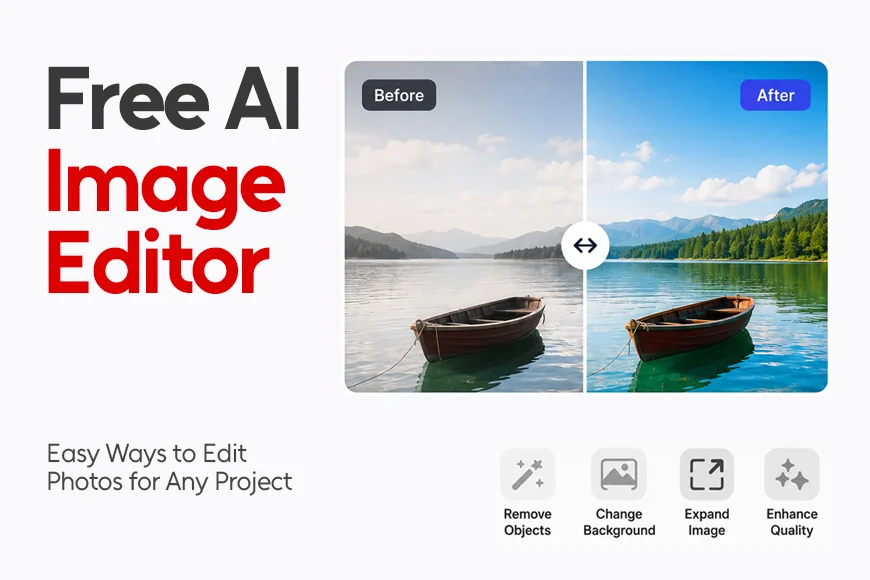
Perhaps the most common pain point in photography is the "cluttered background." Whether it is a photobomber in a portrait or an unsightly power line in an architectural shot, unwanted elements can ruin an otherwise perfect composition. Modern AI allows for surgical-level removal without leaving a trace. Furthermore, users can swap environments entirely, transforming a dull office product shot into a professional studio-quality image for e-commerce, or shifting a portrait to a high-end editorial backdrop.
Generative Expansion (Outpainting)
Content creators frequently encounter the issue of aspect ratio mismatch. A vertical image designed for Instagram Stories might look cramped when forced into a horizontal YouTube banner. AI-driven "image expansion" extends the canvas by predicting what should be at the edges of the image. It does not stretch or warp the subject; it adds new, logically consistent pixels, effectively "zooming out" of a scene that was previously too tight.
Image Restoration and Enhancement
Many users rely on AI to rescue legacy photos. Through algorithms that identify and reduce noise, sharpen focus, and correct color balances, these editors can turn low-quality or aged photographs into crisp, high-definition assets. This has profound implications for archiving and professionalizing content that was previously considered "unusable."
Implications for Industries and Education
The shift toward AI-assisted editing is not merely a convenience; it is an economic and educational catalyst.
Empowering Small Business and E-commerce
Small business owners often lack the budget for full-time designers. With AI, a boutique store owner can take a photo of a product on their kitchen table, remove the background, add a clean studio lighting effect, and generate a professional-grade marketing image. This levels the playing field, allowing smaller players to compete with the visual standards of larger corporations.
Educational Advancements
In the classroom, students are no longer held back by their inability to master complex software like Photoshop. Whether creating a visual aid for a history presentation or designing a poster for a school event, students can now focus on the content and message of their work, allowing AI to handle the aesthetic execution.

The Professional Designer’s Perspective
Far from replacing designers, these tools are acting as force multipliers. Professional designers often spend 80% of their time on "grunt work"—tasks like background removal, resizing, and color correction. By delegating these repetitive tasks to an AI, professionals can reclaim their time to focus on higher-level conceptual design and strategic branding.
Addressing the Learning Curve: Why Simple Wins
The fundamental hurdle for traditional software has always been the "User Interface (UI) Complexity." Professional design suites are daunting to the layperson because they are designed for professionals.
The philosophy behind modern, web-based AI tools is the exact inverse: Human-Centric Design. By removing the necessity for layers, masks, and adjustment curves, these platforms allow the user to communicate in plain language. You describe what you want, and the AI delivers. This shift makes high-quality graphic design accessible to the masses, reducing the "stress" factor of creative projects.
Conclusion: The New Standard for Digital Content
We are witnessing a fundamental change in how we interact with our digital memories and marketing assets. The ability to edit photos with the precision of a professional—but without the need for years of training or expensive software—is a transformative development for everyone from the casual blogger to the serious entrepreneur.
As these tools continue to advance, the distinction between a "professional" edit and an "AI-assisted" edit will continue to blur, eventually disappearing entirely. For those looking to optimize their workflow, the path is clear: embrace the transition to intelligent, browser-based editing. By leveraging a free AI photo editor, you are not just saving time; you are unlocking a higher tier of visual quality for every project you undertake.
The tools are no longer the bottleneck; the only limit now is your own imagination. Whether you are prepping a social media post, building a business, or capturing a personal memory, the future of editing is fast, accessible, and, above all, creative.