In the plazas of Mexico City, the bustling streets of Buenos Aires, and the public squares of Lima, a peculiar new form of theater is unfolding. It is silent, performative, and entirely dictated by the capricious whims of the digital age. Known as "aura battles," this phenomenon has migrated from the curated feeds of TikTok to the physical realm, turning urban sidewalks into competitive stages where the currency isn’t just clout—it’s cold, hard cash and the nebulous, highly coveted status known as "aura."
What began as a late-2024 internet trend—a lighthearted way for Gen Z to quantify their own "cool factor"—has evolved into a localized, high-stakes competition. For the participants, these battles are a litmus test of social standing, a chance to prove that their internet-born confidence can hold up under the gaze of a real-world audience.
The Genesis of Aura: From Screen to Street
To understand the spectacle, one must first understand the lexicon. "Aura," in the parlance of the current youth zeitgeist, is the intangible quality of charisma, confidence, and effortless cool. "Aura farming" involves a series of deliberate actions—poses, expressions, or lifestyle choices—designed to inflate one’s perceived value in the eyes of peers.
Initially, the trend was confined to TikTok, where users would rate their own "aura points" based on successful social interactions or viral moments. However, as 2025 progressed, the desire for digital validation hit a wall of satiety. The youth of Latin America, in particular, began to yearn for the visceral feedback of an in-person audience. By the summer of 2026, organized "aura battles" began appearing in major cities across the region, formalizing the pursuit of the aesthetic.
How the Battles Unfold: A Choreography of Clout
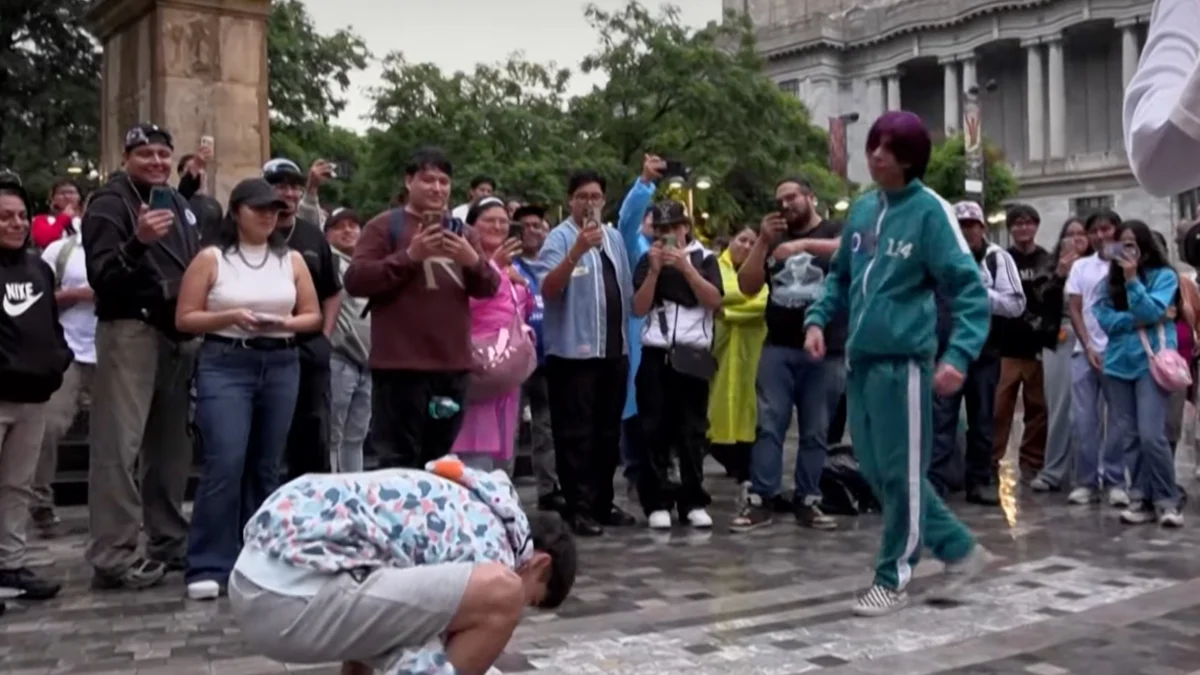
An aura battle is governed by a strict, albeit unwritten, set of rules. Two competitors stand at a distance, usually surrounded by a ring of spectators filming the encounter on smartphones. There is no physical contact, nor is there a debate. The conflict is purely expressive.
Competitors take turns deploying a repertoire of "moves." These might include high-fashion poses, rapid-fire facial expressions derived from popular internet memes, or specific gestures that signify membership in a particular digital subculture.
Take, for instance, a recent tournament in Mexico City, where 14-year-old Carlos Irving Quintana took the stage. His strategy was a masterclass in modern digital signaling. He opened with a precise re-enactment of Cristiano Ronaldo’s iconic "SUI" celebration—a global symbol of athletic dominance—before transitioning into "mewing." This involves sucking in one’s cheeks and tensing the jawline, a practice popularized online as a way to "enhance" one’s facial bone structure.
His opponent, equally committed to the craft, countered with the "6-7" trend—a cryptic, ubiquitous gesture involving the manipulation of imaginary objects—and a series of fluid, dance-like movements. The arbiter of these battles is neither a judge nor a referee; it is the crowd. The winner is whoever elicits the loudest laughter, the most enthusiastic cheers, or the most emphatic gasps from the onlookers.
Chronology of a Viral Movement
- Late 2024: The "Aura" concept gains massive traction on TikTok. Users begin "farming" aura through calculated, charismatic displays.
- Early 2025: The "6-7" meme takes over, becoming a shorthand for coolness and social superiority among teens.
- Mid-2025: "Aura" begins to permeate offline social circles, as teens start "rating" each other’s aura in school hallways and malls.
- Early 2026: The first organized street battles emerge in Mexico City, featuring entry fees and cash prizes.
- Mid-2026: The movement spreads rapidly across Latin America, including Brazil, Argentina, and Peru.
- Late 2026: Regulatory pushback begins. Honduras becomes the first nation to officially ban the public gatherings, citing public nuisance concerns.
Economic and Social Stakes
The transition from digital engagement to physical competition has introduced real-world stakes. At the Mexico City event, the winner, Kaled Rosales Salazar, walked away with 3,000 pesos—approximately $177 USD. While the amount may seem modest to some, for the teenage competitors, it represents a significant windfall. More importantly, it is the social capital that follows. Salazar was crowned with "infinite aura," a title that grants him temporary, yet potent, influence within his social sphere.
This economic layer has shifted the dynamic from a simple game to a quasi-professionalized activity. Organizers like Aldhir Gonzalez, who manages these tournaments, emphasize that the battles are a meritocracy of performance. "Whoever looks the best, shows it off, gets the most laughs and has the most confidence wins," Gonzalez noted in an interview with France24.
Official Responses and Societal Implications
The rapid proliferation of these events has not gone unnoticed by authorities and child development experts. The response has been polarized, reflecting a wider debate on how the digital generation integrates with the physical world.
In Honduras, the government moved to ban the battles, citing concerns over public order and the safety of minors in large, unmonitored crowds. The concern is that the high-pressure environment of a "battle" could easily escalate into genuine conflict if the crowd dynamics turn sour.
Conversely, in Venezuela, the perspective has been surprisingly supportive. Some psychologists have argued that these battles serve as a necessary bridge for teens who have become increasingly isolated by screen-based social lives. "They are finding ways to manifest their personalities in real-time, face-to-face environments," one psychologist observed. "Even if the content of the battle is frivolous, the act of standing in front of your peers and performing requires a degree of courage and social negotiation that is arguably healthier than passive scrolling."
The Psychological Underpinnings
Why do teens feel the need to externalize their "aura"? Sociologists suggest that the digital age has left young people with a "performance deficit." When your entire life is curated through algorithms and filters, the ability to replicate that performance in the "analog" world becomes a proof of authenticity.
The battles are essentially a way for the TikTok generation to reclaim their presence. By turning themselves into the spectacle, they are asserting that their value is not just in their digital profile, but in their ability to command the attention of a live audience. The reliance on memes and specific gestures serves as a shared language, a "digital dialect" that acts as a social bond between participants.
Looking Forward: A Passing Fad or a New Social Norm?
As these battles continue to appear across Latin America, questions remain about their longevity. Will they evolve into more structured youth sports, or will they fade away as the next internet trend takes center stage?
If the "6-7" trend is any indication—having been named a "word of the year" in 2025—these cultural artifacts have a staying power that older generations often underestimate. The "aura battle" is not merely a collection of silly poses; it is a manifestation of a generation’s desire to be seen, to be evaluated, and to be recognized.
Whether one views these gatherings as a nuisance or as a harmless outlet for teenage energy, they are undeniably a reflection of our times. In a world where status is often measured in likes and shares, the "aura battle" brings that search for validation into the light of day. As Kaled Rosales Salazar and others like him continue to compete, one thing is clear: the quest for "aura" is no longer confined to the screen. It is on the streets, and it is here to stay.