

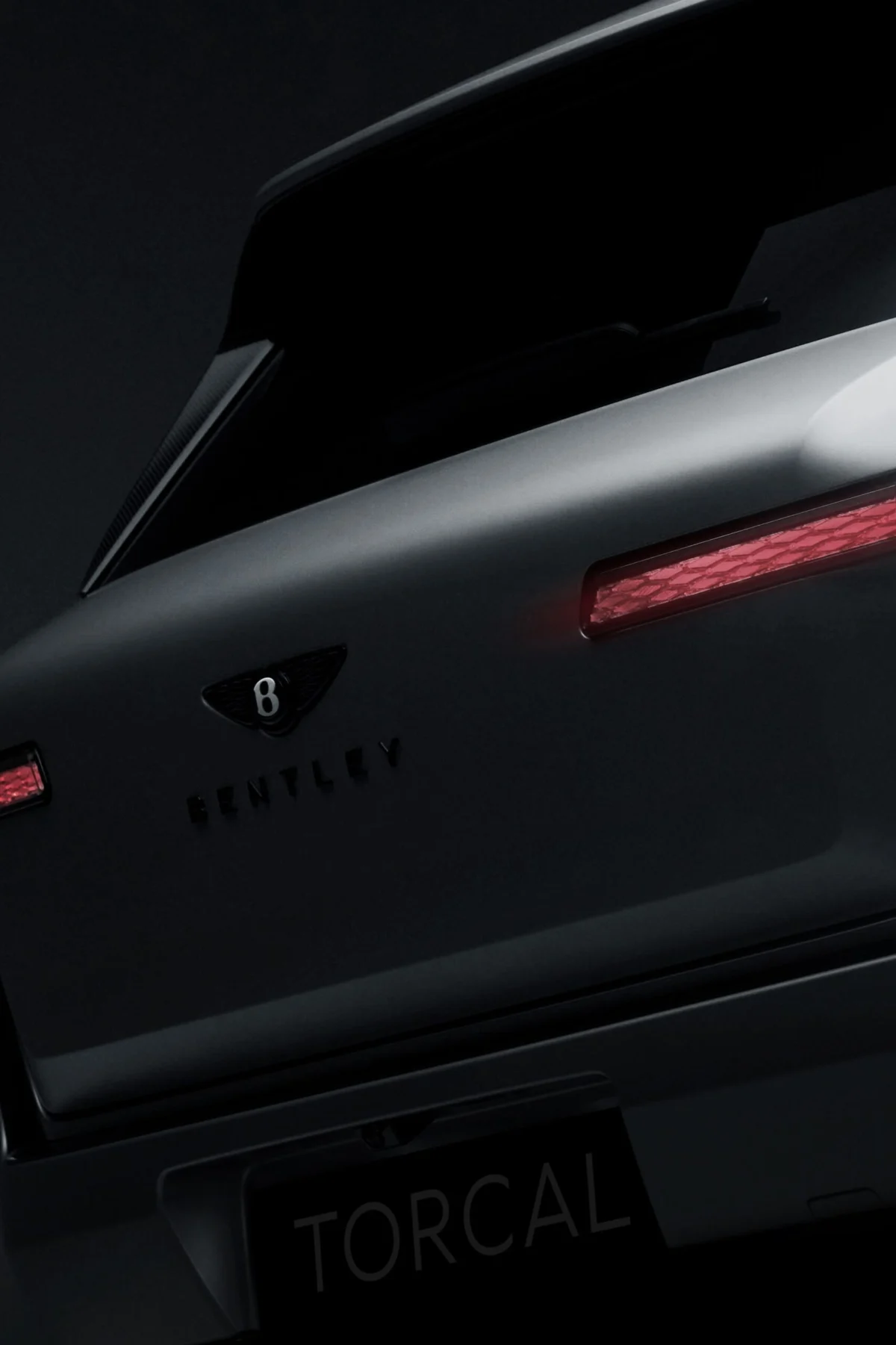
In the storied history of Crewe, few moments have carried the weight of the announcement made this week. Bentley, the quintessential British marque synonymous with grand touring, refined power, and the scent of Connolly leather, has finally pulled the curtain back—ever so slightly—on its most significant project in a century. The company has officially confirmed the name of its first fully electric vehicle: the Bentley Torcal.
The announcement, accompanied by a tantalizing silhouette of the vehicle’s rear haunches, marks a fundamental pivot point for the brand. Scheduled for a full global reveal on September 23, 2026, the Torcal is not merely another product launch; it is the physical embodiment of the company’s "Beyond100 Plus" strategy. While specifications remain largely under wraps, Bentley has confirmed that the Torcal will manifest as a five-meter-long, high-performance SUV, boasting a range in excess of 300 miles—a critical threshold for luxury buyers who demand both opulence and utility.
A Name Rooted in Geography and Physics
The selection of "Torcal" concludes months of speculation among automotive enthusiasts and brand historians. Earlier this year, eagle-eyed industry watchers noted trademark filings across Europe and the UK for both "Torcal" and "Barnato." The latter, a clear homage to Woolf Barnato—the 1920s racing driver and legendary "Bentley Boy" who cemented the brand’s reputation at Le Mans—was widely considered the front-runner.
However, in opting for Torcal, Bentley has chosen to align the new EV with its established naming conventions, which favor natural landmarks. The name is derived from El Torcal de Antequera in Andalusia, Spain, a surreal limestone landscape defined by dramatic, stacked rock formations. Yet, the name serves a dual purpose. Etymologically, it shares a root with the Latin torquere ("to twist"), the origin of the word "torque." By choosing a name that evokes both the raw, jagged beauty of the natural world and the essential physics of electric propulsion—instantaneous, high-force acceleration—Bentley is signaling a marriage of tradition and high-tech performance.
Design Philosophy: Familiarity Meets Future-Proofing
In a clandestine preview held near Bentley’s headquarters in the UK, the design DNA of the Torcal became immediately apparent. To the uninitiated, the vehicle might easily be mistaken for a successor to the Bentayga. It retains the signature long hood, the commanding upright stance, and the muscular rear haunches that have defined Bentley’s SUV aesthetic for the last decade.
However, closer inspection reveals a deliberate evolution. The Torcal is slightly more compact than its predecessor. Most strikingly, the rear roofline adopts a subtle slope—a aerodynamic necessity in the era of electric vehicles where minimizing drag is the primary lever for increasing range. The light clusters, too, have been reimagined; the classic oval signature is replaced by a clean, minimalist light bar that emphasizes the width of the vehicle.

The most controversial element, perhaps, is the front grille. In the absence of an internal combustion engine requiring massive airflow, the designers have replaced the traditional radiator mesh with a solid, illuminated wall of crystals. Influenced by the sharp, bold face of the historical Continental T, this design choice is unapologetically ostentatious. It stands in direct defiance of the current industry trend toward "quiet luxury" and minimalism, suggesting that Bentley intends to remain a brand of spectacle, even in a silent, battery-powered future.
Inside, the cabin strikes a balance between digital integration and tactile heritage. The interior features a sophisticated blend of physical controls—an acknowledgement that luxury buyers often prefer buttons to menus—and curved OLED displays that mimic the fluid ergonomics seen in the latest high-end performance vehicles. Interestingly, and perhaps surprisingly, Bentley has opted against the "passenger screen" trend, signaling a return to a driver-focused interior experience.
The Challenging Landscape: A Market in Flux
The arrival of the Torcal comes at a precarious moment for the luxury electric vehicle segment. The fervor that surrounded the initial transition to EVs has cooled, replaced by a complex reality of high depreciation, shifting consumer sentiment, and softening demand.
Bentley’s parent company, the Volkswagen Group, has seen its share of turbulence. Porsche, often considered the industry benchmark for engineering, has struggled as the depreciation of its Taycan performance EV has soured its reputation among some collectors and dealers. Furthermore, the broader market has been marked by high-profile retreats. Lamborghini recently shelved its Lanzador electric GT, with CEO Stephan Winkelmann bluntly noting that buyer demand for pure EVs in the supercar segment is "going almost to zero."
Ferrari, too, has faced a difficult road. The debut of its first EV, the Luce, saw billions of dollars in market valuation evaporate within hours of its announcement, leading the company to push back the timeline for its second electric model to 2028. Mercedes-Benz and Audi have similarly reported sluggish sales for their high-end electric SUVs, with Audi even closing its Brussels plant due to a systemic decline in orders for premium electric vehicles.
Economic Resilience and Strategic Hedging
Despite this hostile economic climate, Bentley remains in a relatively strong, if bruised, position. The company recently reported its seventh consecutive year of profitability, though the numbers reflect a 42 percent year-over-year decline in operating profit. This financial reality has necessitated difficult choices, including the layoff of 275 management and non-manufacturing roles to help fund the conversion of the historic A1 building in Crewe into a dedicated electric vehicle assembly line.

Frank-Steffen Walliser, Bentley’s Chairman and CEO, has described the Torcal as the "most considered car" in the company’s history. Under the "Beyond100 Plus" strategy, Bentley has hedged its bets. Recognizing the volatility of the EV market, the company pushed its full-electric transition date back from 2030 to 2035. This ensures that for the foreseeable future, Bentley will continue to produce internal combustion and plug-in hybrid models alongside the Torcal, allowing the brand to follow the market rather than being enslaved by it.
The Global Outlook: Can the Torcal Succeed?
Walliser believes the market’s psychological shift will play into Bentley’s hands. "Technology seekers that consider themselves opinion makers… they wanted to have cars that looked different," Walliser remarked during the preview. "Now, people don’t want that. They just want to have a car… using all of our DNA, being careful, delivering the car that feels authentic."
This "authenticity" is the cornerstone of the brand’s strategy. By avoiding the "revolutions" that have tripped up competitors and instead focusing on an evolution of the brand’s existing strengths, Bentley hopes to bypass the consumer fatigue currently plaguing the EV sector.
There is also a glimmer of hope in the East. While the Western market has been skeptical of high-end EVs, wealthy buyers in Asia have shown a different appetite. Ferrari’s Luce, despite its controversial reception in Europe and the US, saw its first-year allocation of 88 units—priced at a staggering $586,600—exhausted almost instantly in Asia. This suggests that the market for ultra-luxury EVs is not dead; it is merely migrating.
Conclusion: A High-Stakes Milestone
The Bentley Torcal is a daring, high-stakes milestone for a brand that has thrived for over a century on the roar of twelve cylinders. By entering the market with a vehicle that prioritizes brand heritage over radical technological experimentation, Bentley is betting that its customers will follow the brand into the electric age, provided the transition feels like a continuation of the Bentley experience rather than a departure from it.
As September 2026 approaches, all eyes will be on Crewe. The Torcal will not only be tested on the road, but on the balance sheet and in the court of public opinion. If Bentley succeeds, it will prove that the luxury market can indeed bridge the gap between the internal combustion engine and the electric motor. If it fails, it will serve as a stark reminder that even the most prestigious names in motoring are not immune to the fundamental shifts of a changing global economy. For now, the Torcal remains a promise—a limestone-inspired, torque-driven bet on the future of the British marque.











