Layla Zulfa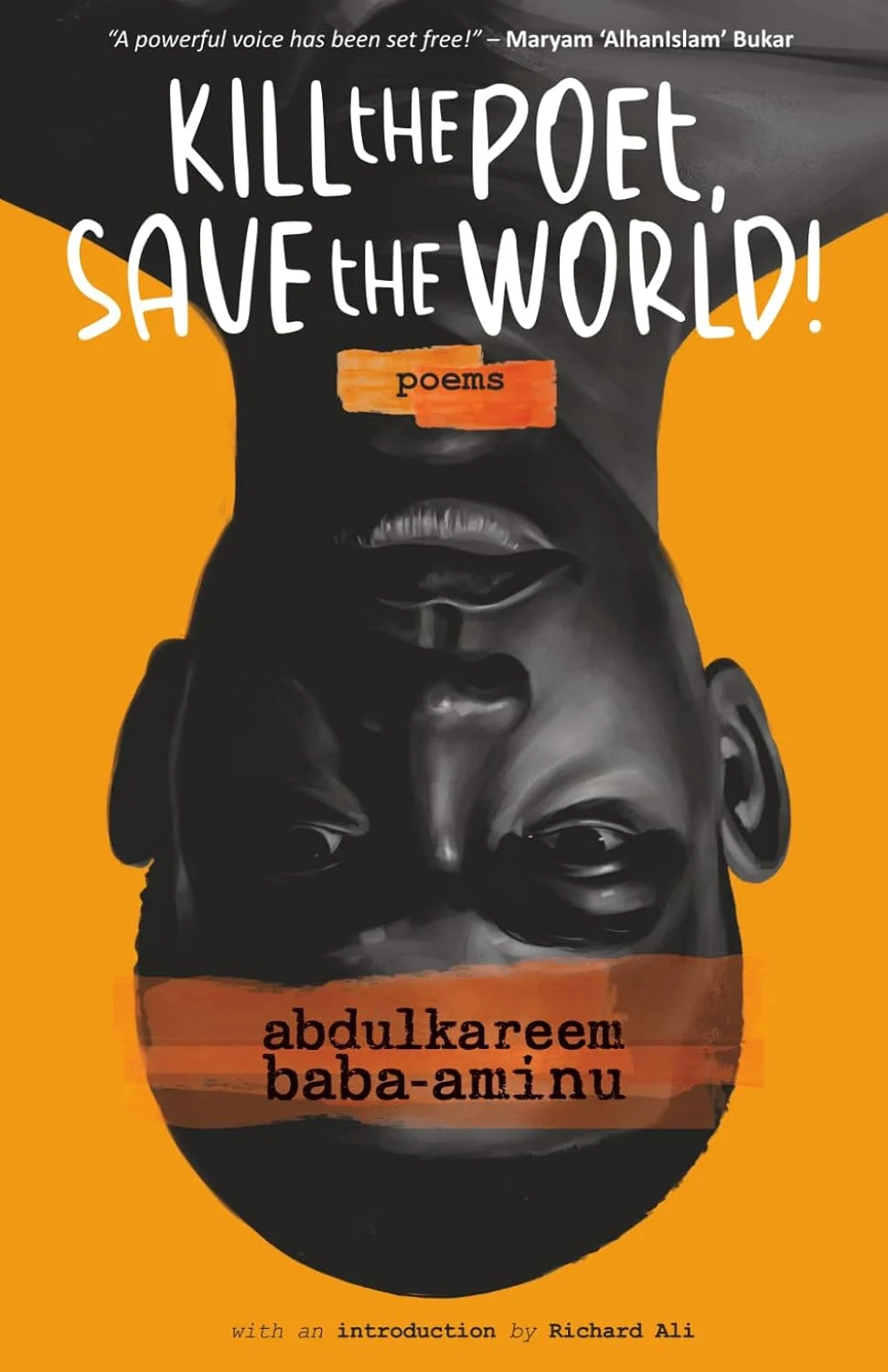
In the landscape of contemporary African literature, few debut collections have arrived with as much structural ambition and thematic urgency as Abdulkareem Baba-Aminu’s Kill the Poet, Save the World! The title itself acts as a provocation, a literary gauntlet thrown at the feet of a generation of writers often accused of retreating into insular, navel-gazing lyricism. By blending the cold, calculated language of technology with the visceral, often painful realities of life in northern Nigeria, Baba-Aminu establishes himself not merely as a poet, but as an "engineer of consciousness."
The Speculative Impulse: Time, Fate, and the Paradox of Intervention
One cannot engage with the collection without confronting its title, which echoes the iconic, high-stakes catchphrase of the NBC cult classic Heroes (2006–2010): "Save the cheerleader, save the world." In the series, the survival of Claire Bennett—a character possessing regenerative abilities—was the linchpin upon which the fate of humanity rested. Baba-Aminu adopts this speculative trope, utilizing the concept of time travel not as a mere sci-fi novelty, but as a philosophical lens to interrogate our cultural obsession with fate and the morality of intervention.
The collection navigates the treacherous waters of the "temporal paradox" with surgical precision. In the standout poem "The Past is Not a Place," Baba-Aminu confronts the genesis of regional trauma. He imagines a hypothetical encounter with an infant Abubakar Shekau—long before he became the notorious face of Boko Haram. The poet poses a haunting question: If one could snuff out the source of such profound misery in its infancy, would the world be redeemed? He writes:
If I end this heartbeat now,
will Chibok still sing?
Will the girls return home
in a different timeline,
braiding their hair
without ghosts in their fingers?
This inquiry transcends mere historical counterfactuals. It forces the reader to consider the cost of "course-correcting" history and whether we have the moral authority to play the role of cosmic architects.
Chronology of a Craft: From Journalism to Verse
Abdulkareem Baba-Aminu’s journey to this collection is as multifaceted as the poems contained within it. Long recognized for his incisive contributions to the Daily Trust—where his journalistic prose has dissected the political and social malaise of Nigeria—Baba-Aminu found that prose was often insufficient for the weight of his personal experience.
The turning point for the collection came in 2024, following a life-altering car accident. The subsequent experience of navigating a fractured and often failing medical system in Nigeria shifted his writing from the observational to the intensely personal. While his columns addressed the systemic failures of the state, his poetry became the vessel for his physical and emotional recovery.
Supporting Data: The Intersection of Tech, Trauma, and Geography
The collection is meticulously structured into thirty-five pieces that function as a suite, bridging the gap between the mechanical and the spiritual.
The "Engineer" Aesthetic
Baba-Aminu utilizes the language of computing as a metaphor for the human condition. In poems like "/pulse.exe" and its sequel, "Hex Education," he frames romantic heartbreak as a form of digital infection—a malware that degrades the system of the self. This is not to say the work is devoid of warmth. On the contrary, his "equilibrium of two" concept suggests that love is a persistent choice, a constant debugging of the heart that allows for resilience in the face of recurring loss.
Geographic Identity and Sectarian Wounds
The poet’s connection to Kaduna State provides the grounding for the work’s more elegiac qualities. Zaria and Kaduna, cities that once symbolized the "liberal" potential of Northern Nigeria, are now scarred by the frequency of sectarian violence. Baba-Aminu does not shy away from these wounds; he catalogs them with the precision of a mapmaker, lamenting the loss of the cosmopolitan spirit that defined his formative years at Ahmadu Bello University.
The Anatomy of Pain
The most poignant sections of the book are those that detail his struggle with chronic pain following his 2024 accident. Poems such as "The Body Forgets" and "Clinical Findings After Two Harmattans" document a descent into a medical purgatory. His use of rhyming couplets in "Farewell" serves as a masterclass in controlled vulnerability:
Call: Who are you when the circuits go cold?
Response: I am learning a hymn so bold.
Call: What is a body when spared or betrayed?
Response: A rumour of light that the dark has mislaid.
Official Responses and Literary Standing
While formal reviews are currently populating the literary journals, the early consensus among scholars of Africanfuturism places Baba-Aminu firmly within the school of thought championed by Nnedi Okorafor. By applying an "engineer of consciousness" approach to ecocriticism—seen in "The Last Butterfly I Ever Saw"—and confronting the long-standing ghosts of the Nigerian Civil War in "An Elegy in Split Frequencies," he has signaled a shift in the poetic register of the region.
The collection has been noted for its "transnational appeal," largely due to its ability to marry the specific linguistic texture of Northern Nigeria—incorporating Hausa, the regional lingua franca—with a universal, almost Rilkean concern for the human trial.
Implications: The Poet as Prophet
What are the implications of a collection that asks us to "kill the poet" to "save the world"? Baba-Aminu is essentially arguing for the end of poetry as a passive, ornamental exercise. He rails against the tendency for contemporary poets to look inward to the point of isolation. Instead, he proposes that poetry must function like code—a set of instructions that, when executed, has the power to change the output of society.
This is a call to action. By framing the poet as a potential prophet, he challenges his contemporaries to move away from the "endogamous" nature of current literary circles and toward a forward-facing stance. He suggests that the craft is a form of engineering, and that the stakes of failing to communicate with clarity and purpose are nothing less than the preservation of our shared humanity.
Conclusion: An Elastic Heart in a Digital Age
Kill the Poet, Save the World! is a rare achievement that satisfies both the technophile and the mystic. Beneath the veneer of "chrome and circuitry"—the scientific metaphors and the references to genetic engineering—lies a deeply spiritual sensibility that invites comparison to the works of Rumi and Rilke.
Whether he is writing about the grief of losing his mother in "For Yaya, For Everything" or critiquing the performative nature of political life in "Masquerade (or A Rational Anthem)," Baba-Aminu demonstrates that the heart remains the most complex, and perhaps the most fragile, technology of all. He concludes that while the world may be fractured, our capacity to rewrite the code of our future remains intact.
For those looking for a collection that refuses to offer easy answers, that treats the human body as both a miracle and a site of malfunction, and that views the act of writing as a vital, high-stakes intervention, Abdulkareem Baba-Aminu’s debut is an essential addition to the modern canon. It is a work that does not just describe the world; it provides the tools to imagine a different one.


 Ali Ikhwan