

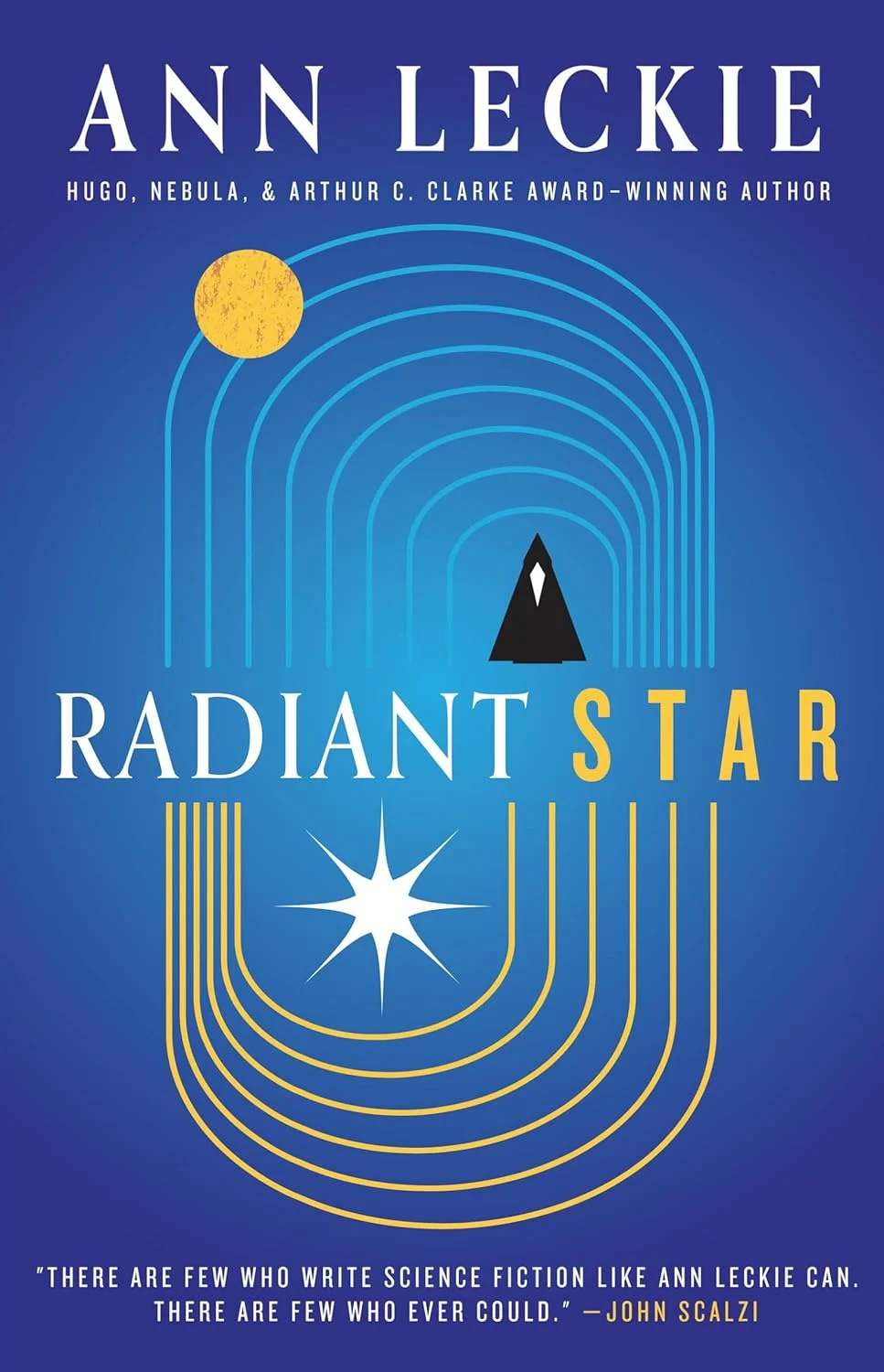
Ann Leckie, the Hugo and Nebula award-winning architect of the Imperial Radch universe, returns to her signature landscape of vast empires and complex cultural friction with Radiant Star. While the novel functions as an accessible entry point for those unacquainted with the Imperial Radch trilogy, it simultaneously serves as a masterclass in sociopolitical decay. Through the lens of the occupied world of Aaa, Leckie crafts a compelling, albeit tragic, exploration of how internal sectarian fragmentation can pave the road for imperial hegemony.
The Setting: A Cultural Microcosm Under Siege
The world of Aaa, and specifically the city of Ooioiaa, is defined by its deep-seated religious devotion to the "Radiant Star." As Emeritus Hierarch Biven articulates, the Star is not merely a deity but the "creator and created, the entire self-moving universe in itself." This theology has bifurcated the population into three distinct ethnic and social precincts—Chath, Ylec, and Athphsid—each governed by its own hierarchs, savants, and religious orders.
These divisions are not merely spiritual; they are systemic. Despite porous geographical borders, an Ooioian’s identity is largely fixed at birth, tethered to the specific precinct of their ancestors. This structure creates a "comparative anthropologist’s playground," where the lines between ethnic identity, social class, and religious orthodoxy blur.
However, this delicate equilibrium is held under the shadow of the Radchaai empire. Following the collapse of the central Imperial Radch, the local Radchaai forces stationed on Aaa—backed by the looming threat of the AI warship Justice of Albis—find themselves in a precarious position. Desperate to maintain their privileges and authority amidst the empire’s broader disintegration, the Radchaai look to occupy the Temporal Location, the spiritual heart of Ooioiaa. Their justification? A syncretic assertion that the Radiant Star is simply an aspect of their own god, Amaat.
Chronology of a Fractured Society
The descent of Aaa into total Radchaai control is marked by a series of cascading failures, both religious and material:
- The Fracture of the Status Quo: The story begins with a failure of succession. A prominent bicentennial aspirant to living sainthood fails his ascension, creating a power vacuum that the Radchaai immediately exploit to seize control of a central religious institution.
- The Famine Crisis: A catastrophic food shortage, exacerbated by the failure of intersystem trade routes during the Radch civil war, forces the population to rely on "skel," a nutrient-dense but unpalatable plant introduced by the Radchaai. The subsequent arrival of "sea-rot," a blight that destroys local food sources while sparing only onions, pushes the city to the brink of starvation.
- The Saint’s Death: During an ascension ceremony, a hungry, desperate crowd hurls skel at the religious procession. The elderly candidate for sainthood dies from the resulting stress and starvation.
- The Sectarian Brawl: Following the death, the Chath and Athphsid sects clash within the Temporal Location, engaging in a physical and theological dispute over the sanctity of the corpse.
- The Radchaai Intervention: Capitalizing on the public disorder, the Radchaai Governor expels the squabbling sects. By positioning themselves as the restorers of order and providers of food, the Radchaai effectively annex the Temporal Location, installing their own hand-picked "savants."
Supporting Data: The Mechanics of Exploitation
The tragedy of Radiant Star is not just in the occupation, but in the internal corruption of the Ooioian leadership. Leckie meticulously documents how local elites facilitated their own subjugation.
- Institutional Profiteering: While the populace starved, local councilors and the Consorority of the Temporal Location engaged in aggressive hoarding and extortion. This "skimming" of resources ensured that even when aid was possible, it failed to reach the populace.
- The Myth of the Rats: In a grim testament to the famine’s severity, the city’s rat population was hunted to extinction. This event was subsequently mythologized, ironically mirroring the hagiographies of saints, illustrating how the society attempted to process trauma through its existing religious framework.
- The "Miracle" of the Onion: The Radchaai Governor’s strategic use of the rediscovered Ylec "Images of Radiance" served as the final psychological blow. By framing the onion as a symbol of divine providence and purity against the sea-rot, the Governor successfully redirected the public’s frustration away from the occupiers and toward the local hoarders, effectively neutralizing dissent.
Official Responses and Political Rhetoric
The Radchaai administration, despite its brutal methods, operates with a sophisticated understanding of soft power. The Governor’s public address—livestreamed to the populace—was a masterstroke of political maneuvering. By simultaneously announcing the eradication of sea-rot, the delivery of food, and the arrest of the "corrupt" councilors, the Governor presented the Radch as a benevolent necessity rather than a foreign oppressor.
In contrast, the local hierarchy’s response was one of pathetic entrenchment. Emeritus Hierarch Biven’s warning to his successor proved prophetic: "You will finally be in sole control of the Temporal Location… but in that moment you will discover that the place belongs not to you, but the Radchaai." The local leaders, blinded by their desire for sectarian supremacy, failed to recognize that they were merely tools being used to stabilize a crumbling imperial outpost.
Implications: The Death of Cultural Sovereignty
The ultimate implication of Radiant Star is the permanent alteration of Aaa’s cultural fabric. While the Radchaai never officially restored the pre-war empire, their influence has become baked into the planet’s identity. The new "Consorors" may claim to worship the Radiant Star, but they do so through the lens of Amaat, employing rituals and items previously rejected by the traditional sects.
Leckie posits a harrowing question: Is a culture truly "itself" if it has been forced to reform to survive? The answer provided by the narrative is a somber negative. By disarming the local government and mandating the adoption of Radchaai staples, the occupation effectively hollowed out the culture from within.
A Critique of "Civilizing" Missions
The novel serves as a sharp critique of the "civilizing" impulse—a concept the Radch language itself equates with the term "Radch." Leckie argues that sovereignty is not a gift to be granted or withheld by an empire; it is an inherent right. The local authorities in Radiant Star are far from blameless—they are shown to be venal, exclusionary, and opportunistic—but their moral failings do not provide a mandate for outside intervention.
The tragic arc of Radiant Star demonstrates that empires rarely "civilize" their subjects. Instead, they curate them. By exploiting existing internal fissures, the Radchaai were able to dismantle the sovereignty of Aaa, not by force of arms alone, but by positioning themselves as the only viable solution to the crises they themselves were intimately involved in managing.
Ultimately, Radiant Star is a cautionary tale about the fragility of community. It suggests that when a society prioritizes sectarian victory over collective survival, it leaves the door wide open for external forces to redefine its future. As the novel concludes, Aaa may continue to function, and its people may continue to pray, but the nature of their world has been irrevocably shifted toward the imperial center. The Radiant Star remains, but it now shines upon a landscape fundamentally rearranged by the hands of its occupiers.










No comments yet. Be the first to join the conversation!