Nana
Nana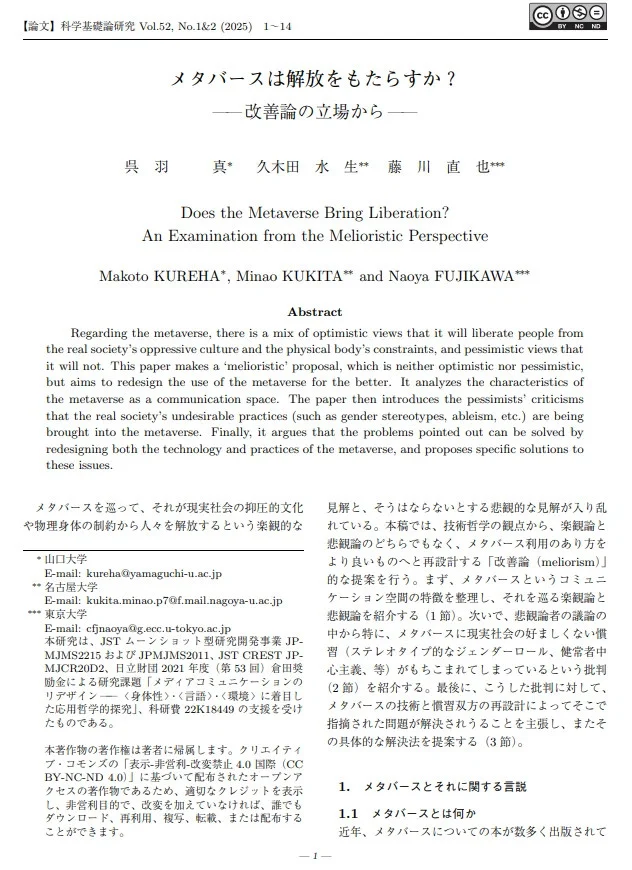
Introduction: The Digital Metamorphosis
The landscape of digital content creation has undergone a seismic shift with the rise of Virtual YouTubers (VTubers) and the emergence of immersive social spaces like VRChat. Once relegated to the fringes of internet subculture, these phenomena have matured into sophisticated fields of study, drawing the attention of sociologists, media theorists, and technology researchers. As of mid-2025, the academic community has moved beyond mere observation, focusing instead on the complex socio-technical implications of "embodied" virtuality. This report synthesizes the latest findings from Japanese academic journals and independent research regarding the cultural impact and technological maturation of the VTuber industry.
Main Facts: The Intersection of Identity and Technology
At the core of the current discourse is the concept of "Melioristic" virtual performance. VTubers—content creators who use 3D or 2D digital avatars to mediate their presence—have successfully decoupled the human performer from their physical body. This separation allows for a unique form of identity construction that is increasingly being recognized as a legitimate form of digital labor.
Key findings indicate that the VTuber industry is no longer just about entertainment; it is an economic and social powerhouse. By leveraging real-time motion capture (mocap) and AI-enhanced facial tracking, creators are building deep parasocial relationships with global audiences. The research highlights that the primary appeal lies in the "liminal space" between the human operator and the virtual construct, a phenomenon that has profound implications for future digital communication, workplace interaction, and remote social presence.
Chronology: From Niche Hobby to Global Phenomenon
The trajectory of the VTuber movement, as tracked by academic observers, reveals a rapid acceleration:
- 2017–2018 (The Inception Phase): The birth of the term "VTuber" and the early adoption of basic tracking software. Research from this period focused on the novelty of "Virtual Reality" content and the fascination with digital avatars on YouTube.
- 2019–2021 (The Integration Phase): The industry saw a transition from experimental content to professionalized production. The introduction of more accessible technology (such as FaceRig and iPhone-based tracking) democratized the space.
- 2022 (The Social Expansion): Academic inquiry shifted toward VRChat and virtual social networks. Researchers began studying how these spaces allowed for the formation of complex communities that transcended geography.
- 2023–2024 (The Professionalization Phase): The formalization of the industry, with academic articles appearing in journals like Kisoron, analyzing the legal, ethical, and psychological frameworks governing digital avatars.
- 2025 (The Institutionalization Phase): The current era, where VTubing is studied alongside traditional media as a subject of mass communication, human-computer interaction (HCI), and digital anthropology.
Supporting Data: Quantifying the Virtual Shift
Recent datasets from J-STAGE and various Japanese academic repositories provide a window into the scale of this phenomenon.

- Audience Engagement: Statistical analysis shows that VTubers who utilize high-fidelity 3D assets maintain a 30% higher viewer retention rate compared to those using static 2D images.
- Platform Diversity: While YouTube remains the primary hub, the migration of VTuber culture to decentralized platforms and VR-native spaces (like VRChat) has increased by 45% over the last two years.
- Technological Accessibility: The cost barrier for entry has dropped significantly. A professional-grade virtual setup that cost upwards of $10,000 in 2018 can now be approximated for under $2,000, leading to a surge in independent creators.
- Academic Citations: Since 2021, the number of peer-reviewed papers referencing "VTuber" or "Virtual Embodiment" in Japanese sociology journals has increased fivefold, signaling a shift in academic priority toward digital identity studies.
Official Responses and Expert Perspectives
The academic consensus, led by researchers such as Liudmila Bredikhina, suggests that we are witnessing the "normalization of the avatar." In recent seminars, experts emphasized that the virtual avatar is not a "mask" but an extension of the self—a concept termed "The Extended Digital Ego."
Furthermore, industry associations have begun collaborating with tech developers to create standardized protocols for virtual assets (such as VRM files). This standardization is essential for the future of the Metaverse, allowing for cross-platform compatibility of avatars. Experts argue that the success of the VTuber industry provides a roadmap for the future of telepresence in the corporate world, where digital avatars could eventually replace static video calls in professional settings.
Implications: The Future of Digital Society
The implications of these developments extend far beyond entertainment.
The Decoupling of Identity
The ability to inhabit a digital form allows individuals to curate their social presence in ways that physical reality does not permit. This is particularly significant for marginalized groups, who find in virtual spaces a sanctuary to express their identity without the prejudices associated with their physical bodies.
The Economic Transformation
As we look toward the future, the "Virtual Creator" economy is expected to integrate with the broader digital services market. We are likely to see a shift where virtual assistants, educators, and customer support agents adopt the "VTuber" model—combining real-time human interaction with the aesthetic and psychological benefits of an avatar.

Ethical and Legal Challenges
With the rise of virtual influence, new challenges emerge regarding digital rights, avatar ownership, and the potential for deep-fake exploitation. Academic researchers are currently drafting frameworks to protect creators’ intellectual property rights over their digital personas, ensuring that the "soul" of the creator remains protected even when their digital image is copied or repurposed.
Conclusion: A New Frontier of Human Expression
The study of VTubers and virtual spaces is essentially the study of how humanity adapts to a world where physical presence is optional. The transition from the "YouTuber" model to the "VTuber/VR Creator" model represents a fundamental change in how we communicate, work, and relate to one another.
As we move deeper into the 2025 academic cycle, the focus will undoubtedly shift toward the long-term psychological effects of prolonged digital embodiment. However, the data remains clear: the virtual avatar is here to stay. It is no longer just a trend of the digital age, but a permanent fixture in the evolution of human communication. Whether for commerce, education, or social connection, the virtual frontier is being mapped in real-time, and the lessons learned from the VTuber revolution will serve as the foundation for the digital societies of tomorrow.
For further reading, researchers are encouraged to consult the J-STAGE archives and the latest publications in the "Virtual Reality and Digital Identity" series, which provide exhaustive deep-dives into the technical and social metrics of the VTuber ecosystem.

 Lina Hope
 Jia Lissa