

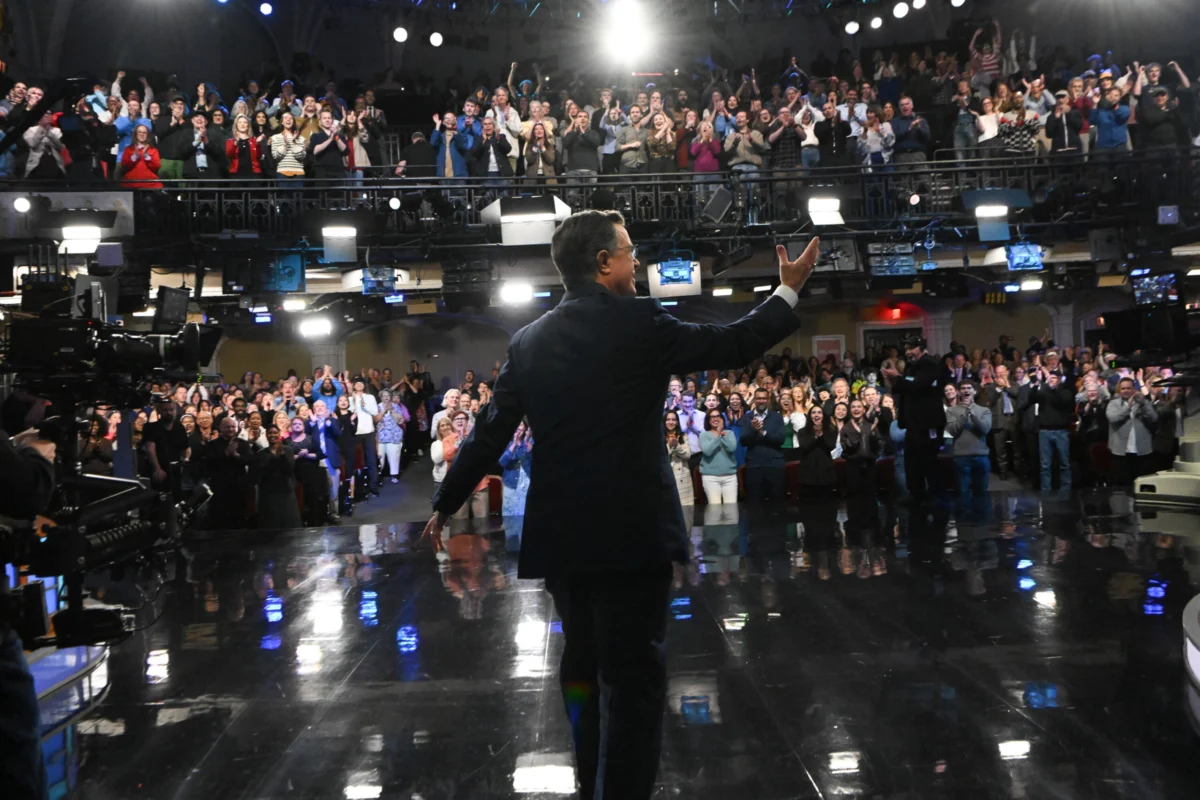
After more than a decade of nightly satire, interviews, and cultural commentary, Stephen Colbert has officially bid farewell to The Late Show. In a final broadcast that spanned over 1,800 episodes, the Ed Sullivan Theater—a venue steeped in the history of American broadcasting—saw the curtain fall on one of television’s most enduring late-night franchises. The finale, which served as both a celebration of the show’s legacy and a poignant acknowledgment of its abrupt conclusion, marked the end of an era for CBS and the late-night landscape at large.
The Final Broadcast: A Night of Joy and Reflection
The atmosphere on Thursday evening was equal parts celebratory and somber. Colbert began the proceedings with a solitary, earnest address to the camera, eschewing the traditional high-energy opening for a reflective monologue that touched on the ethos of the production.
"This show has been a joy for us to do for you," Colbert said, addressing the audience. "We call this show ‘The Joy Machine.’ We call it that because to produce this volume of work, it has to be a machine. But the thing is, if you choose to operate that machine with joy, it doesn’t hurt as much when your fingers get caught in the gears. I cannot adequately explain to you what the people who work here have done for each other, and how much we mean to each other."
Colbert took a moment to contrast his current tenure with his origins on Comedy Central’s The Colbert Report. "On night one of The Colbert Report, I said, ‘Anyone can read the news to you. I promise to feel the news at you.’ I realized pretty soon in this job that our mission was different. We were here to feel the news with you."
A Legacy of Late-Night History
The Ed Sullivan Theater, where the finale took place, is hallowed ground in the world of entertainment. Colbert acknowledged the gravity of the space, noting the legendary performers who had graced the stage before him. "We’ve been honored to have been just a small part of this history," he remarked. "Nichols and May played on this stage. The Beatles made their American debut here. And, backstage, Elvis used the bathroom—and didn’t die."
The show’s history is inextricably linked to the giants of the medium. The Late Show began in August 1993, helmed by David Letterman following his departure from NBC. Letterman’s retirement in May 2015 paved the way for Colbert, who transitioned from his iconic character-driven satire to the more traditional—yet uniquely personal—format of the Late Show host in September 2015.
The "Goodbye Tour": Contextualizing the Cancellation
The finale was the culmination of an "elongated goodbye" that began ten months ago when CBS abruptly announced the cancellation of the show and its entire late-night franchise. The decision, handed down just three weeks before David Ellison’s transition to the head of Paramount, sent shockwaves through the industry.

While the network officially framed the cancellation as a "purely financial decision against a challenging backdrop in late night," citing that it was "not related in any way to the show’s performance or content," skeptics remain. The timing of the announcement—coming mere days after Colbert characterized Paramount Global’s $16 million settlement regarding Donald Trump’s lawsuit as a "big fat bribe"—has fueled intense speculation regarding the true motivations behind the network’s decision.
Star-Studded Cameos and the Interdimensional Wormhole
In true late-night fashion, the finale featured a parade of celebrity cameos that blended humor with genuine camaraderie. Before Paul McCartney took the stage as the sole formal interview guest, a series of stars "interrupted" the monologue, seemingly vying for the coveted spot.
Bryan Cranston made an early appearance, joking, "Maybe I could be your last guest." Paul Rudd interrupted with a bizarre offering of five bananas—a nod to the absurdity of late-night tropes—while Colbert’s former Second City collaborator Tim Meadows unsuccessfully attempted to leverage their shared history to secure the finale slot. Even Tig Notaro made a cameo, jokingly claiming she was only there because she likes attending "historic events," having allegedly been at the moon landing and the Obama inauguration.
A pre-recorded segment added a layer of meta-commentary: a "black hole" (or green screen effect) threatened to swallow late-night television. Neil deGrasse Tyson explained the scientific impossibility of a show being both "Number One" and "Canceled," while Jon Stewart, appearing on behalf of Paramount, delivered a satirical statement about the benefits of a "black hole that is swallowing everything we know and love." The segment concluded with appearances by fellow late-night hosts Seth Meyers, Jimmy Kimmel, John Oliver, and Jimmy Fallon, who collectively lamented the loss of the platform where they made jokes about the news.
The Final Guest: Paul McCartney
The headline of the evening was the appearance of Sir Paul McCartney. Colbert had previously teased that his final guest would be someone "infallible," and he delivered on that promise. McCartney, who famously played the Ed Sullivan Theater with The Beatles in 1964, provided a bridge between the past and present.
"I was just in the area, doing some errands," the music legend quipped. During the interview, McCartney gifted Colbert a framed photo of The Beatles’ debut at the theater, complete with an inscription jokingly claiming Colbert was "better than The Beatles."
The conversation drifted from McCartney’s nostalgia for the 1964 performance—where he recalled the "deafening" screams of the audience—to his thoughts on the current state of America. Despite the political turmoil mentioned throughout the show, McCartney offered a hopeful sentiment: "America was just the land of the free, the greatest democracy… Still is." The interview concluded with a lighthearted discussion about his upcoming projects, his distaste for iPhone updates, and his pre-show ritual of a "cheese and pickle sandwich."

A Musical Farewell
The finale concluded with a poignant musical sequence. Elvis Costello joined the stage for a rendition of "Jump Up," backed by the house band, led by Louis Cato, and featuring a guest appearance by former bandleader Jon Batiste.
The final song of the evening was, appropriately, The Beatles’ "Hello, Goodbye." As McCartney performed, the stage filled with the cast, crew, friends, and family of the production, creating a chaotic, emotional, and warm tableau. It was a final, fitting nod to the cycle of television: the hello that follows the goodbye, and the enduring nature of the art form, even when the lights are dimmed.
Implications for the Future of Late-Night
The cancellation of The Late Show represents more than just the end of a single program; it marks a structural pivot for CBS and the broader television industry. With the departure of a show that dominated ratings and social media discourse, the "late-night" space is effectively being dismantled in favor of alternative programming models.
For the talent involved, the move signals a shift toward streaming, podcasts, and independent platforms where the constraints of corporate oversight—and the potential for friction with parent companies—are significantly reduced. As Colbert exits the Ed Sullivan Theater, he leaves behind a legacy defined by his ability to maintain a connection with his audience, regardless of the shifting tides of network politics.
While the "Joy Machine" has ceased its daily operations, the influence of Colbert’s decade-long run will undoubtedly linger, serving as a benchmark for political satire and the human element of late-night television for years to come.











No comments yet. Be the first to join the conversation!