

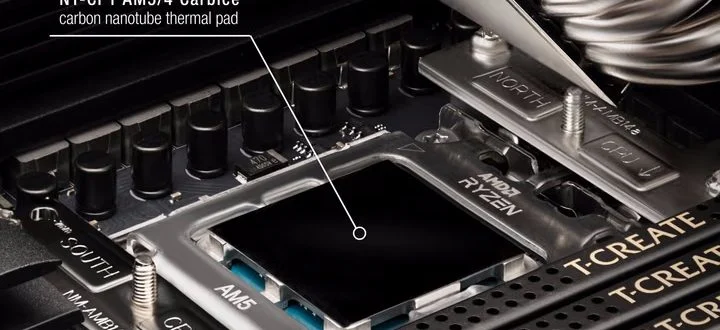
In a landmark development for the high-end PC enthusiast market, cooling giant Noctua has announced a strategic partnership with Carbice, a pioneer in advanced materials. This collaboration marks a significant departure from traditional thermal interface materials (TIM), signaling a shift toward carbon nanotube-based solutions. The inaugural product of this alliance, the NT-CP1 thermal pad, is designed specifically for AMD’s AM4 and AM5 processor architectures, promising a maintenance-free, long-term cooling solution that challenges the status quo of thermal pastes and conventional pads.
Main Facts: The End of Thermal Degradation
For decades, the PC building community has relied on various forms of thermal grease—ranging from silicon-based compounds to high-end liquid metal—to bridge the microscopic gaps between a processor’s integrated heat spreader (IHS) and the cold plate of a cooler. While effective, these materials are inherently prone to "pump-out" (where thermal cycling pushes the paste away from the die), drying out, or delamination over time.
Noctua’s new NT-CP1 thermal pads, engineered in collaboration with Carbice, utilize a sophisticated carbon nanotube matrix to solve these common failure points. Unlike traditional pastes that require periodic reapplication, the NT-CP1 is designed to be a permanent, "install and forget" solution. By leveraging the unique physical properties of carbon nanotubes, the pad is capable of incrementally conforming to the microscopic topography of the processor’s surface. This constant, adaptive contact ensures optimal heat transfer efficiency that does not degrade, but rather maintains or improves its performance over the lifespan of the component.
Chronology of the Innovation
The journey toward the NT-CP1 began long before this week’s announcement at Computex. Carbice, a company with deep roots in aerospace and mission-critical electronics, has spent years refining its carbon nanotube (CNT) technology. Their core expertise lies in creating "Carbice Pad" technology, which provides the thermal conductivity of a liquid metal with the handling ease and reliability of a solid-state material.
- Initial Research and Development: Carbice focused on the aerospace sector, where thermal interface failure is not an option. Noctua, seeking to solve the recurring issues of thermal degradation in DIY PC environments, identified Carbice’s technology as the next logical evolution for consumer cooling.
- Validation Phase: The two companies spent the last 18 months conducting rigorous thermal testing on AMD Ryzen processors. By focusing on the AM4 and AM5 platforms, they ensured that the material properties of the NT-CP1 were perfectly tuned to handle the high heat density and unique heat spreader shapes of modern Ryzen chips.
- The Computex Unveiling: At the 2024/2025 Computex cycle, the partnership moved from internal testing to public display. The companies debuted the prototype units to industry experts and media, garnering significant attention for the bold claim that this product could eliminate the need for thermal paste maintenance.
- Roadmap to Retail: Following the public demonstrations in Taiwan, the companies have confirmed a launch window for September of this year, with initial units expected to hit major retail channels globally.
The Engineering Breakdown: How Carbon Nanotubes Work
The NT-CP1 is not merely a piece of conductive foam; it is a highly engineered composite material. The structure is built around a robust aluminum backbone, which serves as a structural foundation for the carbon nanotubes. This aluminum core provides the necessary rigidity for handling while remaining thin enough to ensure minimal thermal resistance.
Sandwiched around this core are dense forests of carbon nanotubes. Carbon nanotubes are among the most thermally conductive materials discovered by science, capable of transporting heat far more efficiently than the synthetic oils used in traditional thermal pastes. The outer layer of the pad is coated in a proprietary nanoscale polymer, which serves three vital functions:
- Tackiness: It ensures the pad stays firmly adhered to the IHS during the mounting process, preventing accidental slips or misalignment.
- Safety: The coating ensures the pad is non-electrically conductive, mitigating the risk of short-circuiting components if a stray fiber or piece of the pad makes contact with motherboard circuitry.
- Removal: Despite its high-performance bond, the polymer allows for clean removal, ensuring that users do not have to scrape or use harsh chemicals to clean their CPUs when upgrading or swapping coolers.
Implications for the DIY PC Industry
The introduction of this technology could fundamentally alter the maintenance cycle of a high-end gaming or workstation PC. Currently, enthusiasts are often advised to replace their thermal paste every two to three years to maintain optimal temperatures. With the NT-CP1, this maintenance window is effectively removed.
Long-Term Stability
In extreme cooling environments, such as high-performance air cooling or liquid cooling loops, the "pump-out" effect is the primary enemy. As a CPU heats and cools, the metal IHS expands and contracts. Traditional pastes are pushed outward, creating voids that lead to localized hot spots. The carbon nanotube matrix in the NT-CP1 is designed to be "resilient." It maintains constant pressure and contact even under significant thermal expansion, preventing the formation of gaps.
The Shift in User Expectations
If Noctua and Carbice succeed, the market may shift toward a premium tier of "lifetime" thermal interfaces. This is particularly valuable for users who invest in high-end builds. For a system that might be used for five or more years, the peace of mind offered by a non-degrading interface is a major selling point.
Future Collaborations
The press release hinted that the NT-CP1 is only the beginning. By collaborating on future product development, Noctua and Carbice are signaling that they intend to bring this technology to other form factors, potentially including GPU cooling and perhaps even laptop thermal management, where space is at a premium and thermal efficiency is critical.
Official Stance and Expert Analysis
While full third-party benchmarks are pending the September release, the industry reception has been cautiously optimistic. Noctua has built a reputation on conservative, data-backed claims; they rarely bring a product to market unless it demonstrably outperforms current standards in real-world conditions.
Carbice’s CEO has emphasized that this partnership is about "democratizing aerospace-grade thermal management." By bringing a technology that has historically been reserved for satellites and high-end server hardware to the DIY PC market, they are addressing a genuine pain point for power users.
Conclusion: A New Standard?
As we look toward the September launch, the questions remain: How will it perform under extreme overclocking scenarios compared to the best-in-class liquid metal? And will the price point be accessible enough for the average builder, or will it remain a niche product for high-end enthusiasts?
Regardless of the initial price, the move by Noctua to embrace carbon nanotube technology is a clear indicator of where the cooling industry is heading. We are moving away from messy, consumable fluids and toward precise, durable, and scientifically advanced solid-state materials. For the builder who wants their machine to run as well on its 1,000th day as it did on its first, the Noctua/Carbice NT-CP1 may soon become the gold standard in thermal interface technology.
Disclaimer: As of the writing of this article, retail availability is scheduled for September. Interested users should monitor the official Noctua website and major technology retailers for pre-order information.










No comments yet. Be the first to join the conversation!