

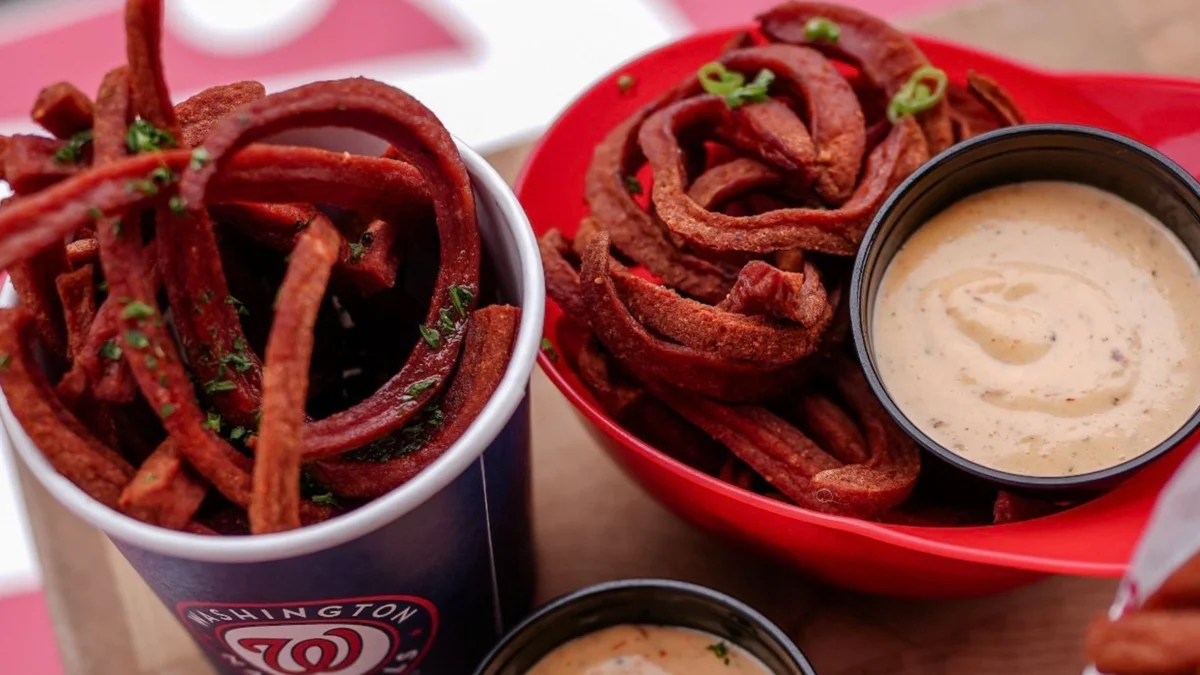
The landscape of professional sports concessions has shifted dramatically over the last decade. Gone are the days when a standard-issue hot dog and a lukewarm bag of peanuts defined the ballpark experience. In the modern era of “stadium gastronomy,” teams are engaged in a high-stakes arms race to create the next viral sensation. The latest entry in this culinary spectacle comes from the Washington Nationals, who have unveiled a menu item that is as polarizing as it is inventive: the hot dog fry.
Main Facts: Deconstructing the Hot Dog Fry
Introduced on May 15, 2026, at Nationals Park, the hot dog fries are precisely what their name implies: shoestring-cut strips of processed frankfurter, deep-fried until they achieve a crispy, golden-brown exterior. These are not a side dish meant to accompany a standard bun-and-sausage combo; they are the main event.
The dish is served in either a standard cup or the fan-favorite souvenir plastic baseball helmet, a nod to the nostalgic aesthetics of ballpark dining. To elevate the salt-heavy flavor profile of the fried meat, the dish is paired with a signature chipotle ranch sauce, providing a creamy, smoky acidity designed to cut through the richness of the fried hot dog. Priced at $20, the item is marketed as a substantial entrée, intended to serve as a singular, filling meal for a hungry spectator.
A Chronology of Concession Chaos
The debut of the hot dog fries did not happen in a vacuum. It is the latest chapter in a broader trend of "extreme concession" culture that has permeated Major League Baseball (MLB).
- April 2026: The Toronto Blue Jays sent shockwaves through the sports world by introducing "Cotton Candy Fries." The dish featured traditional potato fries drizzled with blue mayonnaise and topped with literal cotton candy. The internet reaction was swift and largely horrified, yet the item generated millions of impressions across social media platforms.
- Early May 2026: The Colorado Rockies leaned into the "Glizzy" meme—internet slang for a hot dog—by unveiling the "Glizzilla." This two-foot-long behemoth featured a foot-long hot dog base adorned with a massive portion of macaroni and cheese, establishing a new benchmark for caloric density in sports venues.
- May 15, 2026: The Washington Nationals officially dropped their hot dog fries. Unlike the Blue Jays’ polarizing experiment, the Nationals’ offering struck a chord with a specific demographic: the "junk food connoisseur." By the end of the day, the item was trending on X (formerly Twitter), with prominent sports business influencers like Darren Rovell amplifying the news to a massive audience.
The Economics of Stadium Excess
The $20 price tag attached to the hot dog fries has ignited a rigorous debate among sports economists and casual fans alike. To understand the pricing, one must look at the "experience economy."
Stadiums are no longer just arenas for sport; they are entertainment hubs where the food is an attraction on par with the game itself. From a logistical standpoint, the $20 price point accounts for several factors:
- Preparation Complexity: Unlike a standard hot dog, which can be prepared in bulk, hot dog fries require specialized cutting, deep-frying, and individualized plating.
- Scarcity and Novelty: The "Instagrammability" of the dish provides free marketing for the team. Fans who purchase the item are effectively acting as unpaid influencers, posting photos and videos that reach thousands of potential ticket buyers.
- The "Helmet Tax": The inclusion of the souvenir helmet, which fans often collect, adds a perceived value that justifies the premium cost compared to standard fast-food pricing.
However, critics point out that the price reflects a disconnect between inflation-weary fans and team ownership. While a $20 meal might be considered an "experience" for a family outing, it remains a steep barrier for the average fan who is already paying for tickets, parking, and transportation.
Social Media and the Viral Response
The reaction to the hot dog fries has been characterized by a phenomenon best described as "repulsed intrigue." Social media users have been caught in a loop of biological aversion and culinary curiosity.
One user on X summarized the collective sentiment perfectly: “Disgusting. Would try. But also disgusting. But I really want to try it.” This cognitive dissonance is exactly what the Nationals’ food and beverage team aimed for. By pushing the boundaries of what is socially acceptable to eat, they guarantee a viral cycle.
Others have focused on the health implications. Medical professionals and health-conscious fans have weighed in, noting the high sodium, saturated fat, and nitrate content of a meal comprised entirely of fried processed meat. Jokes about heart health and "artery-clogging" have become standard replies to the Nationals’ official promotional posts. As one user aptly joked, “Straight into the arteries. As intense as a bunt hit and run in extras.”
Supporting Data: The "Stadium Gastronomy" Trend
The Nationals are not operating in a vacuum. Major brands have been quick to partner with sports leagues to push the limits of consumer products. For instance, in early May 2026, Miller Lite launched a custom-engineered soccer ball that functions as a functional cooler, capable of holding an entire 12-pack of beer. This move, intended to align with the FIFA World Cup festivities, mirrors the logic behind the hot dog fries: if it’s weird, oversized, or technically unnecessary, it will capture the attention of the modern, distracted consumer.
Data from stadium surveys suggests that younger demographics (Gen Z and Millennials) are significantly more likely to prioritize unique food options when deciding whether to attend a live game. For these fans, the game is the background; the food, the social media content, and the atmosphere are the foreground.
Official Responses and Strategic Implications
While the Washington Nationals have not issued a formal press release regarding the health concerns, their silence is telling. In the world of viral marketing, any engagement is good engagement. By allowing the public to debate the merits of the dish, the Nationals have kept their brand in the news cycle without spending a single dollar on traditional advertising.
The strategic implication here is clear: the "food arms race" is unlikely to stop. As long as teams like the Nationals, Blue Jays, and Rockies continue to see spikes in engagement and concession sales tied to these bizarre items, we can expect the menu options to get increasingly erratic.
Conclusion: A New Era of Ballpark Dining
The Washington Nationals’ hot dog fries serve as a mirror to our current cultural moment. We live in an era where the extreme, the absurd, and the visceral are rewarded with attention. Whether the hot dog fry is a stroke of genius or a culinary catastrophe remains a matter of personal taste.
However, one thing is certain: the next time you walk through the turnstiles at Nationals Park, you aren’t just there to watch a game. You are there to participate in a grand, deep-fried experiment. Whether you choose to indulge or simply watch from the sidelines, the hot dog fry has successfully done what it was designed to do: it has made us look, it has made us talk, and most importantly, it has made us wonder what they could possibly come up with next.











No comments yet. Be the first to join the conversation!