Despite a volatile global semiconductor landscape characterized by supply chain constraints, fluctuating component costs, and a broader contraction in the consumer CPU market, the discrete graphics processing unit (GPU) sector has demonstrated remarkable resilience. A newly released report from Jon Peddie Research (JPR) for the second quarter of 2026 reveals a surprising trend: while the general PC market faces seasonal headwinds, the demand for high-performance graphics hardware is surging, painting a complex picture of a market driven by intense consumer appetite and evolving digital consumption habits.
Main Facts: A Disconnect Between CPUs and GPUs
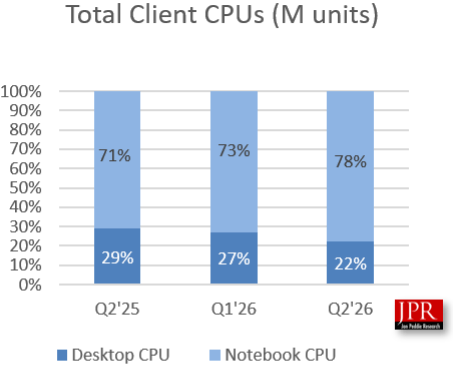
The second quarter of 2026 has provided data that appears, at first glance, to be contradictory. While the overall consumer PC market—encompassing both integrated and standalone graphics—saw total shipments reach 75.5 million units (a 10.4% quarter-over-quarter increase), this growth masks a deeper decline in the foundational CPU market.
According to JPR, consumer CPU shipments contracted by 1.1% year-over-year. This decline was primarily tethered to a sharp reduction in desktop CPU shipments. However, the graphics sector tells a different story. Discrete GPU shipments climbed by 12.2% sequentially and 14.1% year-over-year. This decoupling suggests that consumers are increasingly prioritizing graphics performance, even as they may be deferring full-system upgrades or shifting their purchasing preferences toward more specialized hardware.
A Chronological Look at the Q2 2026 Market Dynamics
To understand the current state of the industry, one must look at the progression of the year. The first quarter of 2026 set the stage with persistent supply chain issues and high component prices. As the industry moved into Q2, analysts expected a typical seasonal slowdown. Instead, the market witnessed an acceleration in the discrete GPU space.
- Early Q2: Initial reports indicated a cooling of desktop interest, leading to a 4% decline in desktop-specific GPU shipments compared to Q1. Industry watchers predicted a similar stagnation for discrete cards.
- Mid-Q2: The narrative shifted as the notebook sector began to show extreme vitality. Notebook GPU shipments surged by 16.8%, effectively compensating for the slump in desktop demand.
- Late Q2: By the close of the quarter, the aggregate data confirmed that the "discrete" category—cards that operate independently of the primary processor—had outperformed expectations. This growth occurred in the face of what Dr. Jon Peddie described as a "global memory crisis," which forced prices upward and created significant cost barriers for the average consumer.
Supporting Data: The Competitive Landscape
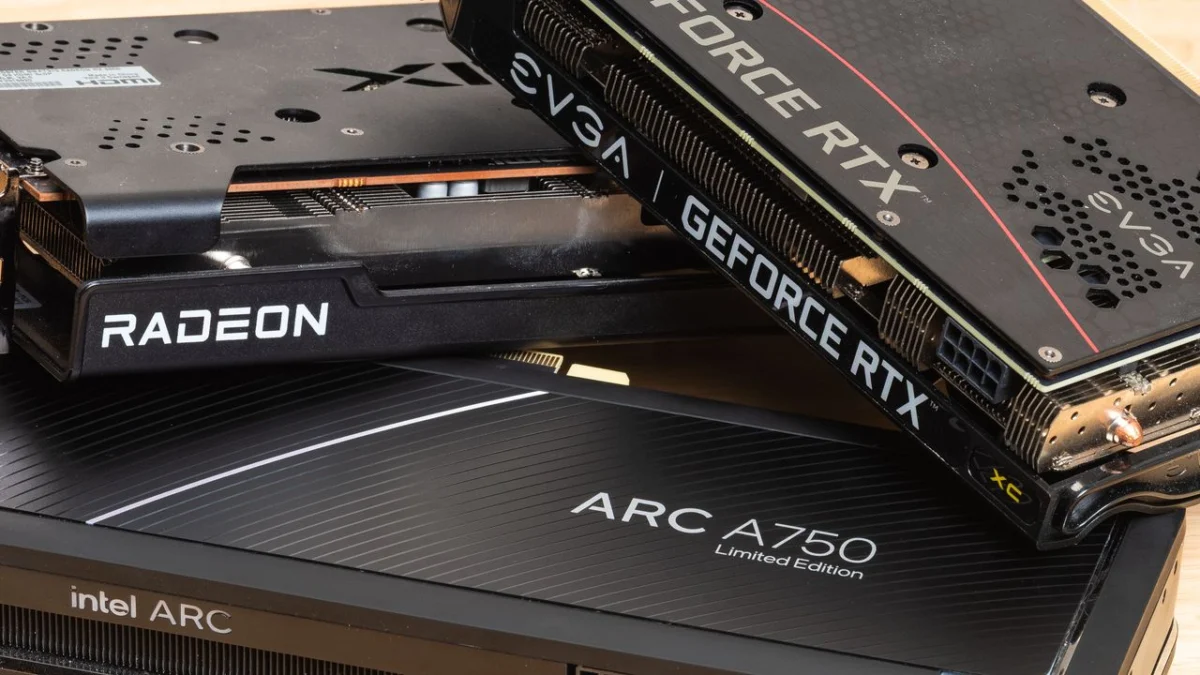
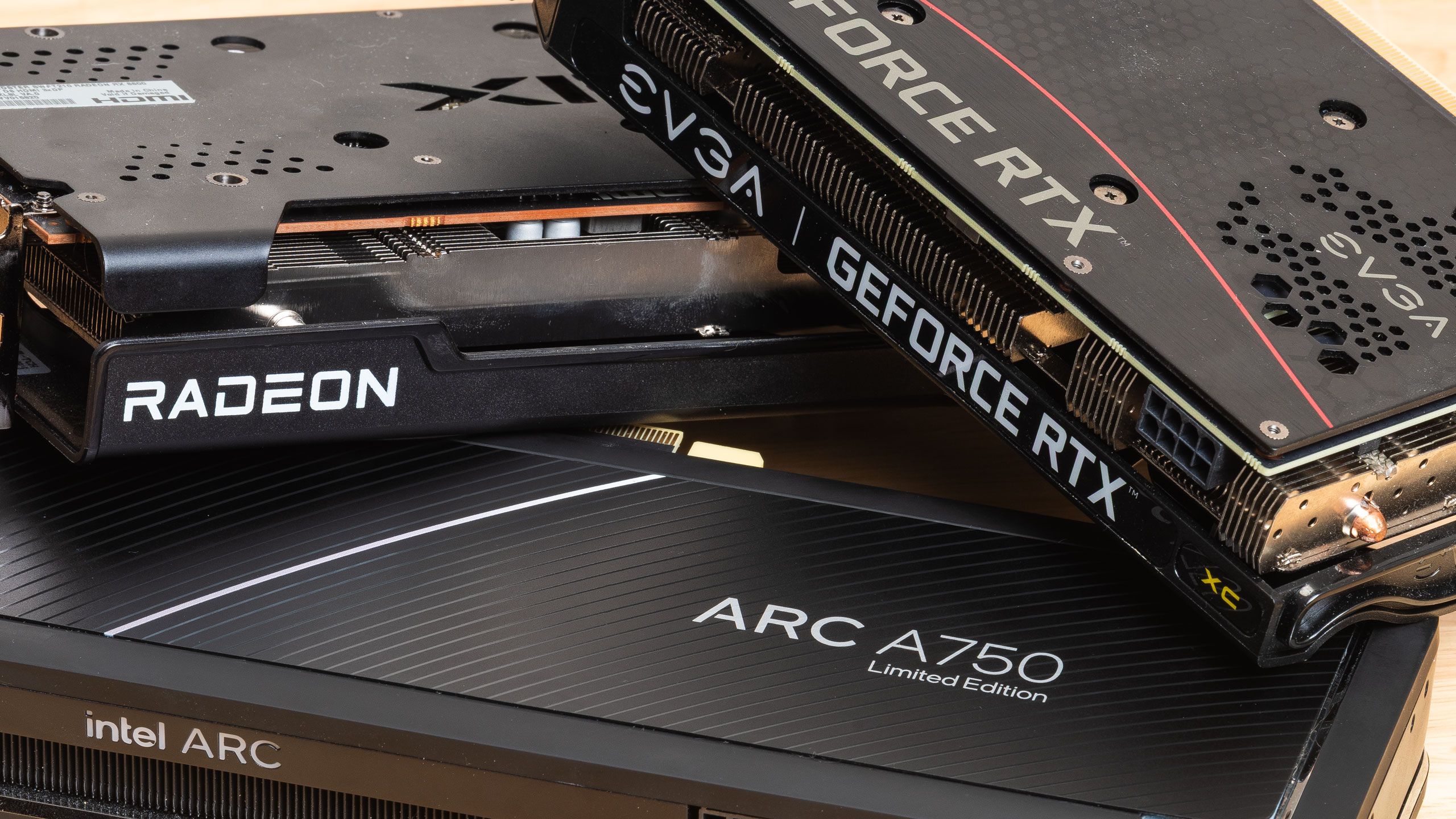
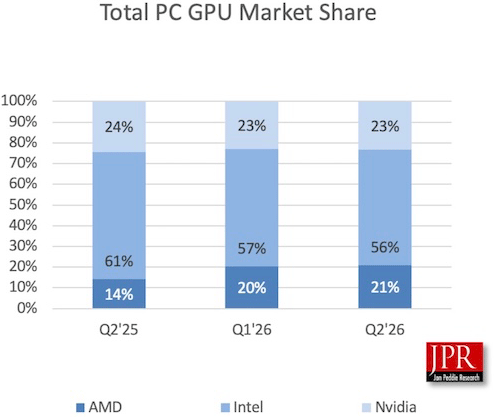
The market share distribution in the consumer GPU space remains a high-stakes battleground for the "Big Three": Intel, Nvidia, and AMD. While the discrete segment is largely a duopoly between Nvidia and AMD, the broader consumer graphics market—which includes integrated graphics—continues to be dominated by Intel.
Market Share Breakdown:
- Intel: Retains the lead with a 56% market share. Intel’s dominance remains anchored in its vast volume of consumer CPU shipments, where integrated graphics are the standard. Their ability to bundle graphics into the majority of mass-market PCs ensures their continued top-tier position.
- Nvidia: Holds 23% of the overall market. It is important to note that Nvidia’s figures are derived almost exclusively from discrete GPUs. Maintaining such a high percentage while having no presence in the integrated graphics market speaks to the immense, sustained demand for its GeForce series, which remains the gold standard for gaming and creative professional workflows.
- AMD: Currently at 21%, AMD has achieved a significant milestone, marking a seven-percentage-point increase from the same period last year. By leveraging its success in the CPU market and aggressively expanding its Radeon GPU footprint, AMD has successfully eroded the gap between itself and its competitors.
The estimated 20 million discrete GPUs shipped in Q2 represent a robust "attach rate," proving that even when component prices soar, the gamer and pro-sumer segments are willing to pay a premium for high-fidelity performance.
Official Responses and Expert Analysis
Dr. Jon Peddie, president of Jon Peddie Research, emphasized that the current environment is unique. "The second quarter is typically down compared to the previous quarter," Dr. Peddie noted. "This quarter, discrete GPUs increased by 12.2%, even while a global memory crisis sent component prices soaring, driven by a mix of supply-side positioning, artificial demand shocks, and localized market dynamics."
This "artificial demand shock" is a crucial piece of the puzzle. It suggests that current shipment numbers are not just a reflection of organic growth, but are also influenced by strategic stockpiling by distributors and a response to the lingering effects of component scarcity. When consumers fear that prices will continue to climb, they often accelerate their purchasing timeline, leading to a spike in shipments that might not be sustainable in the long term.
The Implications: What This Means for Consumers and Manufacturers
The implications of these findings are far-reaching for every participant in the PC ecosystem.
For the Gamer and Pro-sumer
The resilience of the discrete GPU market suggests that "gaming" is no longer just a hobby; it is a core pillar of modern digital life. Consumers are demonstrating a price-inelastic demand for high-end graphics, suggesting that for many, a powerful GPU is an essential tool for productivity, content creation, and entertainment. However, the trend of rising prices, driven by memory costs and supply constraints, means that the entry-level enthusiast is likely to be priced out of the market, potentially leading to a bifurcation where high-end hardware continues to sell, while the mid-range stagnates.
For Manufacturers (Intel, AMD, Nvidia)
For Intel, the challenge remains to maintain its volume lead while improving the performance-per-watt of its integrated graphics. For AMD and Nvidia, the focus has clearly shifted toward maximizing the value of the discrete GPU. Nvidia’s continued success despite a lack of integrated solutions highlights the strength of its software ecosystem (such as DLSS and its proprietary development tools), which creates a "moat" that is difficult for competitors to cross. AMD’s growth, however, signals that their strategy of aggressive pricing and integrated platform solutions is gaining significant traction.
The Long-Term Market Outlook
The shift toward mobile computing—evidenced by the 16.8% surge in notebook GPU shipments—is perhaps the most critical long-term takeaway. As professional and gaming workflows become increasingly portable, the demand for powerful, energy-efficient discrete mobile GPUs will likely dictate the next decade of hardware innovation. Desktop PCs, while still the preferred choice for enthusiasts, may become a niche segment of the market, while laptops become the primary engine of industry growth.
Conclusion: A Market in Transition
The Q2 2026 data from Jon Peddie Research serves as a reminder that the PC market is never static. While the headline figure of a 14.1% year-over-year increase in discrete GPU shipments is a sign of health, it is a health defined by complexity. We are witnessing a transition where the value of a system is increasingly defined by its graphics capabilities rather than its raw compute power.
As we look toward the remainder of the year, the industry must grapple with whether this momentum can be sustained. If the "memory crisis" and supply-side constraints continue to abate, we may see a more balanced market. However, if the current dynamics of high prices and supply chain volatility persist, the GPU market may continue to experience these "artificial" demand cycles, keeping the pressure on manufacturers to innovate while simultaneously managing the volatile expectations of a global consumer base.
For now, the story of 2026 is one of grit: in an era of uncertainty, the demand for high-performance graphics has proven to be one of the few constants in the tech industry. Whether this signifies a permanent change in consumer behavior or a temporary anomaly remains to be seen, but one thing is clear—the appetite for power is stronger than ever.