The landscape of artificial intelligence hardware underwent a seismic shift at the 2026 Hot Chips conference. In a presentation that blurred the lines between historical rivalries and corporate integration, Igor Arsovski, Nvidia’s Vice President of Hardware, took to the stage to unveil the future of AI inference. Standing before an industry audience, Arsovski did not present a new GPU architecture, but rather the Groq 3 LPX rack—rebranded and integrated as part of the expanding Nvidia silicon ecosystem.
This development marks the culmination of the $20 billion deal struck in December 2025, a transaction that effectively brought Groq’s high-speed inference technology under the Nvidia umbrella while simultaneously clearing the path for a fundamental shift in how large language models (LLMs) are served to the world.
The Main Facts: A New Paradigm for Inference
The core of the announcement is the LP30 chip, the engine powering the new LPX racks. Unlike traditional GPU designs that rely heavily on High Bandwidth Memory (HBM) to feed massive parallel compute arrays, the LP30 utilizes a massive, on-die SRAM architecture.

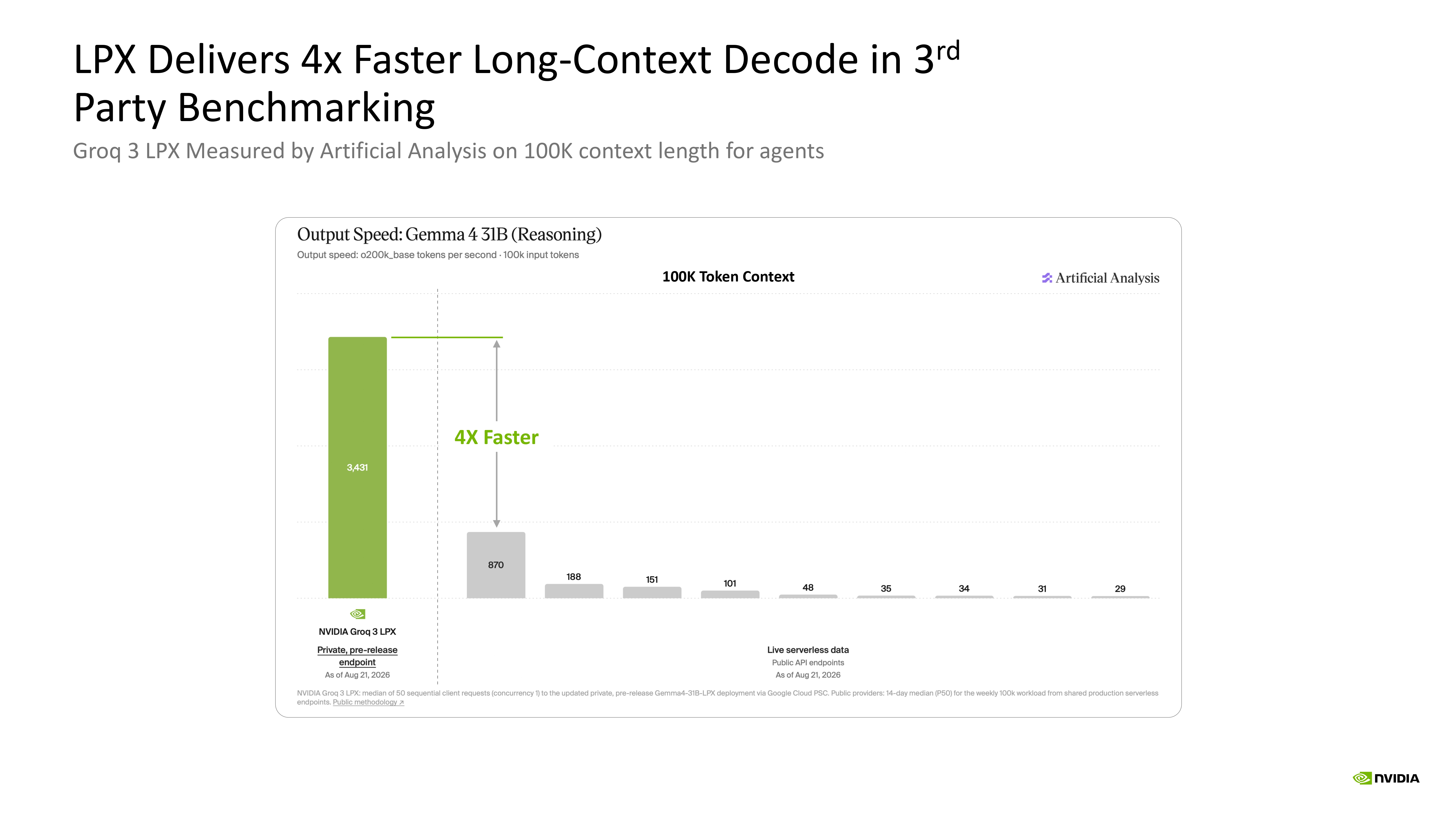
By eliminating the need to stream model weights from external HBM, the LP30 removes the primary bottleneck in single-token generation: memory-access latency. The result is unprecedented performance in LLM inference. According to third-party benchmarks conducted by Artificial Analysis, the LPX rack hit a staggering 3,431 output tokens per second on a 100K-context Gemma 4 31B reasoning workload. For comparison, the next-fastest public endpoint managed only 870 tokens per second.
Nvidia’s internal, self-reported figures were even more aggressive, citing 10,996 tokens per second on the same 31B model. While Arsovski was quick to characterize these as "self-reported" and emphasized the need for independent validation, the implication is clear: the era of the "LPU" (Language Processing Unit) as a specialized, high-velocity inference co-processor has arrived.
Chronology of a $20 Billion Transformation
The journey to this moment began in late 2025, when Nvidia moved to acquire the core assets and intellectual property of Groq. This was not a traditional merger; it was a complex, non-exclusive IP license agreement coupled with the mass hiring of Groq’s top-tier engineering talent, including founder Jonathan Ross and President Sunny Madra.

- December 2025: Nvidia confirms the $20 billion deal, effectively absorbing Groq’s engineering expertise to accelerate its inference roadmap.
- Early 2026: Political pressure mounts as U.S. Senators Elizabeth Warren and Richard Blumenthal express concern to the FTC, labeling the arrangement an acquisition "in all but name."
- GTC 2026: Nvidia officially removes the Rubin CPX accelerator from its roadmap, signaling a strategic pivot toward the LPX/LPU architecture for long-context inference.
- August 2026: Hot Chips 2026 serves as the formal unveiling of the integrated platform, with Nvidia presenting the LP30 as the definitive solution for real-time AI responsiveness.
Supporting Data: Why SRAM Changes the Game
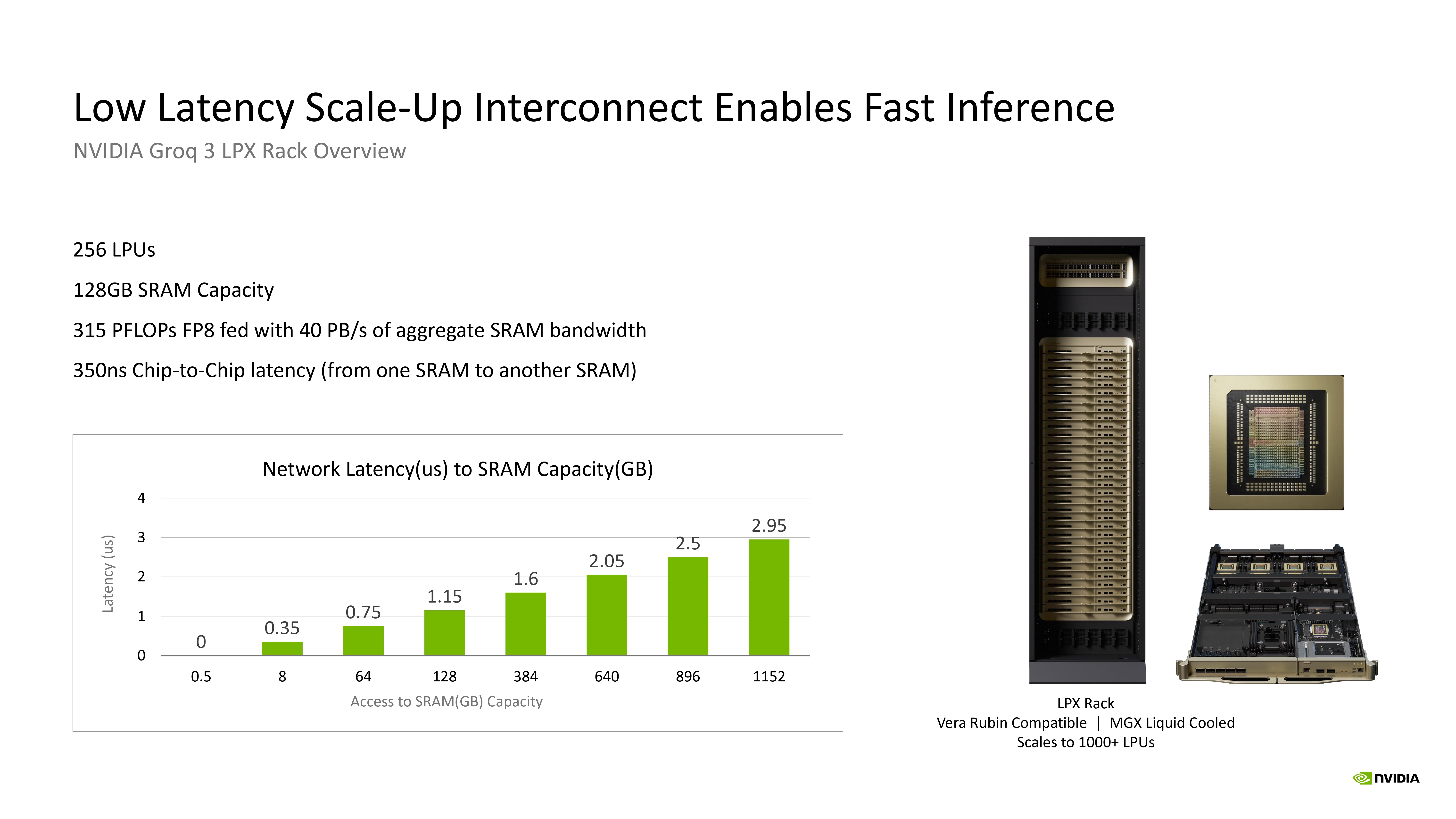
The technical departure from the GPU-standard model is profound. Each LP30 chip features approximately 500MB of on-die SRAM. When aggregated into a full LPX rack consisting of 256 chips, the system delivers 128GB of ultra-fast memory capable of 40 PB/s of aggregate bandwidth. This powers 315 PFLOPS of FP8 compute with a chip-to-chip latency of just 350 nanoseconds.
Deterministic Execution
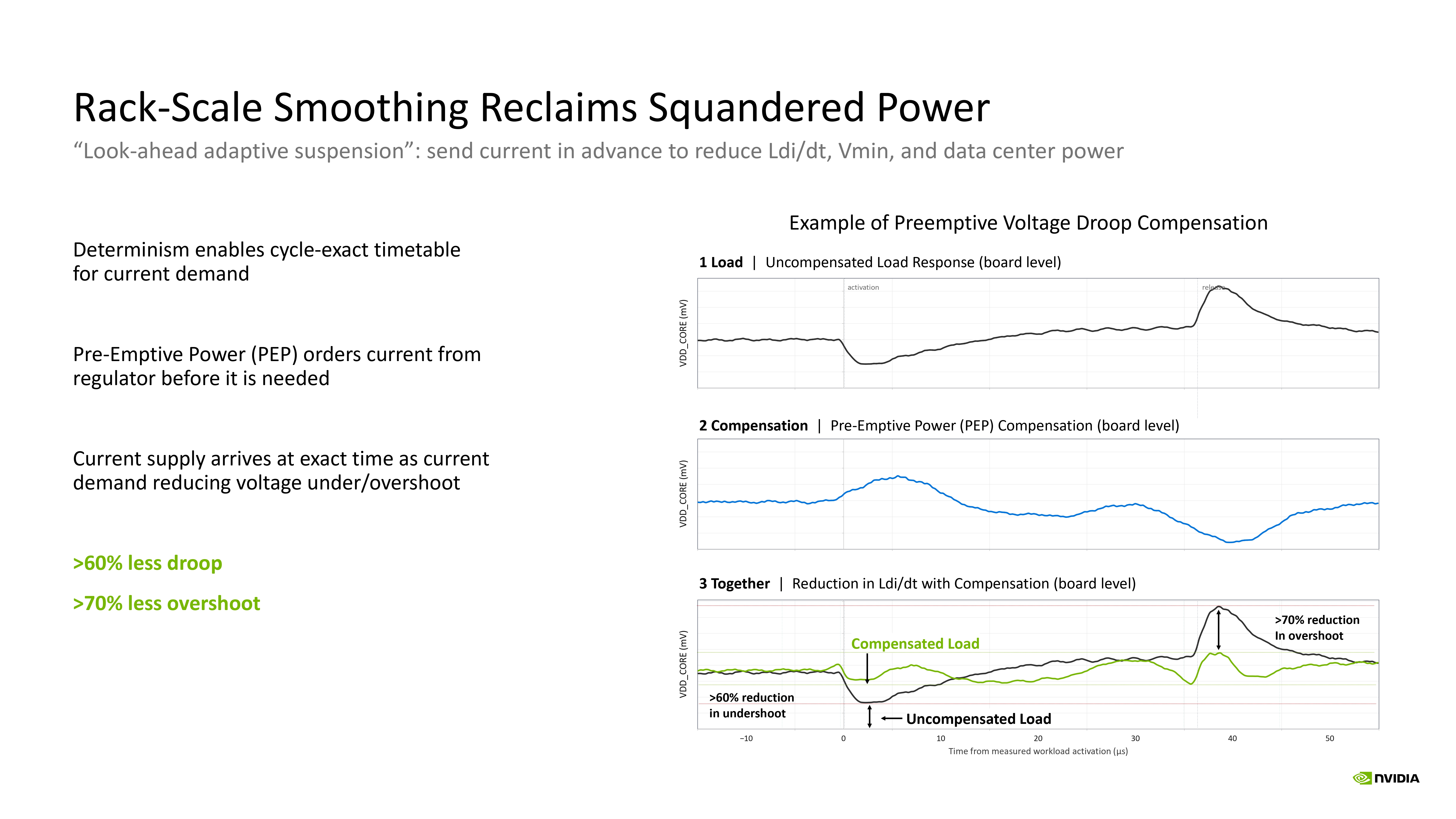
Perhaps the most innovative aspect of the design is the shift to a fully deterministic execution model. By dropping traditional features like caches, branch prediction, and out-of-order execution, the LP30’s compiler schedules operations at clock-cycle granularity.
This determinism allows for two massive efficiency gains:
- Power Management: The system can predict power draw cycle-by-cycle, reducing voltage droop by 60% and overshoot by 70%.
- Thermal Equalization: Instead of throttling the entire chip when a single tile hits a thermal limit, the compiler manages per-block scheduling, resulting in a 10% to 11% performance uplift under the same thermal envelope.
Scaling and Synchronization
Across the rack, Nvidia utilizes a "plesiosynchronous" network. Each chip acts as both a processor and a router, removing the need for adaptive routing or congestion sensing. Clock drift between chips is compensated at the hardware link level, creating the illusion of a single, massive virtual clock.
Official Responses and Regulatory Scrutiny
The strategic absorption of Groq has not gone unnoticed by regulators. The letter from Senators Warren and Blumenthal to the FTC highlighted the monopolistic risks of Nvidia essentially "buying out" its most significant challenger in the inference space.
Nvidia’s response has remained largely focused on technological synergy. During the Hot Chips presentation, Arsovski framed the integration as a "pinch me moment" for the engineering teams, emphasizing that the focus is on performance and the democratization of high-speed AI. When pressed during the Q&A session regarding hardware reliability and the "blast radius" of a failed chip in a 1,000-LPU cluster, Arsovski remained pragmatic, noting that users would manage failures through standard checkpointing or hardware reconfiguration, much as they do with existing GPU clusters.
Implications: The Future of AI Infrastructure
The introduction of the LPX rack fundamentally alters the role of the GPU in the data center. Nvidia is no longer positioning its hardware as a monolithic "do-it-all" solution. Instead, the company is promoting a disaggregated, multi-chip strategy:
- The Prefill Phase: The heavy, compute-intensive prefill work will continue to be handled by the Vera Rubin NVL72 GPU platforms, which are optimized for building large KV caches.
- The Decode Phase: The LPU (Groq 3 LPX) will take over for the actual output generation, providing the low-latency "real-time" experience that users now demand.
This division of labor, supported by the Dynamo runtime and an LPU-specific extension to CUDA, offers a three-to-five-times performance increase over a standalone GPU-only approach for massive models, such as those with two trillion parameters and 400K-token context windows.
Competition and Market Realities
The competition remains fierce. Cerebras, also presenting at Hot Chips, unveiled its CS4 wafer-scale system. Chief Architect Jean-Philippe Fricker asserted that the CS4 runs 30 times faster than traditional GPUs and boasts 43 PB/s of memory bandwidth. Cerebras is also adopting the "split" strategy, partnering with AMD to pair Helios GPUs for prefill with their wafer-scale engines for decode.
The Bottom Line
Nvidia’s move to integrate Groq’s technology serves as an admission that the traditional GPU architecture, while unparalleled for training, faces diminishing returns in the latency-sensitive world of real-time inference. By adopting the SRAM-heavy, deterministic design of the LPU, Nvidia has effectively "future-proofed" its roadmap against the rising threat of wafer-scale competitors.
The industry now stands at a crossroads. As AI models grow to trillions of parameters, the ability to store weights in local, high-speed memory—rather than fetching them from external banks—will likely become the defining metric for success. With the LPX rack, Nvidia has secured its dominance not just by building better GPUs, but by recognizing when it was time to change the fundamental architecture of the chip itself. Whether this will draw a definitive line under the FTC’s interest remains the primary uncertainty in an otherwise clear, high-performance future.