Nila Kartika Wati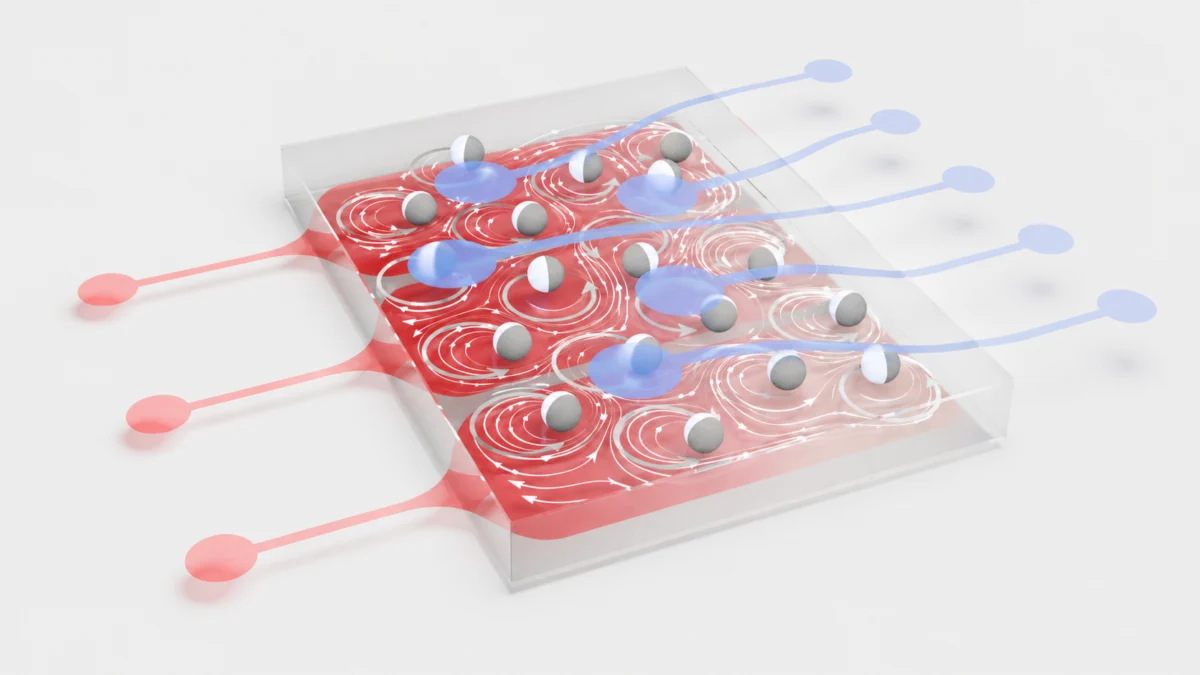
In a groundbreaking development that blurs the lines between fluid dynamics and computational science, researchers from the Universities of Konstanz and Stuttgart have successfully constructed a physical computer using 400 microscopic particles suspended in a liquid medium. This unconventional approach to processing, detailed in the journal Communications AI & Computing, represents a significant step toward "reservoir computing"—a paradigm that moves away from traditional silicon-based logic gates toward systems that exploit the complex, chaotic physics of natural materials to perform data processing.
The experimental setup, while still in its nascent stages, has demonstrated the ability to forecast chaotic signals and detect subtle anomalies in datasets, albeit with performance metrics that highlight both the potential and the current limitations of liquid-based computation.
The Mechanics of the Colloidal Computer
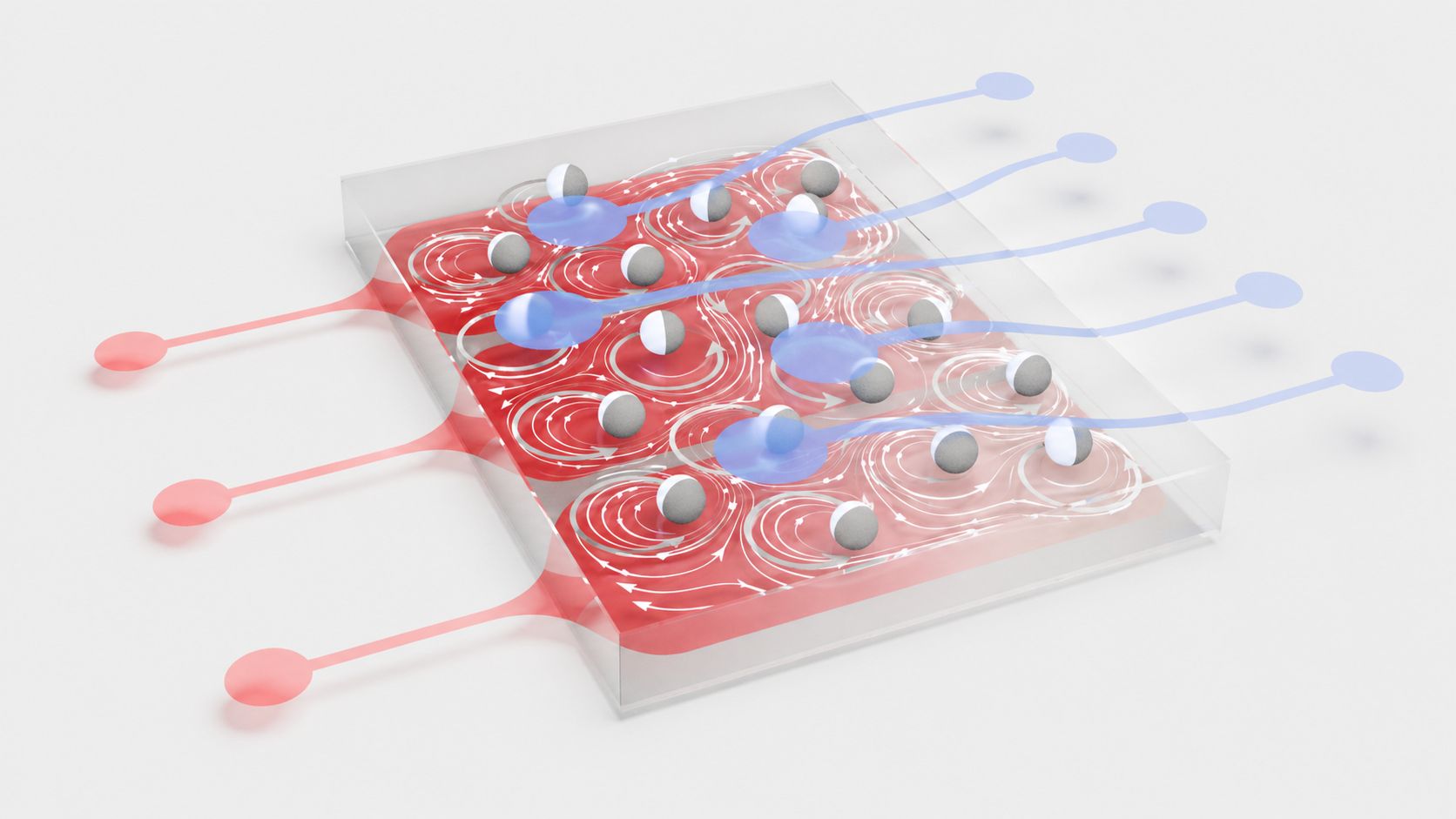
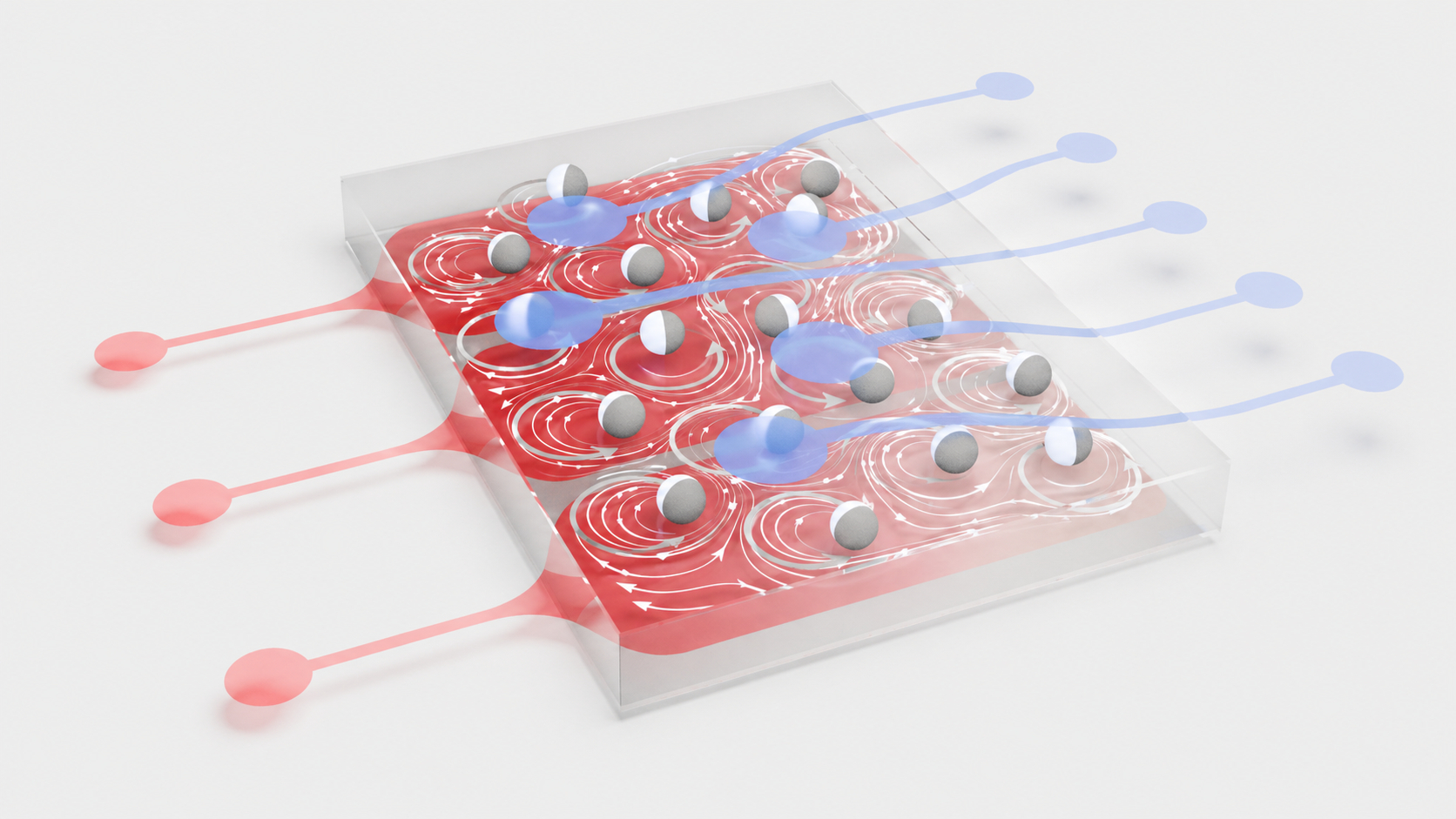
At the heart of this experiment lies an intricate, microscopic ballet. The "processor" consists of 400 silica spheres, each measuring just 3 micrometers in radius. To facilitate manipulation, each sphere is capped with an 80nm layer of carbon. These particles are suspended in a water-lutidine mixture maintained at a precise 28°C.
The computation is driven by a 532nm laser. By heating the carbon cap of each sphere, the laser exerts force, nudging the particle toward a designated target coordinate within the liquid. However, due to the inherent latency between imaging the particle’s location and the corrective repositioning of the beam, the particles rarely hit their targets perfectly. Instead, they settle into a persistent, small-scale orbit.
It is within these tiny, hydrodynamic interactions that the magic happens. As the spheres orbit, they create flow fields in the surrounding liquid that couple with the movements of neighboring particles. By adjusting the lattice spacing—which dictates the strength of these hydrodynamic interactions—and the damping thresholds of the individual oscillators, the researchers can effectively program the system to respond to external inputs. When data is introduced as a series of displacements to the target coordinates, the collective "chaos" of the system transforms that input into a predictable output.
A Chronology of the Research
The path to this discovery is part of a broader, decade-long shift in material science toward reservoir computing, where the physical state of a system acts as a high-dimensional mapping space.
- Early Conceptualization: The researchers aimed to move away from the energy-intensive and rigid structures of traditional transistors, seeking to leverage the "physics of the substrate" to perform computations.
- System Development: Over the past few years, the team refined the use of optical tweezers and acousto-optical deflectors, allowing for the rapid, high-frequency manipulation of hundreds of particles simultaneously.
- The Breakthrough: By late 2025, the team successfully demonstrated that the collective movement of 400 particles could be read to interpret complex temporal patterns.
- Publication: The formal findings, published in Communications AI & Computing (2026), codified the performance metrics of the system, marking the transition from theoretical possibility to experimental reality.
Performance Metrics and Technical Challenges
In the world of computing, results are measured in accuracy and efficiency. When tasked with predicting the Mackey-Glass series—a standard benchmark for chaotic systems—the colloidal array achieved a normalized root-mean-squared error (NRMSE) of 0.1.
While this demonstrates that the system is indeed "thinking," it is not yet competing with the gold standards of physical reservoir computing. Memristor-based systems, which utilize variable-resistance devices to mimic synapses, currently achieve NRMSE scores of 0.01 or lower. The research team candidly acknowledges this tenfold accuracy gap.
However, the team points to a distinct advantage: the elimination of time-multiplexing. Most existing physical reservoirs (photonic, spintronic, or memristive) rely on time-multiplexing to create enough virtual "nodes" to process information. The Konstanz-Stuttgart system, by using 400 distinct, physical oscillators, processes information in a parallel, spatial domain. This could theoretically allow for massive scaling if the physical hardware is expanded, potentially bypassing the clock-speed limitations inherent in time-multiplexed devices.
Furthermore, the system showed remarkable robustness. Even when the input reached only 20% of the oscillators, or when individual particles clumped together or failed to respond to the laser, the system’s overall output remained remarkably stable—a trait that could lead to highly fault-tolerant computing architectures.
Expert Insights and Official Responses
Clemens Bechinger, a professor of soft condensed matter at the University of Konstanz and a lead researcher on the project, emphasized that the goal is not to force the liquid to behave like a standard CPU, but to allow it to be itself.
"The dynamics don’t need to be fully understood in every minute detail; they only need to respond in a reliable, repeatable manner," Bechinger stated during the university’s announcement. "Once you have that reliability, the physics of the material can be directly harnessed for computation. We aren’t building a computer; we are conditioning a physical system to solve problems."
This "physics-first" approach is catching on globally. A separate team of scientists recently announced the synchronization of 105,000 nano-oscillators in just 45 nanoseconds, suggesting a rapid acceleration in the development of non-traditional, hardware-accelerated AI platforms.
Implications: The Future of Reservoir Computing
The implications of this research extend far beyond the laboratory bench. While the current setup—requiring high-end microscopy, temperature-controlled quartz cells, and a 532nm laser—is far from a consumer-ready product, it serves as a proof-of-concept for a new class of "soft" computers.
1. Energy Efficiency
One of the primary motivations for this research is the unsustainable energy cost of modern AI. Traditional GPUs and TPUs rely on moving massive amounts of electrons through billions of transistors. In contrast, the colloidal reservoir uses the inherent fluid dynamics of the environment to perform the heavy lifting of matrix multiplication. If the actuation can be moved from power-hungry lasers to simpler, electrode-driven colloidal movement, the energy-per-operation cost could drop by orders of magnitude.
2. Anomaly Detection
The system’s performance in anomaly detection is particularly promising. In the study, it successfully identified anomalies that left the signal’s mean, variance, and autocorrelation untouched—tasks that are notoriously difficult for standard statistical models. This suggests that liquid-state computers could be uniquely suited for cybersecurity, predictive maintenance, and real-time monitoring where subtle, non-obvious patterns hold the key to identifying threats.
3. Challenges to Scalability
Critics argue that the reliance on complex optical setups limits the immediate commercial viability. However, the researchers are already looking toward the next phase: simplifying the actuation. By replacing laser-driven heat with electric fields, they believe they can shrink the entire apparatus from a laboratory-sized experiment to a chip-scale device.
Conclusion: A New Paradigm
The colloidal computer created at the Universities of Konstanz and Stuttgart is a reminder that computing is not inherently limited to the binary logic of semiconductors. By tapping into the chaotic, coupled, and highly sensitive world of soft condensed matter, scientists are beginning to explore what it means to "compute" using the laws of nature themselves.
While we are unlikely to see a liquid-filled laptop on store shelves in the near future, the path is clear. As the gap in accuracy between these physical reservoirs and traditional silicon devices closes, we may find that the most efficient way to process the chaos of the modern world is to use a computer that is, itself, inherently chaotic. As the research matures, it will undoubtedly contribute to the mosaic of next-generation hardware, potentially serving as a specialized co-processor for the complex, pattern-matching tasks that current digital architectures struggle to solve.


 Ammar Sabilarrohman
 Reynand Wu