
 Asro
Asro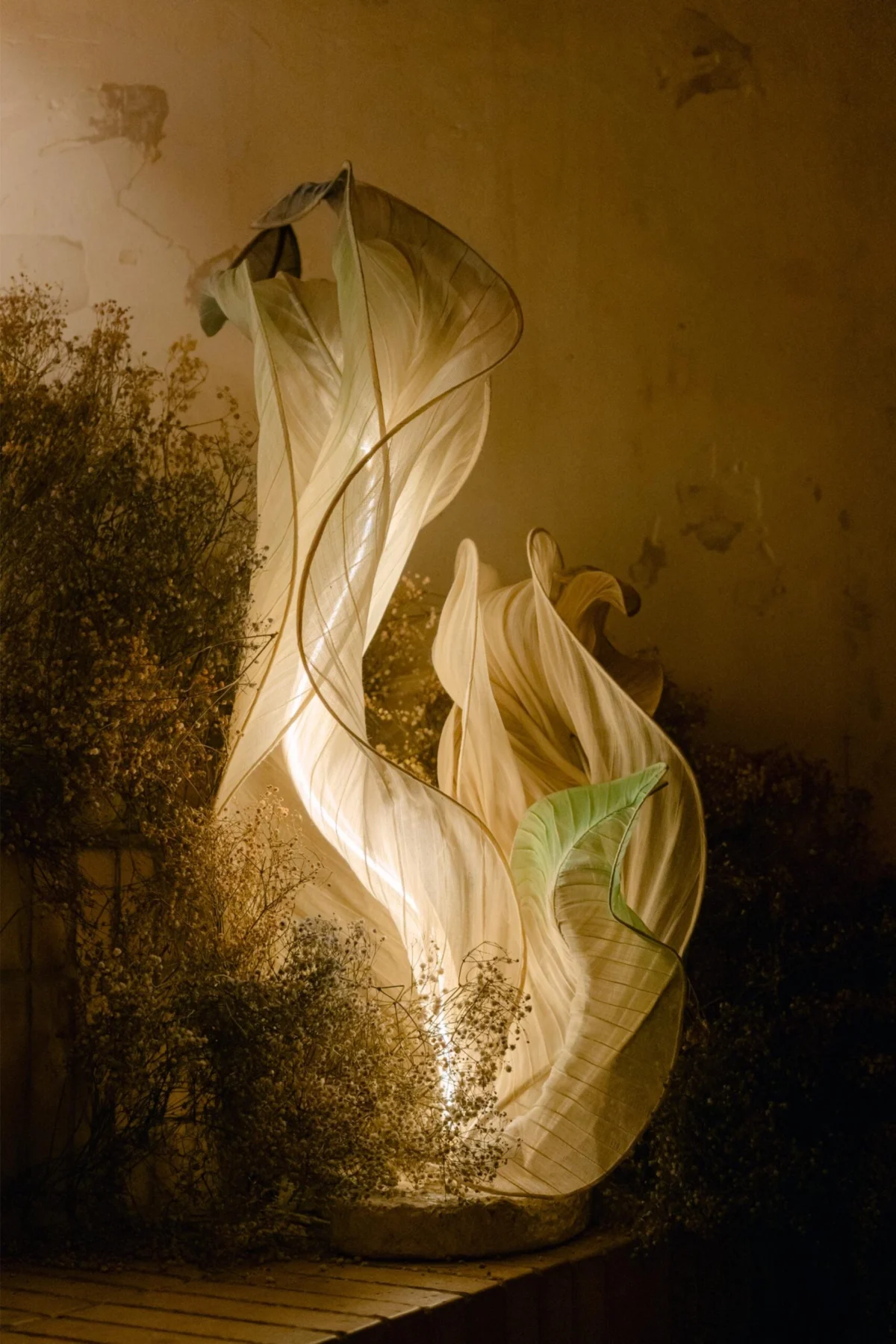
In the quiet, light-drenched corners of Milanese design studios, a silent revolution is taking place—one that breathes, pulses, and glows. Milan-based Filipina designer Mirei Monticelli is redefining the intersection of industrial lighting and fine art, crafting biomorphic fixtures that occupy the nebulous space between inanimate objects and living organisms. Her works do not merely occupy a room; they inhabit it, swaying with a gestural grace that feels inherently alive. By merging the ancestral heritage of Philippine fiber art with the avant-garde sensibilities of European design, Monticelli has created a new language of illumination, one that honors the human hand as much as it does the natural world.
The Architecture of Light: Main Facts and Aesthetic Philosophy
At the core of Monticelli’s practice lies a commitment to material innovation and sculptural form. Her lamps are characterized by undulating silhouettes—forms that rise, fold, and recede with a fluidity reminiscent of deep-sea creatures or the soft contours of the human body. When illuminated from within, these structures cast a warm, diffused glow, transforming the sheer textiles into ethereal membranes that soften the harsh geometry of modern interiors.

These pieces are crafted using Banaca, a unique material developed by Monticelli. A hybrid of modern design application and traditional weaving, Banaca is derived from Abacá—a species of banana plant native to the Philippines, prized for its exceptional tensile strength and silken texture. By utilizing this sustainable, biodegradable fiber, Monticelli creates lighting that is environmentally conscious yet visually arresting. Her design process is less about manufacturing and more about "sculpting with light," where the material’s structural integrity allows for bold, dramatic volumes that would be impossible with traditional glass or metal.
A Legacy of Labor: The Chronology of Craft
To understand the soul of a Monticelli lamp, one must look back centuries to the verdant landscapes of the Bicol province in the Philippines. The history of Abacá is a history of communal effort, a timeline that stretches from the wild, towering stalks of the plant to the sophisticated looms of the modern atelier.

The Harvest and the Weave
The production of Banaca begins with the labor-intensive extraction of fibers from the Abacá stalks. This is a task that has defined the rhythm of life in Bicol for generations. The stalks are stripped, layered, and dried under the tropical sun, a process that requires both patience and precision. Once dried, the fibers are knotted into long, continuous threads before being hand-woven into textiles.
The Evolution of a Partnership
Monticelli’s journey began by bridging the gap between her life in Milan and her roots in the Philippines. Her studio does not merely "source" materials; it fosters a symbiotic relationship with local weavers. Over several years, Monticelli worked closely with these artisans to refine the weave of the fabric, adapting it for the high-performance needs of modern lighting. This collaboration has transformed a heritage craft into a contemporary medium, ensuring that the "human rhythm" of the weaving process remains the heartbeat of every finished fixture.

The Fashion Influence
The final stage of the chronology is the assembly in the studio, where Monticelli applies techniques borrowed from the world of high fashion. Influenced by her mother—a professional fashion designer—Monticelli approaches her lamps as if she were tailoring a garment. She uses draping, volume-building, and intricate pleating to give the fabric its dynamic form. This "garment construction" approach ensures that each lamp possesses a bodily essence, a sense of presence that resonates with the viewer on a visceral level.
Supporting Data: The Sustainability and Structural Resilience of Abacá
The choice of Abacá is not merely an aesthetic one; it is rooted in the material’s superior physical properties. Abacá fiber is one of the strongest natural fibers in the world, often referred to as "Manila hemp." Its inherent resistance to saltwater damage and its high tensile strength make it a remarkably durable choice for sculptural lighting.

- Biodegradability: As global design shifts toward a circular economy, the use of biodegradable, renewable materials like Abacá is increasingly critical. The fiber decomposes without leaving synthetic residues, aligning with the industry’s push for sustainable luxury.
- Light Diffusion: The weave density of Banaca can be calibrated to control light transmission. This allows Monticelli to create gradients of intensity, where the light appears to bleed through the fabric, mimicking the way sunlight filters through leaves or skin.
- The "Human" Metric: While industrial materials are uniform, Banaca bears the subtle irregularities of the weaver’s hand. Data collected from the studio’s output suggests that these micro-variations are precisely what give the lamps their "alive" quality. When light hits a surface that is slightly uneven, it creates a play of shadows and highlights that is impossible to replicate with machine-made materials.
Official Responses and Collaborative Impact
Monticelli’s work has garnered significant attention from the global design community, most notably during her recent exhibition at Milan Design Week. Her installation, Pleasure Garden, served as a masterclass in atmospheric design. By clustering her biomorphic lamps, she created a landscape of light that felt less like an exhibition and more like an immersive, otherworldly ecosystem.
Interior designers and architects have been quick to adopt her work for high-end hospitality and residential projects. When asked about the importance of her collaborative process, Monticelli noted:

"We’ve developed the material together over time, so it’s not just sourcing, but a relationship. Human rhythm is what gives the material its character, and it’s also why every piece feels alive when it’s lit."
Her partners describe the integration of her work into architectural spaces as a "softening" of the built environment. By introducing elements that feel organic and hand-wrought, architects are able to bridge the gap between cold, modern architecture and the human need for sensory warmth.

Implications: The Future of Biomorphic Design
The implications of Monticelli’s work extend far beyond the realm of interior lighting. She represents a growing cohort of designers who are looking toward traditional indigenous crafts to solve modern environmental and aesthetic challenges.
Bridging Cultures
Monticelli’s success highlights the potential for "design diplomacy." By taking a material deeply ingrained in Philippine culture and presenting it on the world stage in Milan, she is fostering a deeper appreciation for Southeast Asian artistry. This elevates the status of the local weaver from a supplier to a vital creative contributor, challenging the traditional hierarchies of the global design market.

A New Sensory Standard
The success of her "living" lamps suggests a shift in consumer preference. As digital screens and artificial interfaces dominate our daily lives, there is an increasing demand for physical objects that possess "life." Monticelli’s work provides a sensory counterpoint to the sterile perfection of modern technology. Her lamps are not static; they are responsive to the space around them, changing their character as the light moves throughout the day.
The Path Forward
Looking ahead, Monticelli’s studio continues to explore the limits of the Banaca textile. Experiments with new weaving patterns and structural reinforcements are already underway, hinting at larger, more ambitious installations. As she continues to collaborate with architectural studios and hospitality partners, the "living" quality of her work is set to transform even more spaces, proving that the future of design may well lie in the preservation and reimagination of the past.

In a world that is increasingly mass-produced, Mirei Monticelli’s creations stand as a testament to the power of the human hand. They remind us that light is not just a utility—it is an experience, a dance, and a connection between the weaver in the Bicol province, the designer in Milan, and the observer in their own home. Through the humble Abacá fiber, she has captured the ephemeral, proving that when we imbue our spaces with objects that carry the rhythm of life, we make our own environments a little more human.


 Dwi Wanna
 Lina Irawan




