In the bustling contemporary art scene, where noise and confrontation often dominate the visual dialogue, Seoul-based artist Guimi You offers a radical alternative: the power of stillness. Her latest body of work, currently on view in New York City, captures the ethereal intersection of memory, desire, and the passage of time. Through a mastery of oil on linen, You invites viewers into a haze-filled, atmospheric world where the ordinary becomes profound, and the act of beginning again is rendered with both somber reflection and radiant hope.
The Art of Introspection: An Overview
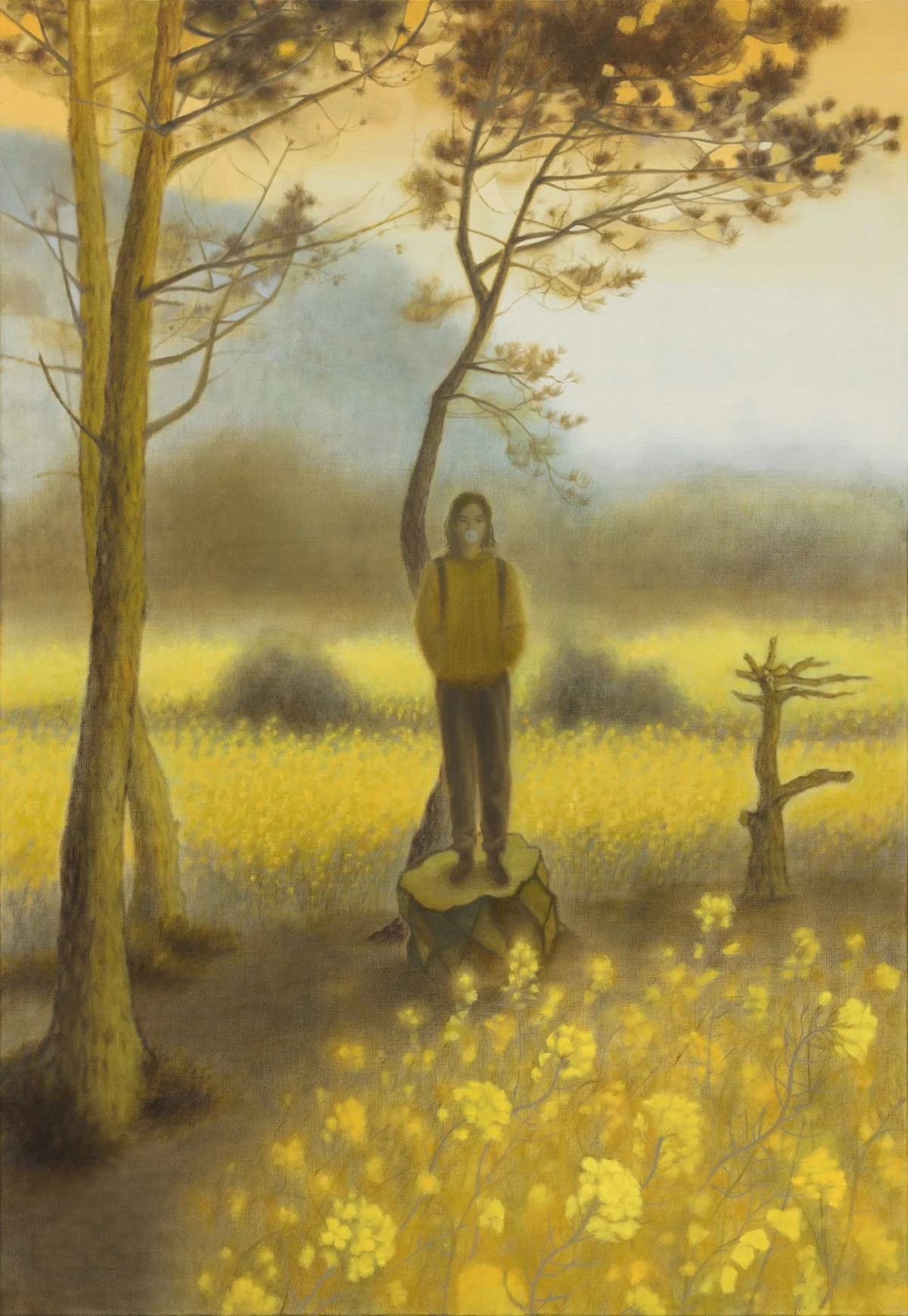
Guimi You’s canvases act as portals to a quiet, interior existence. Whether depicting a woman wandering through a rain-drenched park or a solitary figure engaged in the tactile labor of pottery, her compositions are marked by a distinct wistfulness. Her style is a deliberate synthesis, merging the transparency and evocative nature of East Asian pictorial traditions with the foundational tenets of Western Romanticism and Surrealism.

In her world, the landscape is not merely a background for escapism; it is a psychological container. By obscuring the faces of her subjects—often casting them in shadow or having them look away—You shifts the viewer’s focus from individual portraiture to the universal experience of introspection. She posits that the space surrounding the figure—the light, the objects, and the architectural portals—is just as vital to our understanding of human subjectivity as the figures themselves.
Chronology of a Creative Evolution
To understand the depth of You’s current exhibition, one must look at the trajectory of her artistic practice. Her journey has been one of gradual refinement, moving away from explicit narrative toward a more nuanced, atmospheric visual language.

- Formative Years: Early in her career, You experimented with various mediums, but it was in the tradition of still life and landscape that she found her voice. Her initial focus was on the mechanics of light—how it behaves when filtering through a window or reflecting off a stream.
- The Pivot Toward Atmosphere (2020–2024): During this period, You began to emphasize the "haze" that now defines her work. This period saw her move toward a more muted, dream-like color palette, prioritizing emotional resonance over photographic accuracy.
- The "When the Sun Shines Again" Era (2025–2026): Her most recent works, including pieces like Park in the Drizzle (2026) and Painting, Again (2026), represent a consolidation of her themes. These works explicitly grapple with the concept of renewal. Following a period of hiatus or creative reassessment, You has turned her attention to the courage required to return to the easel, the wheel, or the open road.
Supporting Data: The Anatomy of the Exhibition
The current exhibition, When the Sun Shines Again, hosted at the prestigious Lehmann Maupin gallery in New York, serves as a comprehensive study of the artist’s recent output. The collection is notable for its scale and its technical consistency.
Featured Works and Technical Specifications
| Title | Year | Dimensions (inches) | Primary Medium |
|---|---|---|---|
| Park in the Drizzle | 2026 | 46 x 36 | Oil on linen |
| Painting, Again | 2026 | 65 x 81.8 | Oil on linen |
| Spring Walk | 2026 | 65 x 81.8 | Oil on linen |
| Pause | 2025 | 65 x 80 | Oil on linen |
| The Shape of Silence | 2026 | 81.8 x 65 | Oil on linen |
| Deep in the Yellow | 2025 | 63.8 x 44.1 | Oil on linen |
These works share a common thread: the recurring image of sunlight. In Let the Sunlight In, the light is treated almost as a physical presence, a tangible force that breathes life into the inanimate objects of the still life. The technical precision—the way cerulean shadows interact with magenta accents in Spring Walk—demonstrates You’s rigorous attention to color theory and atmospheric perspective.

Official Perspectives: The Philosophy of Renewal
The gallery representing You, Lehmann Maupin, has been instrumental in framing the narrative of this exhibition. In their official statement, the gallery notes that the works are "conceived as a tribute to those who have returned to creating after time away." This perspective provides a crucial key to interpreting the paintings.
The gallery emphasizes that You does not view "beginning again" as a simple act of restarting, but as a complex psychological process. By utilizing the metaphor of sunlight—a perennial symbol of clarity and renewal—You avoids the trap of sentimentality. Instead, she presents the struggle of returning to creative work as a sober, courageous act. The "somberness tinged with hope" noted in her work is, according to the gallery, a direct reflection of the artist’s own philosophical inquiry into how we "situate ourselves within the world" after experiencing shifts in perspective.

The Implications of "Quietude" in Contemporary Art
The success and critical reception of Guimi You’s work carry broader implications for the contemporary art market and cultural discourse.
The Rejection of Hyper-Stimulation
In an era dominated by digital saturation, the "fuzziness" of You’s paintings acts as a visual balm. By refusing to provide sharp, immediate, or easily consumable imagery, she demands a slower, more deliberate form of engagement from the viewer. This is not mere nostalgia; it is a tactical choice to carve out a space for meditation in a public gallery setting.

The Landscape as Subjectivity
You’s work challenges the historical Western notion of the landscape as an objective, external entity. By blending the landscape with personal memory and dream-like elements, she aligns herself with a tradition of artists who use nature as a mirror for the human psyche. Her work suggests that our physical environments are inextricably linked to our emotional states. The "park" or "meadow" in her paintings is never just a geographic location; it is an emotional state—a place of waiting, of thinking, or of transition.
The Courage of the Creative Return
Perhaps the most poignant implication of this exhibition is the acknowledgment of the "artist’s block" or the "creative hiatus." By making the act of returning to painting a central theme, You provides a rare, honest look at the cycles of productivity. This resonates not only with other artists but with a general audience that is increasingly concerned with mental health, the pressures of professional success, and the necessity of reevaluating one’s needs and desires as they navigate life’s inevitable transitions.

Conclusion: An Enduring Light
As When the Sun Shines Again continues its run in New York City through August 14, it remains a vital touchstone for those seeking depth in their visual experience. Guimi You’s work does not shout for attention; it waits patiently, rewarding the careful observer with layers of meaning and a profound sense of peace.
Through her masterful use of light, shadow, and silence, You invites us to look at our own lives—our memories, our pauses, and our new beginnings—with the same grace she affords her anonymous subjects. She proves that even in the blur of memory or the haze of the atmosphere, there is always the potential for clarity, provided we are willing to stand in the light and see what it reveals.

Her work stands as a testament to the idea that art, at its best, is not merely a reflection of the world, but a space for us to find ourselves within it. Whether through the gentle brushwork of a spring scene or the quiet complexity of a still life, Guimi You remains one of the most compelling voices in contemporary painting, reminding us that there is always time to start again, and that when the sun shines, it is never too late to begin anew.