

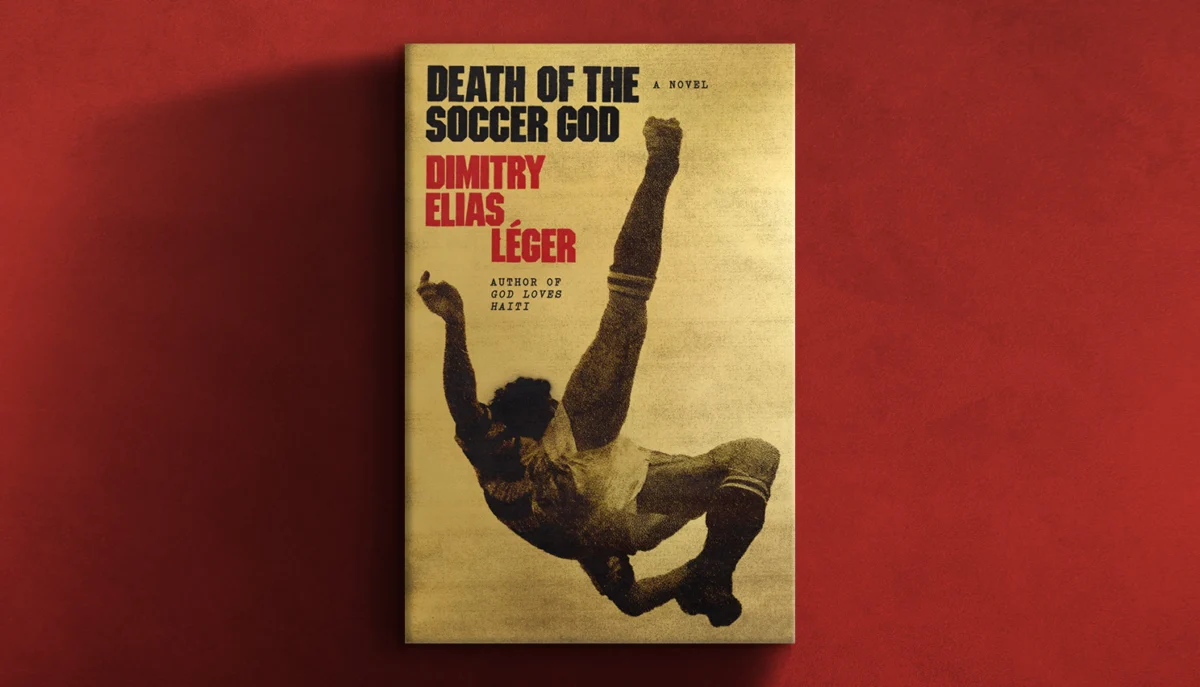
In the landscape of contemporary Caribbean literature, few voices capture the intersection of national identity, global ambition, and the visceral human cost of success as sharply as Dimitry Elias Léger. His latest novel, Death of the Soccer God, serves as a complex tapestry woven from the threads of sporting glory, political machination, and the enduring search for spiritual grounding.
In a recent installment of the Poured Over podcast, hosted by Isabelle McConville, Léger provided an intimate look into the genesis of this ambitious narrative. The novel traces the life of a Haitian soccer prodigy—a young man thrust from the dusty pitches of his homeland into the high-stakes, neon-lit arenas of international fame. As the protagonist navigates the precarious currents of celebrity, love, and the volatile political climate of Haiti, the reader is forced to confront the price of excellence.
Main Facts: The Narrative Core
Death of the Soccer God is not merely a sports novel; it is a meditation on what it means to be a modern icon. The protagonist, whose rapid ascension mirrors the meteoric rise of real-world football legends, finds his identity fragmented by the competing pressures of his public persona and his private morality.
Léger’s prose examines the “Soccer God” not as a static hero, but as a vessel for his nation’s hopes and a target for its political anxieties. The book poses a fundamental question: When a country looks to an individual to embody its salvation, what happens when that individual falters? The narrative moves fluidly across continents, bridging the gap between the insular world of professional sports and the expansive, often brutal, realities of global politics.
Chronology: From Port-au-Prince to the World Stage
The story follows a classic, albeit tragic, arc of a hero’s journey. The timeline begins in the embryonic stages of the protagonist’s career, where the focus is on discipline, the purity of the sport, and the early recognition of his unique talent.
- The Formative Years: Set against the backdrop of Haiti, the early chapters focus on the rigorous, often grueling, training that creates a prodigy. Here, the soccer field is a sanctuary, a place where the rules are clear and the rewards are tangible.
- The Transatlantic Shift: As the prodigy gains traction, the setting shifts to the European stage. This transition serves as a catalyst for the loss of innocence. The protagonist is introduced to the mechanisms of international fame, the commercialization of talent, and the loneliness of the expatriate life.
- The Political Entanglement: The novel’s middle act sees the protagonist’s rise intertwined with political figures back in Haiti. As his fame grows, he becomes a tool for those seeking to leverage his popularity for nationalistic or personal gain.
- The Downfall: The resolution of the novel is characterized by the swift and often cruel erasure of the “God” status. The descent is as rapid as the ascent, leading to a profound reckoning with faith, legacy, and the true meaning of success.
Supporting Data: Research and Literary Precedents
During the Poured Over interview, Léger revealed that the density of the novel is the result of years of meticulous research. He sought to move beyond the tropes of the “rags-to-riches” sports story, opting instead to analyze the sociological structures that enable—and eventually destroy—the modern athlete.
Léger’s influences are as diverse as the themes he explores. In discussing his craft, he highlighted the structural irony of Joseph Heller’s Catch-22 as a template for navigating systemic absurdity. Similarly, he pointed to the stoicism and clean, muscular prose of Ernest Hemingway’s A Farewell to Arms as a stylistic north star. These influences provide the intellectual scaffolding for a story that is at once emotionally raw and analytically precise.
Furthermore, the author’s previous work, God Loves Haiti, acts as a thematic precursor. Where God Loves Haiti dealt with the communal trauma of a nation, Death of the Soccer God internalizes that struggle, placing the weight of a nation’s history on the shoulders of one man.
Official Responses and Critical Reception
Since its release, Death of the Soccer God has been met with significant critical acclaim, particularly for its refusal to provide easy answers. Critics have lauded Léger’s ability to balance the technical aspects of soccer with the abstract philosophical questions of the narrative.
In the Poured Over session, cohost Isabelle McConville noted the rhythmic quality of the writing, which Léger attributed to his deep affinity for jazz. He argued that the improvisation and tension inherent in jazz music mirror the unpredictability of a soccer match and the chaotic nature of life in Haiti. This synthesis of music, sport, and literature has distinguished the book as a standout entry in the year’s literary offerings.
Readers and critics alike have praised the book’s “unflinching” look at the intersection of faith and celebrity. The "Soccer God" is not treated with hagiographic reverence; rather, he is treated with the empathy due to any human who has been forced to carry an impossible burden.
Implications: The Burden of Excellence
The broader implications of the novel reach far beyond the pitch. Léger’s work invites a critique of how we commodify human talent and the speed with which society pivots from adoration to abandonment.
The Role of Discipline
Léger emphasizes that excellence is not a gift but a discipline. In the novel, the protagonist’s decline is often tied to his struggle to maintain that discipline amidst the distractions of fame. This highlights the precarious balance between the athlete as a professional and the athlete as a public property.
Faith in a Secular Age
The title, Death of the Soccer God, is deliberately provocative. It touches upon the way fans imbue players with god-like qualities, projecting their own desires for transcendence onto these figures. When the athlete fails—or simply ages—that secular religion collapses. Léger’s exploration of this phenomenon is perhaps the most compelling element of the work, suggesting that our modern obsession with celebrities is, in essence, a search for meaning in a world that has largely moved away from traditional structures of faith.
The Global-Local Nexus
By grounding his story in the specificities of Haiti while expanding into the global soccer industry, Léger highlights the tension between local identity and global citizenship. The protagonist is a hero to his countrymen, but he is a product to the global market. This dual existence is the source of the novel’s tragic tension.
Conclusion: The Resonance of a New Classic
As the Poured Over podcast episode concludes, it becomes clear that Death of the Soccer God is a work that demands repeat readings. Its complexity—ranging from the intricacies of football tactics to the nuances of Haitian political history—ensures that it will remain a relevant text for those interested in the sociology of sport and the aesthetics of the modern novel.
Dimitry Elias Léger has crafted a story that functions like a well-played match: it is unpredictable, physically demanding, and ultimately, deeply moving. By stripping away the glamour of the spotlight, he reveals the human heart beating beneath the jersey. For anyone seeking to understand the machinery of fame or the persistent, quiet resilience of the human spirit, Death of the Soccer God is an essential addition to the literary canon.
For those interested in exploring the full breadth of the conversation, the episode of Poured Over featuring Dimitry Elias Léger is available now on all major podcast platforms. New episodes continue to drop on Tuesdays and Thursdays, offering listeners a window into the minds of the world’s most compelling authors.
Featured Works Referenced in this Discussion:
- Death of the Soccer God by Dimitry Elias Léger
- God Loves Haiti by Dimitry Elias Léger
- Catch-22 by Joseph Heller
- A Farewell to Arms by Ernest Hemingway












No comments yet. Be the first to join the conversation!