

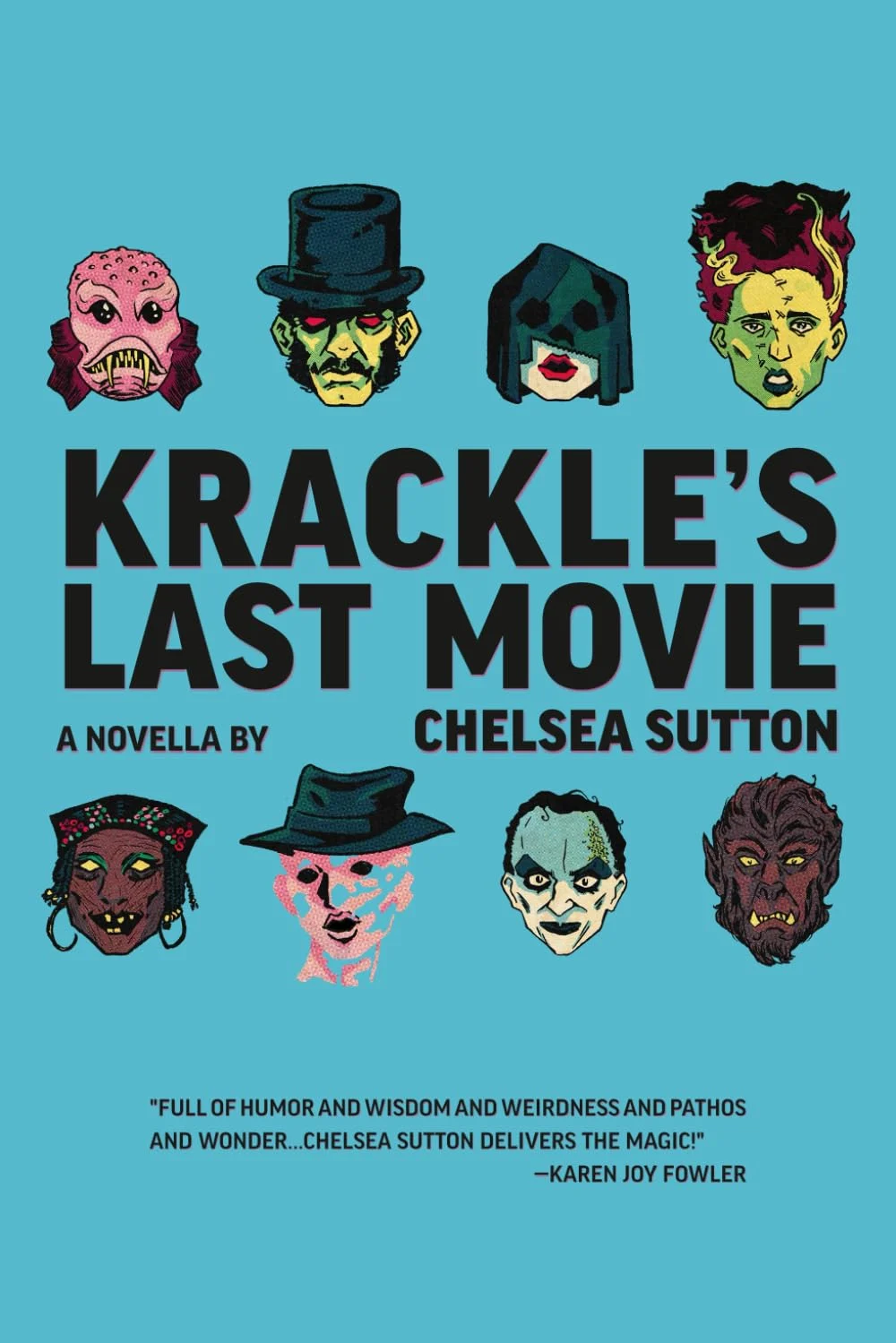
In the landscape of contemporary speculative fiction, few debuts have arrived with the intellectual weight and aesthetic shimmer of Chelsea Sutton’s Krackle’s Last Movie. Part documentary procedural, part psychological excavation, the novella serves as a profound meditation on the nature of "the other," the ethics of representation, and the inherent violence found in the act of observation. Through the lens of the Curious Monster Syndrome (CMS)—a mysterious, transformative phenomenon that leaves its subjects in a state of permanent liminality—Sutton constructs a narrative that is as much a critique of societal normativity as it is a haunting piece of fiction.
The Premise: Documenting the Unclassifiable
The story opens in the immediate wake of Minerva Krackle’s disappearance. Krackle, an ambitious documentary filmmaker, had dedicated her career to capturing the lived reality of those affected by CMS—a condition described by the author as an "evolution or growth or degeneration" (p. 25) that renders the individual profoundly "other."
Tasked with completing the project for a festival submission, Krackle’s assistant, Harper, finds herself submerged in a sea of raw footage, field notes, and audio transcripts. Harper is not merely a technician; she is an active participant in the "monstrous" world she documents. She carries her own secret—dwarfed wings hidden beneath baggy shirts—and lives in constant, fearful negotiation with her own identity. As she edits the film, Harper must reconcile her mentor’s legacy with her own lived experience, constantly choosing what to reveal and what to excise.
Chronology of an Investigation
The narrative structure of Krackle’s Last Movie is non-linear, mirroring the fractured nature of the footage Harper is editing. The chronology is defined by the encounters Krackle documented before she vanished:
- The Initial Interviews: Krackle’s early work serves as the foundation, introducing the audience to the subjects: a desert-dwelling sea creature, a grieving werewolf, and an invisible dancer named Isabel.
- The Escalation of Exposure: As the film progresses, the subjects move from being "subjects" to being active voices. The mermaids, for instance, challenge the interviewer’s perspective on their own nature, refusing to be reduced to mere objects of horror.
- The Meta-Reflexive Turn: The final act focuses on the editing process. Harper realizes that by cutting the film, she is participating in the same "mutilation" of truth that she suffered as a child. The climax is not a traditional resolution of the mystery surrounding Krackle, but a resolution of Harper’s internal struggle to claim her own narrative.
Supporting Data: Monstrosity as a "Category Crisis"
Sutton utilizes the concept of the monster as a "harbinger of category crisis," a term famously explored by cultural theorist Jeffrey Jerome Cohen. In the novella, monstrosity is not a biological imperative but a social shorthand for anyone who fails to conform to the dominant culture’s expectations of "normal."
The Aesthetics of the "Other"
Sutton’s world-building draws heavily on the "cabinet of curiosities" aesthetic. By blending the grotesque with the whimsical, she creates a space where the characters’ differences are both a burden and a form of majesty. The novella references various representations of the monstrous—from B-movie schlock to classical literature—to demonstrate how "otherness" is constructed by the observer rather than the observed.
The Medicalization of Difference
A significant portion of the text focuses on the institutional frameworks used to punish or "cure" those who exist outside the norm. Sutton traces the intersection of medicalization and religious dogma, illustrating how these systems treat difference as a "human-shaped contamination." Harper’s own story of cutting her wings—an act of self-mutilation to gain social acceptance—serves as the harrowing heartbeat of the book. Even when the wings grow back, they are "warped and distorted," a literal manifestation of stunted development caused by the pressure to conform.
Official Perspectives and Ethical Implications
The brilliance of Krackle’s Last Movie lies in its refusal to offer a didactic moral compass. Instead, it places the reader in the role of the judge.
The Ethics of the Camera
Sutton, herself an experienced filmmaker, infuses the text with a deep understanding of the medium’s inherent power imbalance. The "official" perspective of the film studio—which seeks to rebrand Krackle’s documentary as a "fictional comedy"—represents the commercial erasure of minority voices. By stripping away the depth of the subjects and turning their lives into digestible entertainment, the studio mirrors the broader societal tendency to mock that which it cannot categorize.
The Mirror of Perception
One of the most poignant scenes involves Isabel, the invisible dancer. Her performance is a triumph of artistic expression, yet the audience’s reaction depends entirely on their ability to see past her invisibility. Sutton poses a critical question: When is an anomaly a talent, and when is it an aberration? The answer, she suggests, is not found in the subject, but in the framing. As Harper notes, "It’s like we hold our breaths until our lives are over" (p. 25). The psychological toll of being observed but never truly seen is the central, haunting theme of the novella.
Critical Analysis: A Debut of Ambition
Krackle’s Last Movie positions itself alongside the works of Kelly Link, Carmen Maria Machado, and Aimee Bender—authors who use the uncanny to explore the visceral realities of the human condition. While the plot occasionally leans into genre-standard tropes that feel slightly less nuanced than the philosophical vignettes, the overall impact is undeniable.
Formal Control and Conceptual Depth
Sutton’s use of varied media—journal entries, audio transcripts, and camera observations—allows for a multifaceted look at her characters. By echoing the film theory of Siegfried Kracauer, the novella treats the camera not just as a recording device, but as an extension of perception. It captures what the naked eye cannot: the quiet, humanizing details of a monster’s grief or a performer’s pride.
The Legacy of the Edit
Ultimately, the novella is an interrogation of history. Harper’s realization that she is "editing" her own life—cutting pieces of herself away to fit the frame—serves as a powerful metaphor for the trauma of assimilation. The act of creation, Sutton argues, is inseparable from the act of destruction. To define something is to limit it, and to frame a story is to exclude the parts that do not fit the narrative arc.
Conclusion: A Carnival of Truth
Chelsea Sutton has delivered a work that is as much a challenge to the reader as it is a story. Krackle’s Last Movie is a dense, glittering, and occasionally agonizing piece of fiction that demands attentive deliberation. It does not offer a comfortable resolution; instead, it leaves us with the unsettling awareness that we are all, in some capacity, both the monster and the observer.
By forcing us to confront the "horror and the glory of otherness," Sutton successfully dismantles the artificial boundaries between the normal and the monstrous. In the end, the film Harper creates is not about the Curious Monster Syndrome at all—it is a mirror held up to the audience, reflecting the jagged, beautiful, and often painful reality of what it means to be visible in a world that prefers us invisible.
Selected Bibliography and References
- Cohen, J. J. (1996). Monster Culture (Seven Theses). In Monster Theory: Reading Culture. University of Minnesota Press.
- Kracauer, S. (1960). Theory of Film: The Redemption of Physical Reality. Oxford University Press.
- Sutton, C. (2026). Krackle’s Last Movie. Strange Horizons Publishing.










No comments yet. Be the first to join the conversation!