Iffa Jayyana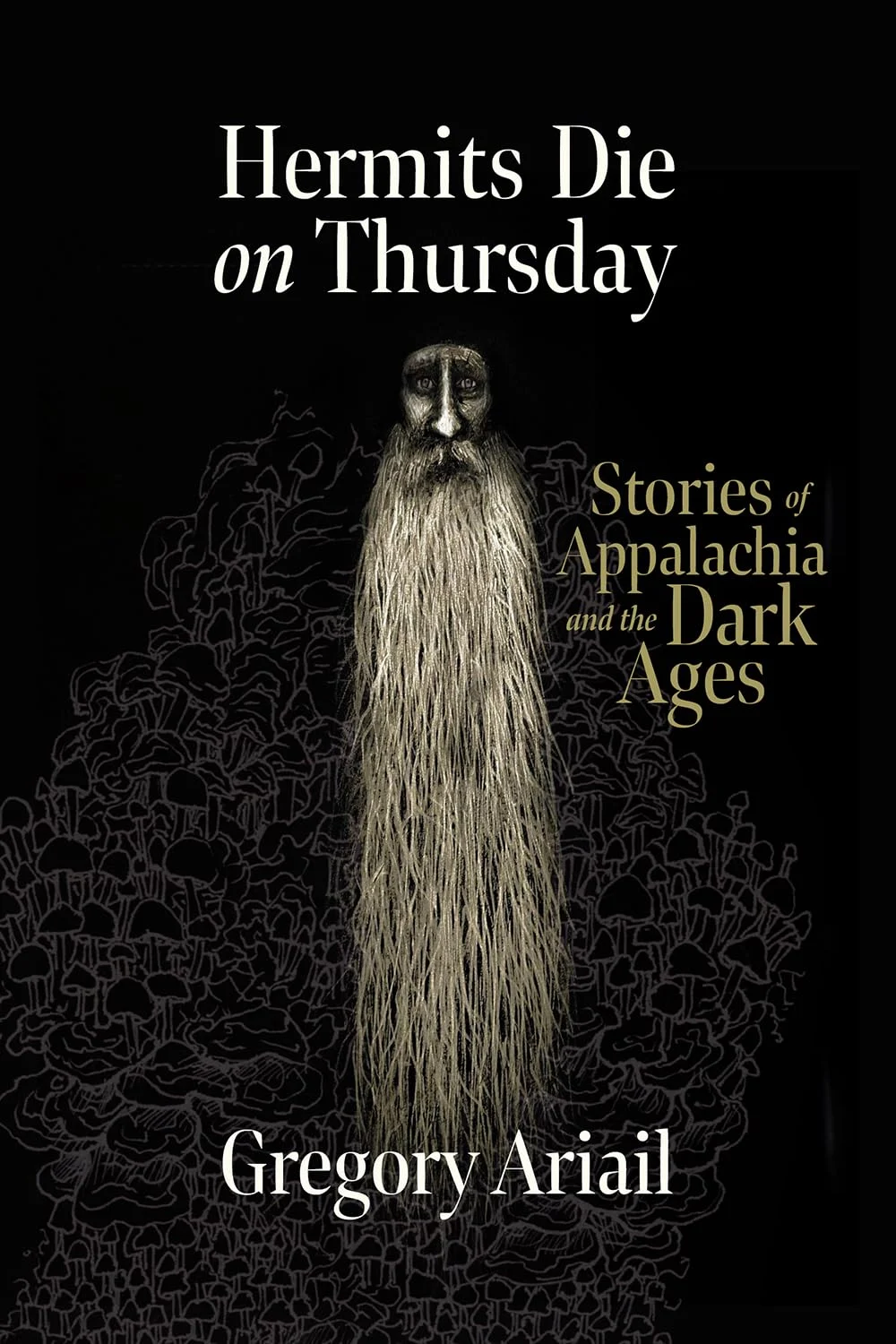
In the cultural imagination, the hermit is a figure of convenient simplicity. We envision them as static silhouettes against the backdrop of an untamed wilderness—men and women who have retreated from the noise of modernity to live in a state of suspended animation. However, as Alabama-based author Gregory Ariail illustrates in his masterful new collection, Hermits Die on Thursday: Stories of Appalachia and the Dark Ages, this perception is a profound reduction of a much more volatile reality. Through a blend of magical realism and regional folklore, Ariail peels back the layers of the Appalachian landscape, revealing that the true history of the mountains is not one of isolation, but of profound, unsettling complexity.
The Anomaly of the Human Spirit: Historical Hermits
To understand the literary hermits of Ariail’s work, one must first look at the historical realities that birthed such legends. Long before the modern era, the American South was home to individuals who defied the conventional trajectories of their time.
Consider the life of Marx Edgeworth Lazarus, a figure whose biography reads like a fever dream of nineteenth-century intellectualism. Born in North Carolina in 1822, Lazarus was a man of the cloth, a surgeon, and a radical anarchist living in the heart of the antebellum South. He was a philosopher who championed the "perfectibility of man," yet his personal life was a tapestry of contradictions. He wrote treatises on the suppression of nocturnal emissions, railed against the institution of marriage as a tool of female enslavement, and then promptly married a nineteen-year-old woman in his thirties.
Lazarus was also a fervent advocate for the "phalanstery"—a communal living structure designed to facilitate free love and shared property. While his attempts to convert Southern plantations into multiracial, anarchist utopias never came to fruition, his post-Civil War retirement into the Appalachian foothills of Alabama cements his place in the annals of regional eccentricity.
Similarly, the legend of Ches McCartney, the "Alabama Goat Man," serves as a testament to the irreducible nature of the hermit. While more socially active than the archetypal recluse, McCartney’s life was defined by the surreal: he traveled the Southeast in a goat-drawn wagon, far removed from the comforts of air conditioning and internal combustion. History often forgets the bizarre footnotes of such lives—like McCartney’s teenage flight to marry a circus knife-thrower, or his quixotic journey across the country to Los Angeles with the sole intention of courting actress Morgan Fairchild. These figures remind us that the hermit is not a "simple" person; they are a collision of biographical wires and philosophical vines, often as tangled as the forests they inhabit.
Chronology of a Literary Vision
The evolution of Gregory Ariail’s writing mirrors this shift from the external to the internal. Growing up in North Carolina, Ariail was, by his own admission, a child of fantasy—a fan of speculative worlds who found himself searching for the "Endor" of his childhood imagination within the rolling hills of his home.
The turning point occurred when Ariail transitioned from fan-based filmmaking to a deeper, more grounded engagement with the natural world. He began to see the Appalachian mountains not merely as a setting for genre tropes, but as a vast, untamed entity with its own agency. This evolution is central to the structure of Hermits Die on Thursday. The collection is divided, moving from the idiosyncratic, magical-realist tales of the Appalachian wilderness to a more traditional, albeit equally atmospheric, exploration of the European Dark Ages.
The chronology of this book serves as a deliberate progression: first, the reader is introduced to the "weird" Appalachia—where physics and logic are treated as mere suggestions—before being led into a landscape of kings, fjords, and glaciers. It is a journey that validates the local by treating it with the same mythic weight as the epic sagas of antiquity.
The Architecture of the Impossible: Themes and Data
Ariail’s narrative strategy relies on the subversion of expectations. Each story in the collection presents the reader with a riddle that defies the laws of logic. In the title story, "All Hermits Died on Thursday," the hermits do not merely exist; they transcend the mundane. They are portrayed through short, haunting obituaries: one man chokes to death on his own overgrown beard; another continues to levitate long after his pulse has ceased; a third leaves behind a suicide note declaring his intent to "ride the moon all the way down to hell to meet my mother and Mr. Price, my Latin teacher."
This is the "shorthand" of the hermit’s complexity. Ariail does not need to provide a multi-volume biography to explain the depth of these characters; he uses the impossible to represent the profound. The inclusion of the Latin teacher is a brilliant stroke of characterization—it suggests that even in the deepest, most isolated reaches of the hills, the echoes of classical education and human connection remain.
Furthermore, Ariail’s work challenges the reader’s perception of "poverty." In the Appalachian context, poverty is often used as a journalistic lens for suffering. Ariail uses it as a lens for perspective. In his fictionalized Appalachia, there is not enough logic to explain the world, and not enough God to ensure justice. This "too-short blanket of rationality" allows the supernatural to poke through. When the impossible happens—be it mushrooms forming the likeness of Queen Elizabeth or chickens manifesting human features—it is not treated with the shock of a fantasy novel, but with the weary acceptance of a local who has seen a moth the size of a pizza slice and knows that the woods are simply not governed by the rules of the city.
Implications for Regional Literature
The critical implication of Hermits Die on Thursday is that it breaks the mold of contemporary regional writing. Much of the literature focused on Appalachia tends to lean toward sociology or historical trauma, dissecting the region through the lens of political or economic hardship.
Ariail avoids these well-trodden paths by focusing on the "forest and mountains themselves." By doing so, he elevates the landscape to a character of its own. He argues that the moon and sun became gods to early humans because they were untouchable; he posits that if one touches the mountains, one enters the spirit world. This shift in focus is significant: it suggests that the "weirdness" of the region is not a byproduct of its isolation, but an inherent quality of its environment.
The transition from the American hills to the European Dark Ages in the latter half of the collection is seamless. By placing these two worlds side-by-side, Ariail suggests that the experience of the sublime—and the terrifying magic that accompanies it—is a universal human constant. The ragged magic of his Appalachian tales serves as a "portal" that makes the subsequent epic fantasy sections feel more luminous and grounded.
Conclusion: A Worthwhile Journey
In an era where we are constantly tethered to the digital and the immediate, Hermits Die on Thursday serves as a necessary, if jarring, reminder of the mysteries that persist on the periphery of our vision. Whether one approaches this collection seeking insights into the human condition or simply the desire to be transported to a place where the landscape is as alive as the characters, the book delivers.
Gregory Ariail has not merely written a collection of stories; he has mapped a topography of the imagination. He reminds us that the hermit, the mountain, and the history we think we know are always more complex, more interconnected, and more magical than we dare to admit. To read these stories is to accept that the universe has feet that stick out from under the blanket of civilization, and that those feet are kicking, dancing, and waiting to be discovered in the quiet corners of the woods.


 Nila Kartika Wati
 Siti Muinah