

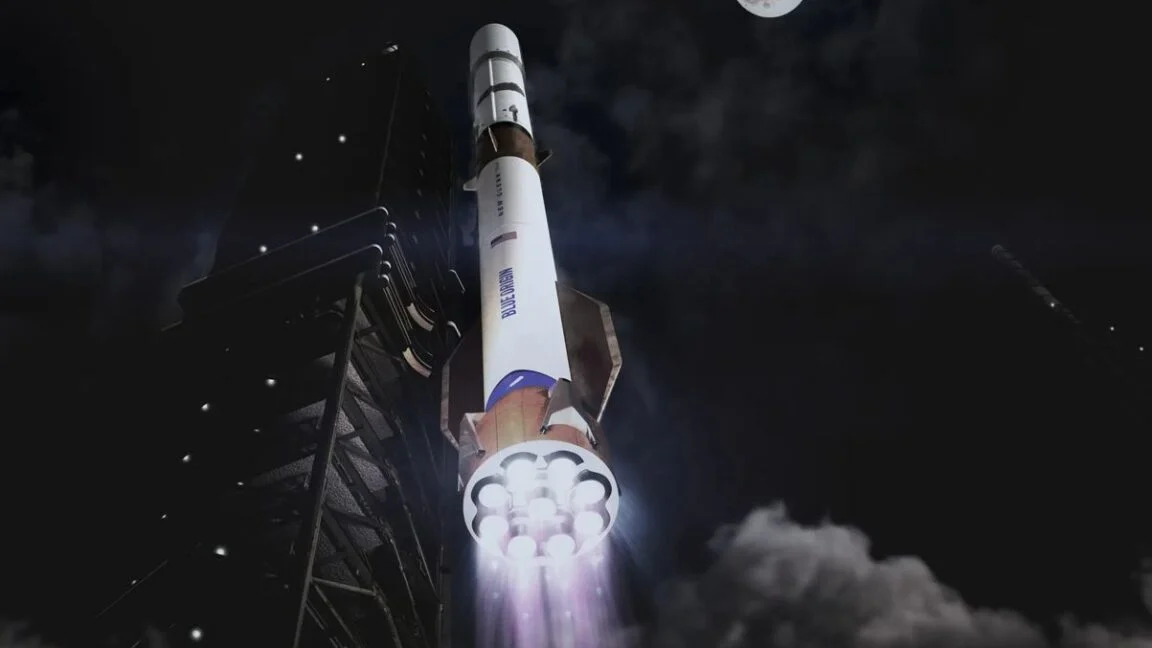
The space industry is currently grappling with the seismic fallout of a late-May incident that saw Blue Origin’s New Glenn rocket destroyed during a static-fire test. As the smoke clears from the charred remains of Launch Complex 36A at Cape Canaveral, the implications for the commercial space sector—and NASA’s ambitious Artemis program—have become the subject of intense scrutiny. In a recent Ars Live panel, industry experts dissected the engineering, logistical, and timeline challenges that Blue Origin now faces in the wake of this catastrophic failure.
The Incident and the Immediate Aftermath
The destruction of the New Glenn vehicle during a routine static-fire test was a jarring reminder of the inherent volatility of orbital-class rocketry. For a company that has spent years refining its "Gradatim Ferociter" (step-by-step, ferociously) philosophy, the loss of hardware is not merely a financial blow; it is a profound psychological and operational setback.
The vehicle in question was the "7×2" variant—a two-stage rocket featuring seven first-stage BE-4 engines and two second-stage engines. While static-fire tests are designed to push systems to their limits, the resulting explosion effectively grounded the launch site and forced a complete re-evaluation of the company’s launch cadence. The explosion did more than destroy a rocket; it crippled a critical piece of infrastructure at Launch Complex 36A, raising questions about how quickly Blue Origin can return to flight operations, let alone meet its broader mission objectives.
A Chronology of Ambition and Obstacle
To understand the weight of this event, one must look at the timeline of Blue Origin’s development. Since its inception, Blue Origin has operated with a degree of secrecy that often obscures its developmental pivots.
- 2018 Pivot: In mid-2018, Blue Origin announced a shift from a three-stage vehicle to the two-stage configuration. At the time, the company argued that this simplification would accelerate the path to orbit.
- Late May 2026: The catastrophic static-fire failure occurs, destroying the 7×2 test vehicle and damaging Launch Complex 36A.
- Present Day: The industry is currently waiting on forensic analysis of the failure, while simultaneously looking toward the next, more complex iteration of the rocket: the 9×4 variant.
Historically, the space industry has been littered with companies that promised rapid iteration only to be thwarted by the "tyranny of the rocket equation" and the sheer complexity of heavy-lift vehicle integration. As Caleb Henry, director of research at Quilty Space, noted during the Ars Live discussion, there is a recurring pattern of architectural changes being framed as "accelerants" that ultimately lead to further delays.
The 9×4 Architecture: Complexity vs. Capability
The focal point of the current debate is the "9×4" variant of the New Glenn. Unlike its predecessor, this rocket is designed for significantly higher performance, featuring nine engines on the first stage and four on the second. This architecture is considered essential for Blue Origin’s role in NASA’s Artemis IV mission, which requires the heavy-lift capability to ferry landers to the lunar surface.
However, increasing engine count inherently increases the probability of failure and the complexity of ground support systems. When asked about the feasibility of the 9×4’s debut—currently rumored to be targeted for late 2027 or early 2028—industry analysts expressed significant skepticism.
"I have not seen anyone put out a date for a new rocket, and actually hit it," Caleb Henry stated. He suggested that, given the history of the aerospace sector, a delay factor of 1.5 is a standard rule of thumb. This would push the actual debut of the 9×4 closer to the end of the decade. Anthony Colangelo, host of the Main Engine Cut Off podcast, echoed this sentiment, noting that it would not be a surprise to see the development slip into the early 2030s.
Supporting Data: Why Reliability Remains Elusive
The challenge facing Blue Origin is not just about building a bigger engine; it is about the integration of complex systems. The shift to a 9×4 configuration involves:
- Thrust Management: Managing the acoustic and thermal loads of nine massive BE-4 engines firing in unison.
- Structural Integrity: The 9×4 requires a beefier frame to handle the increased thrust, requiring extensive testing that cannot be bypassed.
- Launch Infrastructure: The damage to Launch Complex 36A must be repaired, and then the site must be upgraded to support the larger footprint of the 9×4 vehicle.
When evaluating these factors against the current state of the industry, the math becomes difficult. NASA relies on redundancy; the Artemis program depends on the assumption that private partners will be ready on time. If the heavy-lift assets are delayed, the entire lunar mission sequence experiences a cascading effect of postponements.
Official Responses and Industry Sentiment
While Blue Origin has remained characteristically tight-lipped regarding the specific cause of the failure, the industry at large is watching closely. The failure is not just a Blue Origin problem; it is a critical variable in the success of the Artemis program.
NASA’s strategy for the Moon relies on a "dual-provider" approach—utilizing both SpaceX and Blue Origin to ensure that if one provider faces a delay, the other can pick up the slack. However, this strategy is predicated on the idea that these providers will eventually reach operational maturity. The loss of the 7×2 vehicle suggests that maturity is still a distant goal for New Glenn.
The sentiment among experts is one of cautious, and often cynical, observation. The space industry is maturing, but the laws of physics do not care about corporate deadlines or mission manifests.
Implications for Artemis IV and Beyond
If the 9×4 variant does not arrive until 2030 or later, NASA faces a significant strategic crisis. The Artemis IV mission is intended to mark a sustained presence on the Moon. If the rockets necessary to deliver the lunar landers are unavailable, NASA may be forced to:
- Re-scope Missions: Delaying ambitious lunar landings in favor of orbiting missions.
- Extend Contracts: Potentially leaning further on existing partners, though this too carries risk.
- Shift Timelines: Officially moving the goalposts for human return to the lunar surface to accommodate the slow pace of heavy-lift vehicle development.
The failure of the New Glenn in May serves as a stark reminder that we are still in the "experimental" phase of the current lunar space race. While the potential for commercial space is immense, the road to the Moon is paved with engineering hurdles that rarely yield to deadlines.
The Path Forward: What’s Next?
The next six months will be critical for Blue Origin. The company must identify the root cause of the May explosion, rectify the design flaws, and demonstrate to the FAA and NASA that it has the safety culture and engineering rigor to move forward.
For the space industry, the New Glenn incident is a litmus test. Can a company that has moved cautiously and methodically accelerate its timeline in the face of failure, or will the complexity of its next-generation architecture lead to further stagnation?
As the Ars Live discussion concluded, the consensus was clear: the space industry is at a crossroads. The promise of the 9×4 is immense, but until the hardware is on the pad and the engines ignite successfully, it remains a paper rocket. For NASA and the broader scientific community, the wait for a second reliable heavy-lift vehicle is no longer just a luxury—it is a necessity for the future of human exploration. The coming years will determine whether Blue Origin can meet the moment, or if the dream of a multi-provider lunar infrastructure will have to wait for a new decade to truly take flight.











