

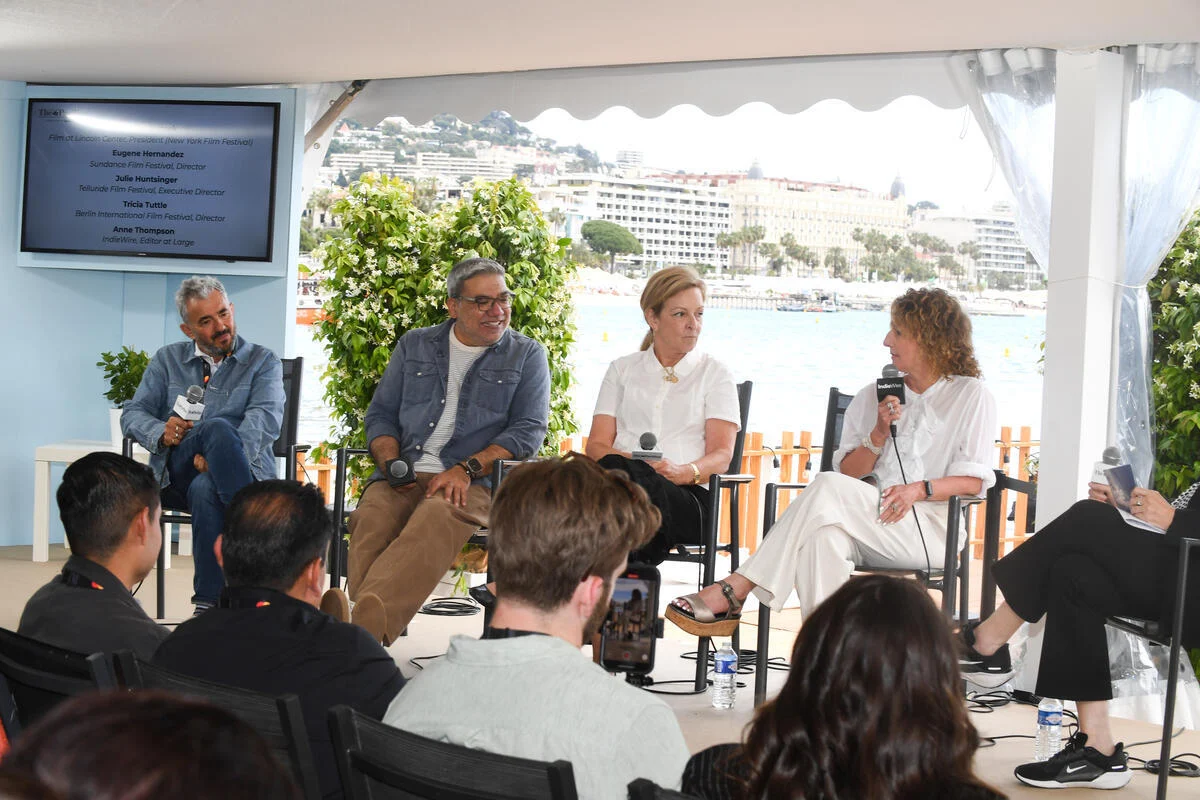
In the high-stakes, star-studded environment of the world’s most prestigious film festival, a quiet revolution is taking place behind the scenes. While the red carpets are dominated by A-list talent and the flashbulbs of international press, the true engine of the independent film ecosystem was on display inside the American Pavilion. In a rare "meeting of the minds," the architects of global cinema culture gathered to address the existential questions facing the industry: How does independent film survive, and more importantly, thrive, in an era of fractured attention spans and evolving distribution models?
Moderated by IndieWire’s Anne Thompson, the panel featured a formidable lineup of industry leaders: Sundance Film Festival director Eugene Hernandez, Berlin International Film Festival director Tricia Tuttle, Telluride Film Festival executive director Julie Huntsinger, and Film at Lincoln Center president Daniel Battsek, who oversees the New York Film Festival. Their consensus was as surprising as it was optimistic—the "death of cinema" narrative, so prevalent in industry trade papers, is being contradicted by the ground-level reality of surging festival attendance and a revitalized, younger cinephile base.
The State of the Ecosystem: A Strategic Overview
The fundamental premise of the discussion was that the role of the film festival has shifted from a mere marketplace to a necessary cultural anchor. As the economic landscape for independent film remains in flux—marked by the volatility of streaming platforms and the consolidation of theatrical distribution—festivals have doubled down on their core competency: curation.
Daniel Battsek opened the discussion by framing the festival’s role not as a relic of the past, but as a critical infrastructure for the future. "It’s one of those topics that’s constantly discussed. It’s always been difficult, but never impossible," Battsek remarked. He argued that the perceived instability of the industry is actually forcing festivals to become more essential. "I feel that film festivals right now have reached a priority level. People really look to festivals because they curate films and audiences."
For Battsek, the most encouraging metric is the demographic shift. Contrary to the belief that younger generations have abandoned the theatrical experience, he noted a marked increase in younger audiences engaging with cinema. "Younger audiences are more aware of cinema than they’ve been in the past ten years, in my opinion, and we see it because we see them coming in," he stated.
Chronology of a Resurgence: From Pandemic Slump to Modern Revival
To understand the current health of the festival circuit, one must look at the timeline of the post-2020 landscape.

- 2020–2021: The Great Disruption. The industry faced an existential crisis as festivals went virtual or were canceled entirely. The "experience" of cinema was threatened by isolation and the rapid acceleration of direct-to-streaming models.
- 2022: The Transitional Phase. As in-person events returned, there was deep skepticism regarding whether audiences would return to crowded screening rooms.
- 2023–2024: The Data Reversal. Contrary to early projections of a permanent decline, festivals began reporting steady, then record-breaking, attendance figures.
- 2025–2026: The New Normal. The current era is defined by a "boutique" approach. Festivals are no longer just places to watch movies; they are immersive cultural events that offer the personalized experience that digital platforms cannot replicate.
Supporting Data: The Growth Trajectory
The panel provided empirical evidence that the appetite for independent film is not only intact but growing. Tricia Tuttle, leading the charge at the Berlin International Film Festival, offered perhaps the most striking data point of the session.
"We have gone up seven and a half percent in the last two years," Tuttle revealed, highlighting a significant growth trajectory that defies broader industry trends. This growth, she noted, is mirrored by the health of repertory cinemas—small, independent theaters that focus on classics and indie gems. This synergy suggests that the "festival effect" is spilling over into the rest of the year, as audiences who discover a love for cinema at a festival continue that habit in their local independent theaters.
However, the panel was quick to temper this optimism with a sobering reality check. Tuttle emphasized that the limiting factor is no longer audience interest, but the physical and organizational infrastructure. "It’s not just film festivals, it’s also rep cinemas having the same growth trajectory. We’re failing audiences because we have an infrastructure problem, not a desire problem."
Official Perspectives: The Curators’ Challenge
The panelists discussed the delicate balance between maintaining the "prestige" of a festival and keeping it accessible.
The Curation Paradox
Julie Huntsinger of Telluride highlighted that while the sheer volume of content is higher than ever, the noise is also louder. "The audience is overwhelmed," she noted. "Our job is to cut through that noise." By acting as a filter, festivals provide a stamp of quality that acts as a beacon for audiences who are tired of algorithmic recommendations.
The Economic Realities
Eugene Hernandez of Sundance addressed the changing nature of the "deal." For decades, the festival was the primary place to secure distribution. Today, as distribution models diversify, festivals serve as launchpads for brand-building and community engagement. The panel agreed that the definition of a "successful" festival run has evolved—it is no longer just about the bidding war; it is about finding the right audience and sustaining a film’s life cycle.

Implications: The Future of Independent Distribution
The takeaway from this assembly of leaders is clear: the future of cinema is not in the death of the theatrical experience, but in its specialization.
- The Rise of the "Third Space": Festivals and independent cinemas are becoming "third spaces"—social hubs where community, education, and entertainment intersect.
- Infrastructure Investment: As Tuttle pointed out, the demand is there. The industry must now pivot toward solving the infrastructure bottlenecks—modernizing theaters, streamlining the logistics of film transport, and investing in the talent pipelines that connect creators to these venues.
- Audience-First Programming: The success of the current festival circuit is driven by younger audiences who value the "event" nature of cinema. Future programming will likely continue to lean into repertory screenings, filmmaker Q&As, and interactive components that turn a standard screening into a communal event.
Conclusion: A Collaborative Path Forward
As the session concluded, the tone was one of collective responsibility. These festival directors are not competitors in a zero-sum game; they are colleagues managing different nodes of a singular, interconnected network. By sharing data and strategies, they are ensuring that independent film remains a vital part of the cultural conversation.
The message to the independent film community is one of tempered resilience. The economics of film will always be a struggle, and the landscape will always be in flux. But as the leaders of Sundance, Berlin, Telluride, and the New York Film Festival have demonstrated, the desire for the shared experience of cinema is a fundamental human impulse—one that no amount of digital convenience can fully replace.
This report was brought to you in partnership with United Airlines. United’s shared purpose is "Connecting People. Uniting the World." United offers the most diversified international route network among US airlines, and is proud to support the entertainment industry through specialized travel products, including reduced airfare, special rates for equipment, custom booking options, and a dedicated entertainment support desk. For more information, visit www.united.com and https://www.united.business/.











No comments yet. Be the first to join the conversation!