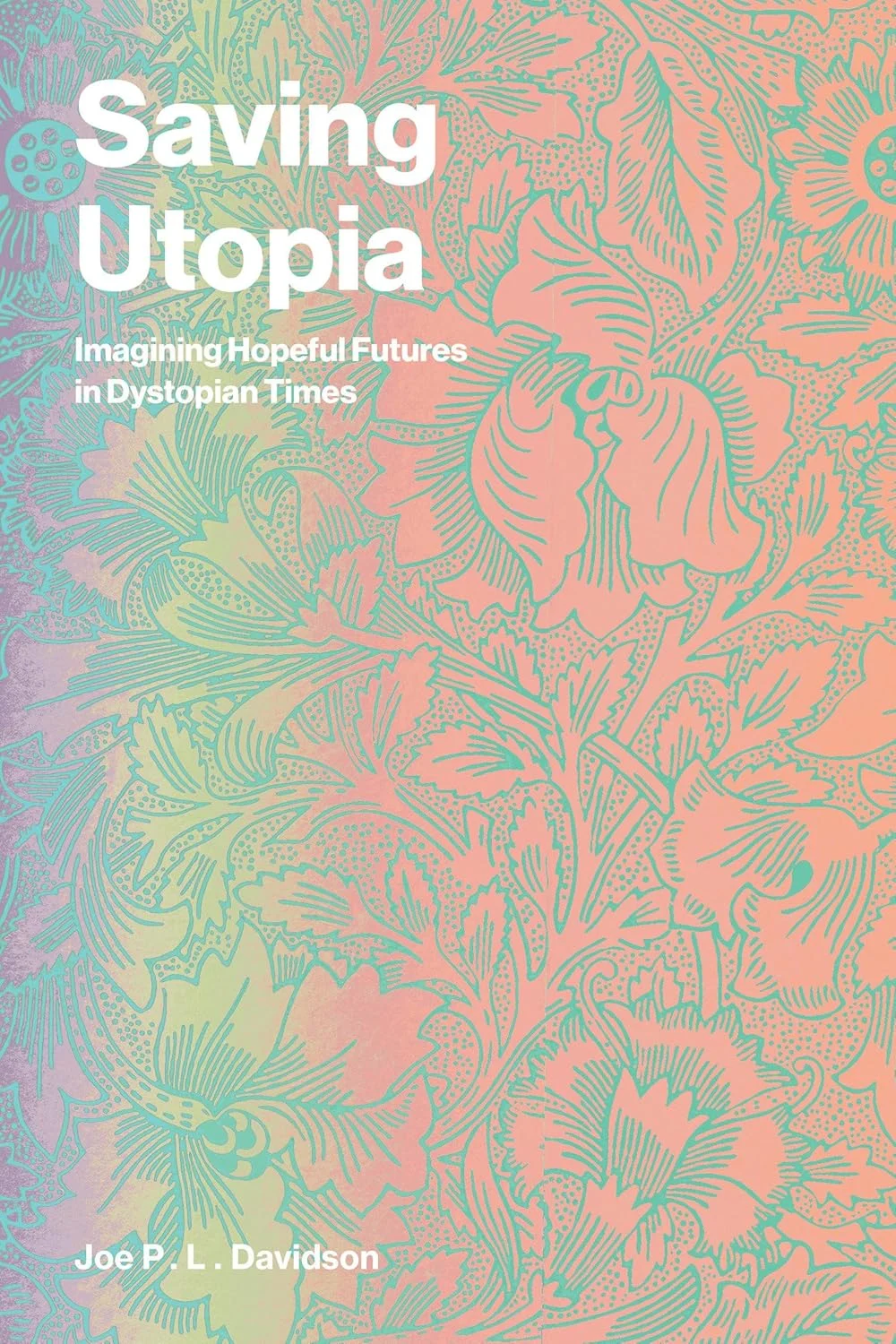
In the contemporary literary and political landscape, it has become a reflexive, well-rehearsed trope to declare that utopianism—and by extension, utopian fiction—is a relic of a bygone era. We are told, with increasing frequency, that we live in "dystopian times," and that the impulse to imagine a radically better society is not only naive but perhaps even dangerous. Into this intellectual climate steps Joe P. L. Davidson, a research fellow at Loughborough University, with his provocative new monograph: Saving Utopia: Imagining Hopeful Futures in Dystopian Times.
Davidson’s work arrives at a moment of profound cultural fatigue. By attempting to define and defend the utopian impulse, Davidson invites readers to reconsider the map of our political imagination. However, his book serves as both a valuable contribution to genre studies and a case study in the limitations of current academic discourse.
The Architecture of Utopia: Definitions and Historical Context
At the heart of Davidson’s project is a robust, academically grounded definition of utopian fiction. He characterizes it as literature that "constructs a society that is both radically other and significantly better than the world of the present." Crucially, Davidson distinguishes these visions from the purely mythical or supernatural. He argues that genuine utopian fiction is inherently political, foregrounding the sociopolitical structures that would facilitate a "better" existence.
To understand why utopianism has seemingly withered, Davidson leans heavily on the historiography of Reinhart Koselleck. He traces the emergence of "modern time consciousness" in the eighteenth century—a shift from a cyclical view of history to a linear one, where the future is seen as a space for progress, novelty, and betterment. This "temporalization" of utopia allowed writers like Thomas More (the progenitor of the genre) to transition from placing their ideal societies in distant, unreachable corners of the globe to placing them in the future.
This temporal shift enabled works like Edward Bellamy’s Looking Backward (1888) and William Morris’s News from Nowhere (1890). Yet, as Davidson astutely observes, this same tethering of utopia to the concept of linear "progress" made the genre uniquely vulnerable. When the twentieth century’s catastrophes—the industrial slaughter of World War I, the rise of totalitarian regimes, the Holocaust, and the dawn of the nuclear age—shattered the belief in inevitable progress, the utopian tradition suffered a corresponding collapse.
Chronology of a Disillusioned Century
The arc of Davidson’s argument follows a distinct chronological trajectory:
- 1516–1700s (The Spatial Era): Utopia is an island, a hidden valley, or a distant land. It exists in space, but not necessarily in the timeline of human history.
- 1800s–1914 (The Temporalization): The era of high confidence. Writers map "progress" onto the future. Utopia is seen as an inevitable destination toward which humanity is marching.
- 1914–1945 (The Crisis): The "Thirty Years’ Crisis" of the twentieth century renders the promise of progress hollow. The collapse of the "modern time regime" begins in earnest.
- 1945–1970s (The Dystopian Turn): As confidence in the future wanes, dystopian fiction thrives. However, this period also sees the rise of the "critical utopia," such as Ursula K. Le Guin’s The Dispossessed (1974), which acknowledges ambiguity and struggle rather than perfection.
- 1980s–Present (The Neoliberal Freeze): The era of "There Is No Alternative" (TINA). Utopian impulses are driven to the margins, appearing in fragmented forms such as Afrofuturism, climate fiction, and explorations of trauma.
Supporting Data and The "Postmodern" Trap
While Davidson’s analysis of the history of the genre is nuanced, his reliance on a specific brand of postmodern skepticism creates a fundamental contradiction. He attempts to analyze the prospects of utopia while largely adopting the "Cold War liberal" premise that the failure of utopianism was a natural, almost inevitable reaction to the horrors of the twentieth century.
The data, however, suggests a more complex reality. Davidson argues that the "catastrophes" of the century destroyed the belief in progress. Yet, a closer inspection of history shows that for every person who abandoned utopianism in the face of war, there were those who argued that the true problem was not the failure of reason, but the fact that a just, rational social order had never been fully attempted.
The "pessimism" of the current era is not merely a byproduct of historical trauma; it is the result of a deliberate political project. As scholars like David Harvey have documented, the rise of neoliberalism was not a passive collapse of hope, but an aggressive counter-offensive against the egalitarian movements of the 1960s and 70s. The "Golden Straitjacket" of globalized financial capitalism was designed to foreclose the possibility of alternatives, branding them as "totalitarian" or "impossible."
Official Narratives vs. Underground Resistance
Davidson often treats the "official" narrative—that socialism and grand utopian projects inevitably lead to tyranny—as an irrefutable fact. This creates a significant blind spot in his research. He largely overlooks the persistent, albeit marginalized, tradition of utopian literature that continued to thrive even after the 1970s.
For instance, he mentions Kim Stanley Robinson’s Mars trilogy but fails to engage with the deeper implications of Iain M. Banks’ Culture series, which depicts a post-scarcity, functional socialist society. Similarly, he ignores Norman Spinrad’s Greenhouse Summer (1999), which explicitly contrasts the failures of capitalist climate management with the efficacy of a syndicalist order.
By adopting the framework of the "anti-utopian right," Davidson misses the degree to which neoliberalism itself acts as a utopian project—albeit one for the few. The billionaire class’s obsession with luxury doomsday bunkers is a perverse, private form of utopianism, suggesting that while they claim "there is no alternative" for the public, they are actively planning for a world where their own survival is secured regardless of the collapse they have helped engineer.
Implications: Where Do We Go From Here?
The primary implication of Saving Utopia is that our current inability to imagine a better world is not a failure of human nature, but a failure of our political culture. Davidson’s book is most useful when it stops attempting to justify the "collapse" of utopianism and starts looking at where the impulse still lives—in the cracks of the system.
If the postmodern era of "incredulity toward grand narratives" is indeed ending, as current geopolitical instability and the resurgence of popular support for socialist policies suggest, then Davidson’s next project may be even more vital. We are living in a time where the "official wisdom" of the neoliberal era—the idea that we have reached the end of history—is crumbling under the weight of climate change and economic inequality.
Key Takeaways:
- Utopia is not dead: It has merely been pushed into the shadows of trauma, nostalgia, and speculative fiction.
- Definitions matter: We must distinguish between the "closed" utopias of the nineteenth century and the "critical" utopias that grapple with the messiness of human reality.
- The Power of the Narrative: The collapse of the "future" was a political act, not a historical accident. Understanding this is the first step toward reclaiming our collective capacity for hope.
In conclusion, Saving Utopia is an uneven but deeply necessary book. It serves as a reminder that the map of our future is not yet drawn, and that the "utopian" maps we have been told to burn are perhaps the only ones capable of guiding us out of the current darkness. While Davidson remains somewhat shackled to the very postmodern conventions he critiques, his work opens a crucial door: the realization that the "impossibility" of a better world is the greatest lie of our time.