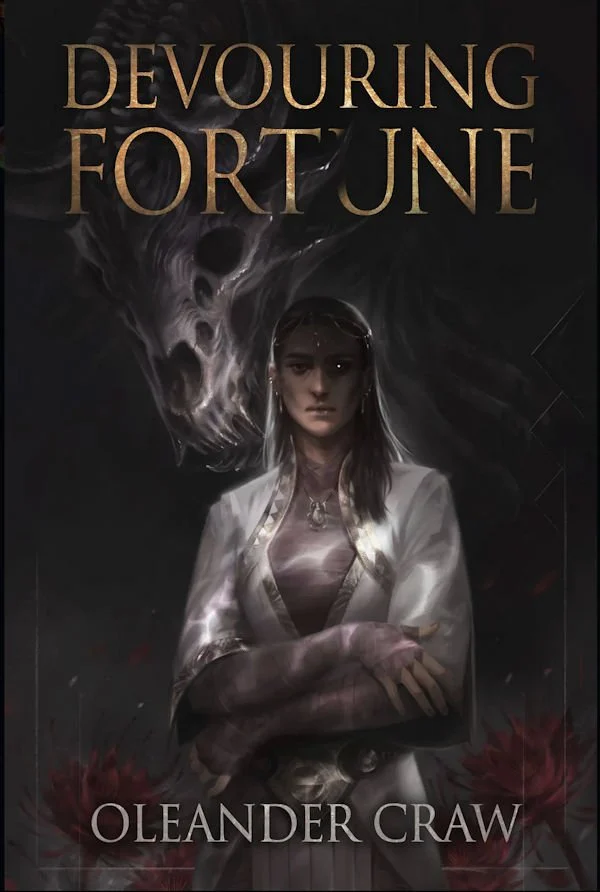
In the crowded landscape of contemporary fantasy, where tropes are often recycled and worldbuilding can feel like an exercise in encyclopedia-writing, a rare, crystalline voice has emerged. Devouring Fortune, the debut novel by Oleander Craw, arrives as a profound exploration of ambition, environmental decay, and the high cost of playing god with one’s own destiny. As the Kickstarter campaign for this dark science-fantasy standalone launches this Friday, June 8th, readers and critics alike are beginning to take note of what many are already calling the best indie release of the year.
The Core Premise: A Bargain with the Void
The narrative follows Reed, a "fortune weaver" haunted by the ghosts of his past. Twelve years prior, a catastrophic failure in his craft resulted in the deaths of his companions, leaving Reed in a state of perpetual penance. His life, defined by misfortune, takes a sharp turn when he finally tracks down a "fortune beast"—an ancient, enigmatic entity capable of bestowing the power to reshape reality.
However, in Craw’s universe, nothing is granted without a devastating tax. The beast offers Reed the ability to construct a fortune mechanism powerful enough to resurrect the dead and stall the environmental collapse threatening his world. The price? Reed must listen to—and perhaps become inextricably linked to—the history of Daryifel the Eighty-Seventh. As Reed delves into Daryifel’s story, he discovers that the past and present are not merely adjacent; they are two sides of the same coin, both struggling against an encroaching, inescapable blight.
A Chronology of Two Worlds
Devouring Fortune operates through a dual-timeline structure, expertly weaving together the fates of two protagonists across disparate, yet spiritually connected, landscapes.
The Present: Reed’s Dying Forests
Reed inhabits a world where the natural order is fracturing. The environment is succumbing to a "Calamity"—a slow-acting, toxic degradation that threatens to wipe out his people. Reed is not a traditional hero; he is a man driven by grief and the desperate, morally ambiguous need to undo his past mistakes. His journey is one of obsession, as he attempts to rewrite history to salvage a future that may already be beyond repair.
The Past: Daryifel’s Salt-Crusted Empire
Contrasting Reed’s forest-bound struggle, Daryifel lives in a world defined by salt. She is a priestess of Fortune, presiding over a crumbling temple complex located in an arid, white-washed landscape. Her role is to guide desperate pilgrims through the "Underluck"—a perilous network of salt caverns. Here, the desperate consume water tainted by the marrow of deceased fortune beasts, hoping to buy a future that the environment no longer provides.
The interplay between these two settings creates a sense of profound scale. As the reader navigates the salt-laden theology of Daryifel’s era and the forest-withered reality of Reed’s, the cyclical nature of their struggle becomes clear: both are victims of a world that consumes its own inhabitants to sustain its existence.
Supporting Data: Why Worldbuilding Matters
What distinguishes Devouring Fortune from the current wave of "romantasy" or standard epic fantasy is the seamless integration of its setting. In many modern novels, worldbuilding is either an overwhelming infodump or a minimalist backdrop for character relationships. Craw achieves a "third way": a symbiotic relationship where the environment, the characters, and the plot are entirely codependent.
The salt-based culture of Daryifel is not merely aesthetic; it informs the characters’ metaphors, their religious hierarchy, and their very survival. By grounding the narrative in such a specific, sensory reality, Craw avoids the trap of placing modern, Westernized archetypes into a fantasy setting. These characters feel like products of their environment—alien yet profoundly human.
Furthermore, the book tackles the concept of "Fortune" with a refreshing cynicism. Where many fantasy novels rely on the heavy-handed trope of inevitable prophecy, Devouring Fortune positions its protagonists in a fierce, defiant struggle for agency. The stakes are global, but the focus remains tight and personal. It posits that there is no fate, only the collision of human ambition, love, and malice.
Character Dynamics and Ethical Ambiguity
A standout feature of the novel is its commitment to complex, morally grey protagonists. Reed and Daryifel are, by any standard, "unapologetically ambitious." They make choices that are often questionable, yet they remain deeply sympathetic because they are permitted to be flawed.
This is particularly notable given the book’s "queer-normative" setting. Reed is a transmasculine character, and Daryifel is engaged in a sapphic relationship with a palace guard. Craw avoids the common pitfall of forcing queer characters into a performative "trauma cycle" or holding them to higher moral standards than their cis-heterosexual counterparts. In Devouring Fortune, the characters are allowed to simply exist. They are ruthless, grieving, and hopeful in equal measure.
The presence of the rogue character, Yashen, serves as a crucial tonal counterweight. In the darker, more suffocating moments of the narrative, Yashen provides a necessary levity that prevents the heaviness of the protagonists’ burdens from overwhelming the reader. His interactions with Daryifel offer glimpses of warmth in a world otherwise defined by cold, crystalline salt and encroaching death.
Implications for the Genre
The success of Devouring Fortune as an indie debut signals a potential shift in the fantasy market. Readers are increasingly seeking narratives that prioritize character depth and atmospheric, immersive worldbuilding over the repetitive, high-action tropes that have dominated the bestseller lists for years.
The novel challenges the reader to consider: If your world were dying, how much of your own humanity would you be willing to devour to save it? By keeping the stakes intimate even within a "save-the-world" framework, Craw has crafted a story that feels both epic in scale and deeply personal in impact. It is a testament to the idea that a story’s strength lies not in the size of its maps or the complexity of its magic systems, but in the truth of its characters’ desires.
Official Details and How to Support the Project
The Kickstarter campaign for Devouring Fortune is set to launch on Friday, June 8th. Prospective readers are encouraged to visit the official Kickstarter page to access the first three chapters and participate in the launch.
For those interested in following the author’s journey and future developments regarding the Devouring Fortune release, Oleander Craw can be found on:
- Instagram: @oleander_craw
- Threads: @oleander_craw
- Bluesky: @oleandercraw.bsky.social
As the publishing industry continues to evolve, projects like this serve as a reminder that the most compelling narratives often come from creators willing to take risks. Whether you are a fan of dark science fantasy or simply looking for a story that breaks the mold, Devouring Fortune demands a place on your bookshelf. It is a rare, mature, and gripping debut that marks the beginning of what promises to be a significant career in genre fiction.