

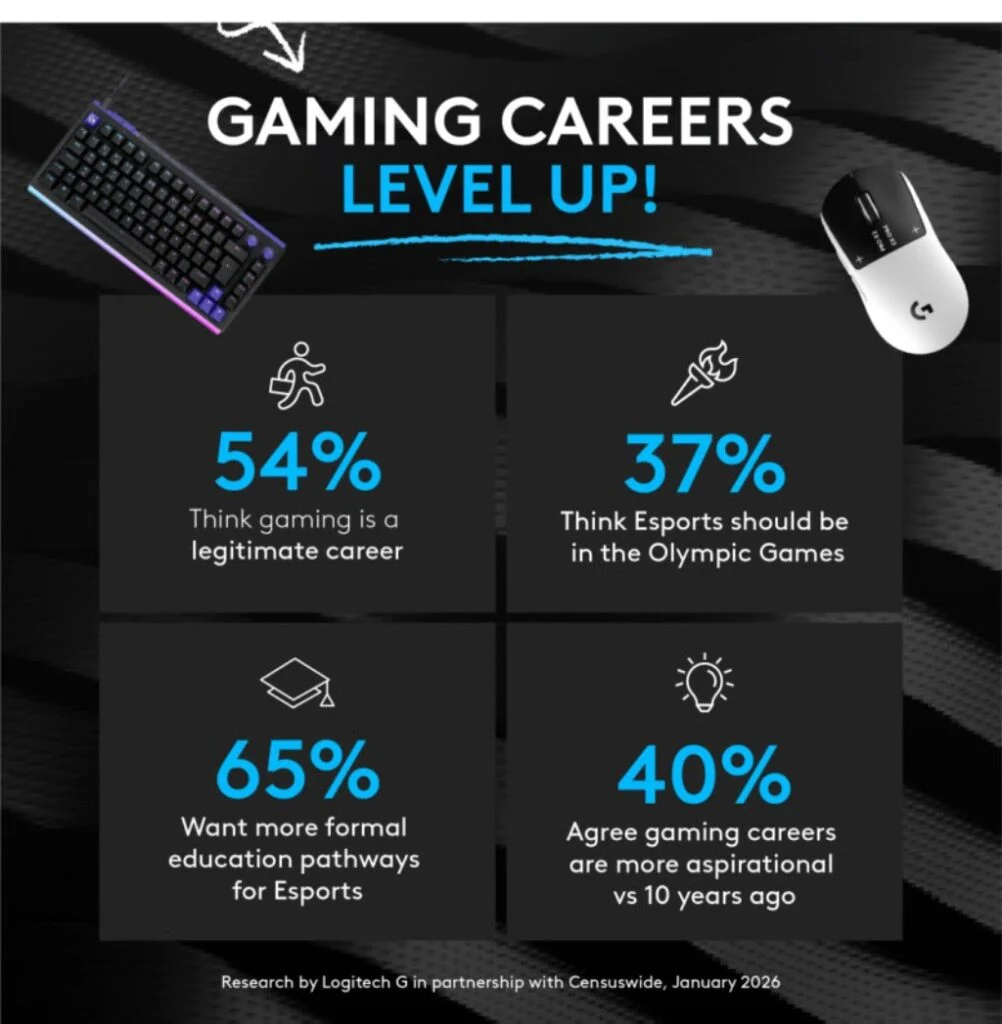
The landscape of professional gaming has undergone a seismic shift over the last decade. Once dismissed as a niche pastime, esports has evolved into a multi-billion-dollar global industry, capturing the attention of mainstream media, traditional athletic organizations, and, perhaps most importantly, the next generation of workforce entrants. According to a landmark global study recently released by Logitech G, this cultural transformation is reaching a critical inflection point: there is now a widespread, urgent demand for formal educational frameworks and structured career pathways to support those seeking to enter the competitive gaming ecosystem.
While 54% of the global population now views esports as a legitimate career path, the transition from hobbyist to professional remains fraught with systemic hurdles. As the industry matures into 2026, the data suggests that the "Wild West" era of gaming is being replaced by a desire for the same academic and vocational rigor afforded to traditional sports.
Main Facts: The New Reality of Competitive Gaming
The Logitech G report serves as a diagnostic tool for the current state of the industry, highlighting that while the "prestige" of being an esports athlete is at an all-time high, the infrastructure supporting that ambition remains underdeveloped.
The core findings of the study indicate that 65% of respondents—a clear majority—explicitly support the integration of formal esports education into universities, colleges, and specialized technical institutes. This is not merely a request for gaming clubs; it is a call for a curriculum that encompasses everything from advanced mechanical training and tactical analysis to sports psychology, physical conditioning, and broadcast media production.
The report also dispels the myth that gaming is a "casual" pursuit. The data emphasizes that a vast majority of the public now recognizes the cognitive load and physical strain inherent in high-level play. With 84% of respondents acknowledging the mental intensity of the field and 55% identifying it as a physically demanding career, the perception of the "lazy gamer" is rapidly losing ground to the reality of the "esports athlete."
Chronology: From Bedroom Hobby to Global Stage
To understand why this call for education is happening now, one must look at the rapid acceleration of the industry:
- The Early 2010s (The Formative Years): Esports existed largely in decentralized pockets. Career paths were nonexistent; players were self-taught, and sponsorships were sporadic.
- The Mid-2010s (The Growth Phase): Massive tournament prize pools and the rise of streaming platforms like Twitch began to normalize gaming as a potential income stream, though it remained viewed with significant societal skepticism.
- The Late 2010s to Early 2020s (The Institutionalization): Universities began offering esports scholarships. High-end hardware manufacturers, including Logitech G, began tailoring professional-grade gear specifically for the demands of the competitive circuit.
- 2026 (The Current Inflection Point): We have entered an era of "Professional Integration." The focus has shifted from whether esports can exist as a career to how it can be standardized as a career. The current dialogue is centered on educational legitimacy, athlete welfare, and long-term professional sustainability.
Supporting Data: The Generational and Regional Divide
The Logitech G research provides a nuanced look at the demographics of this shift. As expected, generational cohorts view the industry through vastly different lenses.

Generational Shifts
The "Esports Acceptance Gap" is most visible when comparing Gen Z and Millennials against the Baby Boomer generation.
- Gen Z: 67% view esports as a legitimate career path.
- Millennials: 60% support the professionalization of the industry.
- Boomers: Only 37% express support for professional gaming as a career.
These numbers suggest that as younger generations move into positions of political and academic leadership, the institutional support for esports will likely increase exponentially.
Regional Disparities
The survey also reveals a fascinating geographical divide. In markets such as China and Switzerland, where esports infrastructure and government support are robust, the social acceptance of professional gaming is significantly higher. Conversely, in traditional Western markets like the UK, France, and Germany, progress is slower, with a more cautious approach to integrating gaming into public school curriculums.
Interestingly, the report noted that Chinese Boomers were far more supportive of professional gaming than their German counterparts, suggesting that cultural attitudes toward technology and competition play a larger role in adoption than mere age alone.
Official Responses and Industry Vision
Derek Perez, Global Communications Gaming Lead at Logitech G, provided the industry’s perspective on these findings. In his assessment, the current state of esports is a "success of passion, but a challenge of structure."
"Esports has evolved far beyond entertainment," Perez stated. "It offers genuine opportunities for personal and professional success. However, more can be done to support younger generations in pursuing these careers."
Perez underscored that the primary barrier to entry for many young talents is not a lack of skill, but a lack of resources. He noted that the future of the industry depends on providing equal access to high-quality "training, facilities, and technology." By professionalizing the training environment—moving away from 12-hour bedroom marathons toward structured, scientifically backed training sessions—the industry can mitigate burnout and improve the longevity of esports careers.

The Physical and Mental Toll: The "9-to-5" Myth
One of the most revealing sections of the report addresses the physical realities of the profession. Contrary to the "couch potato" stereotype, professional gamers are increasingly operating like traditional athletes. The report notes that gamers often spend 10 to 12 hours per day in active training—a workload that dwarfs the traditional 9-to-5 workday.
This "grafting," as the report refers to it, has consequences. Without proper ergonomic furniture, physical training, and mental health support, the risk of injury and early career retirement is high. The study’s finding that nearly half of all respondents believe schools should integrate esports alongside traditional sports is a tacit recognition that if we want these individuals to succeed, we must provide them with the same athletic support systems—coaches, physiotherapists, and nutritionists—that we provide to football or basketball players.
Implications: A Future Built on Hardware and Education
The implications of this report are two-fold. First, there is a clear market mandate for educational institutions to act. Whether it is through specialized degree programs or vocational training in esports management, the "demand side" (the students) is ready.
Second, the hardware industry is pivoting to meet these professional needs. Logitech G’s recent product launches, such as the PRO X2 SUPERSTRIKE mouse and the Logitech G512 X TMR Analog/Mechanical Gaming Keyboard, are indicative of this trend. These tools are no longer designed just for "gaming"; they are engineered for the specific requirements of the professional athlete who needs precision, haptic feedback, and extreme durability.
The Path Forward
As we look toward the remainder of the decade, the integration of esports into the Olympic Games and broader school curricula remains a primary objective for many advocates. With over a third of respondents in the Logitech G study supporting the inclusion of esports in the Olympic Games, the momentum is undeniable.
However, the "growing pains" remain. Financial volatility, the lack of traditional job security, and the lingering stigma from older generations continue to act as friction. To overcome these, the industry must transition from being a "spectacle" to being a "sector." This requires:
- Academic Standardization: Moving beyond clubs to credit-bearing courses.
- Athlete Welfare: Formalizing the physical and mental health protocols for professional players.
- Parental Engagement: Using data-driven reports like the one from Logitech G to demonstrate the viability and safety of the career path.
The report concludes on an optimistic note. The rise of professional gaming is no longer a trend; it is a fundamental shift in how we define competition and talent. While the journey from basement gaming to the global stage has been long, the path ahead is becoming increasingly illuminated by technology, institutional support, and a generation that views the digital screen not as a distraction, but as a legitimate arena for professional excellence.











No comments yet. Be the first to join the conversation!