

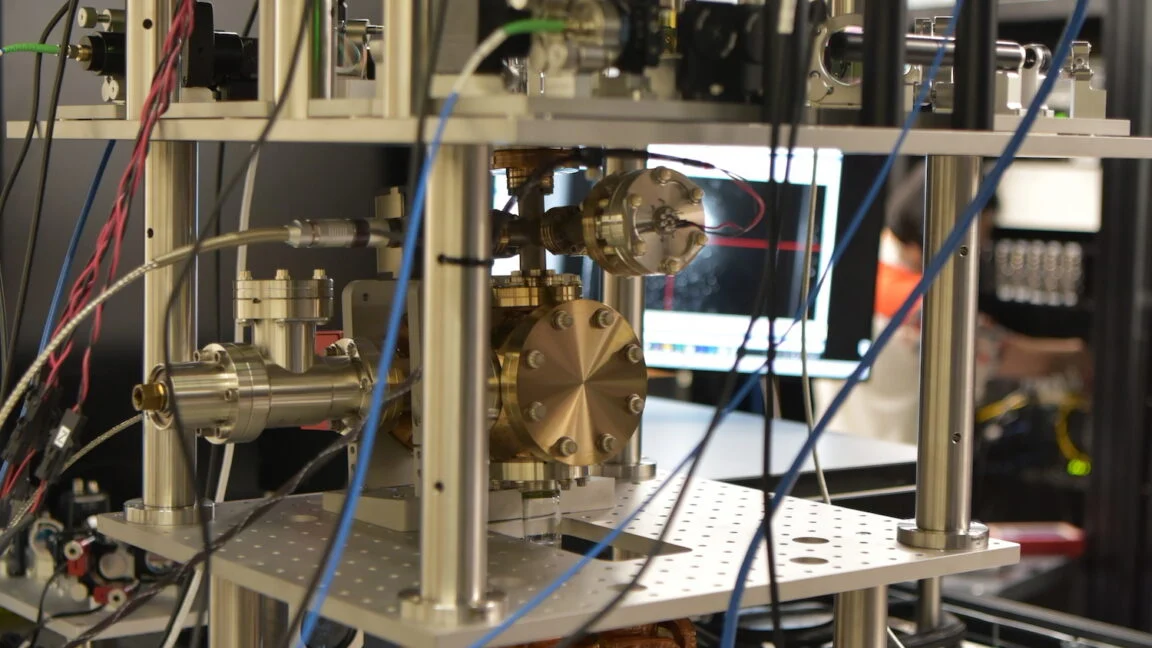
Main Facts: A Paradigm Shift in Quantum Architecture
The landscape of quantum computing, long dominated by the "Noisy Intermediate-Scale Quantum" (NISQ) era, is bracing for a seismic shift. QuEra Computing, a frontrunner in neutral-atom quantum technology, has officially unveiled its strategic roadmap, outlining a trajectory that aims to bypass incremental updates in favor of a singular, massive leap toward fault-tolerant, error-corrected quantum computing.
In a move that has sent ripples through the scientific community, QuEra has announced the discontinuation of its commercial NISQ-era systems. Instead, the company is pivoting entirely toward a high-stakes development cycle aimed at delivering a "useful" quantum computer hosted by Amazon Web Services (AWS) by 2028. This machine will move beyond the experimental, error-prone devices of today, targeting a threshold of 10,000 physical qubits to yield 256 error-corrected logical qubits.
This is not merely a quantitative increase; it is a qualitative transformation. By achieving a 99.9999 percent error-free operation rate, QuEra claims its machine will move quantum computing from the realm of academic experimentation into the sphere of industrial-grade utility, capable of executing millions of operations without the decoherence that has plagued the field for decades.
Chronology: The Path to 2029
To understand the gravity of QuEra’s announcement, one must look at the timeline the company has laid out. Unlike traditional tech firms that favor annual hardware iterative releases, QuEra has adopted a "leapfrog" strategy.
- Pre-2025 (The NISQ Era): QuEra deployed systems utilizing approximately 250 hardware qubits. While these were instrumental in early research, they were fundamentally limited by high error rates, making them unsuitable for large-scale logical applications.
- 2025–2027 (The "Dark" Development Phase): QuEra has declared an end to new hardware releases for the commercial market. The company is dedicating these years exclusively to internal R&D, focusing on the engineering challenges of scaling laser-based neutral atom manipulation.
- 2028 (The AWS Launch): The target date for the delivery of the first fault-tolerant machine. This system, hosted through Amazon, is intended to be the first "useful" quantum computer capable of supporting 256 logical qubits.
- 2029 (The Scale-Up): Just one year later, QuEra plans to double its capacity. The 2029 successor aims to support over 1,000 logical qubits with a staggering 99.9999999 percent error resistance, effectively setting the standard for the next decade of quantum advancement.
Supporting Data: The Physics of Neutral Atoms
The feasibility of QuEra’s ambitious timeline rests on the unique properties of their hardware. Unlike superconducting qubits, which require complex cryogenic environments and suffer from significant connectivity limitations, QuEra’s machines utilize neutral atoms suspended in a grid by "optical tweezers"—highly precise laser arrays.
Scaling via Laser Capacity
Scaling a neutral-atom computer is, in many ways, an exercise in photonics rather than traditional semiconductor manufacturing. Because the atoms are held in place by light, increasing the qubit count is primarily a matter of boosting laser capacity and control architecture. Academic partners that originally spun out QuEra have already demonstrated the stability of a 3,000-qubit system in laboratory settings (ref: arXiv:2506.20660). This proof-of-concept provides a solid, if challenging, roadmap to the 10,000-qubit target.
The Problem of Attrition
One of the most critical hurdles in quantum computing is the loss of qubits during operations. In a neutral-atom system, atoms can be lost due to collisions with background gases or heating effects. However, QuEra’s labs have demonstrated "atom reloading" capabilities—the ability to replenish lost atoms mid-computation without disturbing the state of the remaining system. This ability to self-heal is the linchpin that allows QuEra to promise continuous, long-running operations that were previously thought impossible.
Official Responses: The Strategic Pivot
The decision to abandon the NISQ market was not made lightly. In an exclusive statement to Ars Technica, Yuval Borger, representing QuEra, explained the logic behind this aggressive shift.
"The company made a strategic decision not to sell NISQ systems anymore," Borger stated. This pivot signifies a recognition that the industry is hitting a wall of diminishing returns with noisy hardware. For years, the industry focused on simply adding more qubits; QuEra is now arguing that the marginal utility of adding "noisy" qubits has reached its end.
By focusing solely on fault-tolerant systems, QuEra is effectively telling the market that they are no longer interested in the "toy problems" of the early quantum age. They are positioning themselves as the infrastructure provider for the post-NISQ era, where the focus is not on the quantity of raw qubits, but on the quality of logical, error-corrected ones. This shift effectively places the burden of proof on QuEra’s engineering team to ensure the transition from the lab-demonstrated 3,000-qubit success to the 10,000-qubit commercial reality is seamless.
Implications: A New Era for Computing
The implications of this roadmap are profound, extending far beyond the confines of quantum physics laboratories. If QuEra succeeds in 2028, we are looking at the potential birth of a new industrial revolution.
Breaking the Cryptographic Barrier
Fault-tolerant quantum computers are the "holy grail" of cybersecurity. While the 256-logical-qubit machine promised for 2028 is not yet powerful enough to break modern encryption (such as RSA-2048), the trajectory toward 1,000 logical qubits by 2029 brings us dangerously close to the "Q-Day" threshold. This timeline necessitates an immediate acceleration in the adoption of post-quantum cryptography (PQC) across the public and private sectors.
Material Science and Drug Discovery
The primary commercial application for these machines will be in the simulation of molecular structures. Current classical supercomputers struggle to simulate complex chemical reactions because the number of variables grows exponentially. A machine with 256 to 1,000 logical qubits will allow researchers to simulate catalysts, new battery materials, and drug interactions with a precision that was previously purely theoretical.
The AWS Ecosystem
By tethering this technology to Amazon’s cloud infrastructure, QuEra is democratizing access to fault-tolerant computing. This is a critical move; if only a few research labs had access to these machines, progress would be glacial. By putting this power on the cloud, QuEra is enabling thousands of developers and researchers to stress-test their algorithms against actual error-corrected hardware, effectively creating a feedback loop that will accelerate the software development side of the industry.
The Risk of Failure
It is impossible to ignore the inherent risks in this roadmap. QuEra is betting the company on a massive hardware jump. If they encounter unforeseen physical bottlenecks—such as unexpected decoherence rates at higher qubit densities or technical limitations in the laser arrays—they lack the "bridge" of intermediate products to sustain revenue and momentum. This is a "make or break" scenario that reflects the high-stakes, winner-take-all environment of modern quantum competition.
Conclusion: The Horizon of 2028
As we look toward the end of the decade, the narrative of quantum computing is shifting from "when will it be useful?" to "how will we handle it when it is?" QuEra’s roadmap provides a concrete, albeit aggressive, answer.
By abandoning the low-hanging fruit of NISQ-era sales and committing to the long-term goal of fault-tolerant architecture, QuEra has signaled that the era of quantum hype is giving way to the era of quantum engineering. Whether they meet their 2028 deadline or not, the benchmark has been set. The industry now has a clear target: 10,000 physical qubits, 256 logical qubits, and a level of stability that could finally allow humanity to harness the true power of the subatomic world. The next three years will determine whether this plan is a masterstroke of vision or a cautionary tale of overreach. For now, the eyes of the global scientific community remain fixed on the laser arrays of QuEra, waiting to see if they can truly bridge the gap to the future.











