Evan Lee Salim
The landscape of global journalism is undergoing its most radical transformation since the invention of the printing press. According to the recently published 2026 Digital News Report by the Reuters Institute for the Study of Journalism, the traditional pathways through which citizens access information have been fundamentally dismantled and replaced by algorithmic curation.
Drawing on extensive survey data from over 85,000 respondents across 48 international regions, the report provides a sobering snapshot of a modern information ecosystem. It is an environment where the "gatekeepers" of yesterday—major television networks and established news websites—are being sidelined by a decentralized network of social media platforms, independent creators, and, increasingly, artificial intelligence.
The Decline of Direct Consumption: The Rise of Algorithmic Curation
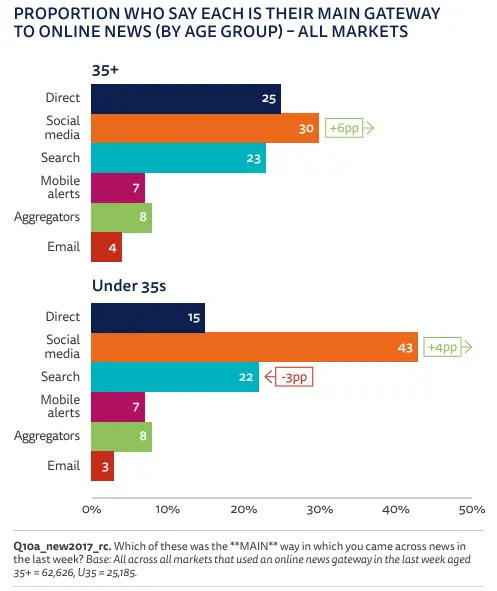
The primary finding of the 2026 report is the decisive shift in how users encounter news. For decades, news organizations relied on direct traffic—readers visiting a homepage or tuning into a broadcast. That era is effectively over.
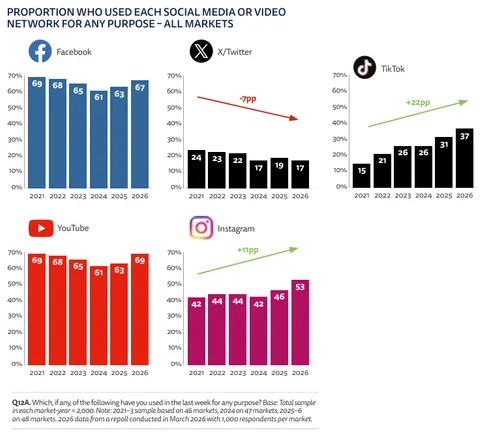
The data indicates that social media platforms have now surpassed traditional news websites and television as the primary vehicle for daily news distribution. This shift suggests that for the average consumer, news is no longer a destination; it is an incidental byproduct of their social media experience. Whether on TikTok, Instagram, or emerging platforms, news is served as a "feed" item, competing for attention against entertainment, personal updates, and advertisements.
This transition has profound implications for editorial control. When news is filtered through algorithmic feeds designed to maximize "time spent on app," the objective truth often takes a backseat to emotionally resonant, highly shareable content. Consequently, the perception of current events is no longer shaped by journalistic editors, but by the mathematical models of platform engineers.
Chronology of a Media Disruption: From Legacy to Creator-Led
To understand how we arrived at this juncture, one must look at the evolution of the digital news cycle over the past decade:
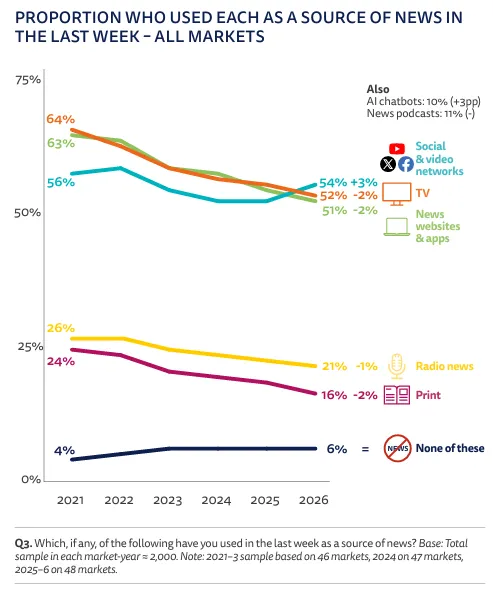
- 2016–2019 (The Social Consolidation): Platforms like Facebook and Twitter solidified their roles as the "town squares," but news was still largely driven by links to legacy media sites.
- 2020–2022 (The Pandemic Inflection): The global health crisis accelerated reliance on digital sources, but also highlighted the dangers of misinformation, leading to the first major debates over platform moderation.
- 2023–2024 (The X/Twitter Fragmentation): Following the acquisition of Twitter by Elon Musk and its rebranding to X, the platform saw a migration of users and a degradation of its reputation as a reliable, centralized news hub.
- 2025–2026 (The Creator and AI Era): We have now entered a phase where "influencer journalism"—news delivered by independent creators—has become a primary source of information, further supplemented by AI chatbots that synthesize data in real-time.
The New Gatekeepers: The Rise of the Online Creator
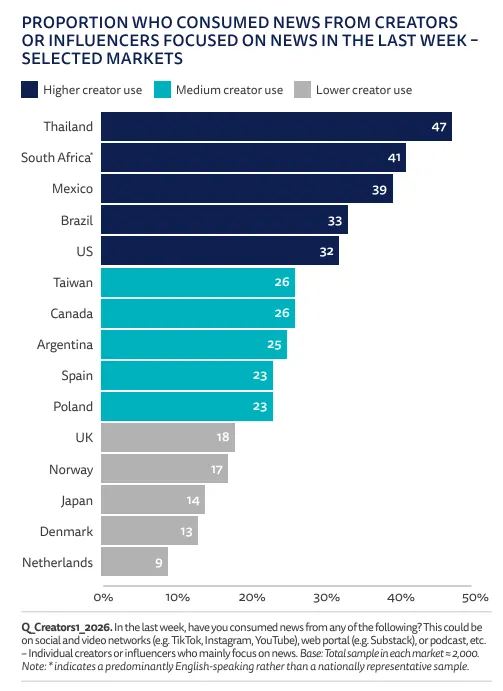
Perhaps the most significant structural change highlighted by the Reuters Institute is the emergence of the independent online creator as a trusted news source. In regions across the globe, users are increasingly turning away from institutional brands, which they often perceive as biased or disconnected, in favor of individual voices.
While these creators provide a sense of authenticity and accessibility, the report raises a critical concern: motivation. Unlike traditional newsrooms bound by editorial standards, fact-checking departments, and ethical codes, online creators are primarily motivated by engagement metrics. When a creator’s livelihood depends on clicks, shares, and algorithmic visibility, the pressure to sensationalize or re-angle stories to suit a specific audience’s bias becomes immense.
This creates a feedback loop. If a creator finds that a specific narrative generates high engagement, they are incentivized to continue producing similar content, regardless of its factual accuracy. This "engagement-first" model is the antithesis of traditional investigative journalism, which seeks to inform the public regardless of whether the story is "viral."
Supporting Data: The Platform Divide
The 2026 report provides clear empirical evidence of this shifting landscape:
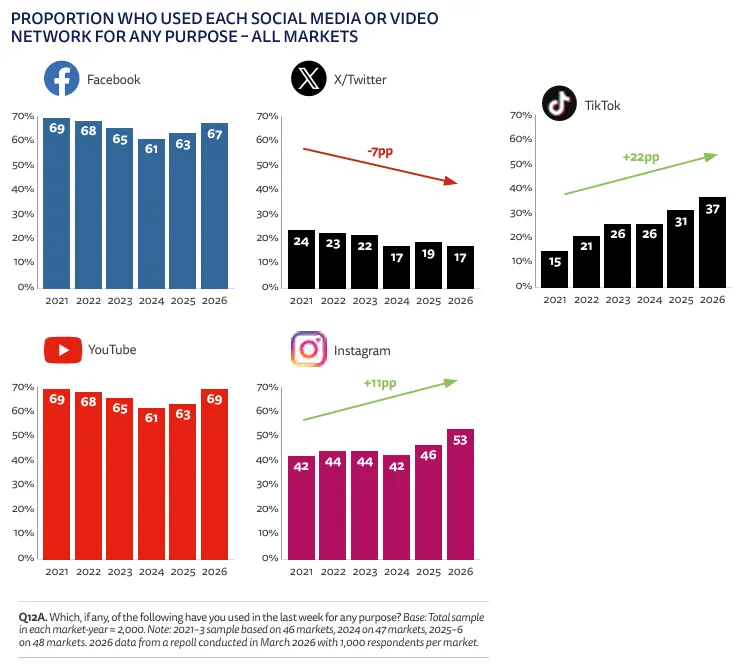
- TikTok and Instagram Dominance: These visual-first platforms are seeing an unprecedented surge in news consumption, particularly among younger demographics. Their ability to deliver bite-sized, video-based news snippets has proven far more effective at capturing attention than long-form written articles.
- The X/Twitter Decline: Data shows a clear drop in X’s status as a top-tier news source. The fragmentation of its user base—caused by policy changes, technical instability, and a shift in content moderation—has led users to seek alternatives, such as Meta’s Threads or decentralized platforms.
- Generational Convergence: Interestingly, the reliance on social apps for news is no longer just a trend for "digital natives." All age groups reported an increased reliance on social apps, suggesting that the migration away from legacy media is a structural change, not merely a generational quirk.
- The Rise of AI Chatbots: A startling new data point in the 2026 report is the emergence of AI chatbots as a primary news source. Users are increasingly asking AI to summarize events rather than reading original reporting.
The AI Challenge: Hallucinations as Headlines
The inclusion of AI chatbots as a news consumption vector is perhaps the most alarming trend identified by the Reuters Institute. AI models are trained to be conversational and authoritative, yet they are not fundamentally designed to be fact-checkers.
The phenomenon of "AI hallucinations"—where a model confidently asserts information that is entirely fabricated—poses a unique risk to public discourse. When users accept an AI’s summary as gospel without verifying it against primary sources, the potential for mass misinformation grows exponentially. If a chatbot presents a skewed or incorrect version of a political event, the user has no way of knowing they are being misinformed, as the AI’s delivery is designed to sound neutral and objective.
Implications for Democracy and Public Discourse
The cumulative effect of these trends is a fragile information ecosystem. The concentration of news distribution in the hands of a few tech giants, combined with the rise of engagement-seeking creators and potentially hallucinating AI, creates a "perfect storm" for the spread of misinformation.
1. The Vulnerability of Information Flow
When the flow of information is governed by algorithms rather than editorial judgment, the "public square" becomes a collection of silos. Users are fed information that reinforces their existing beliefs, making it increasingly difficult to achieve a shared consensus on basic facts.
2. The Economic Pressure on Fact-Based Journalism
As legacy media brands lose their ability to reach audiences directly, their business models are collapsing. This leads to a reduction in the resources available for expensive, time-consuming investigative journalism—the very kind of reporting that holds power to account.
3. The Need for Digital Literacy
The Reuters Institute report acts as a clarion call for increased digital literacy. As the sources of information become more varied and less regulated, the burden of verification shifts from the editor to the reader. Citizens must now navigate a complex web of creators, AI summaries, and algorithmically curated feeds, requiring a higher level of critical thinking than ever before.
Conclusion: Navigating the Future
The 2026 Digital News Report is not merely a collection of statistics; it is a map of a new reality. The decline of the traditional news-reading habit and the rise of algorithmic, creator-led, and AI-assisted information retrieval is a permanent shift.
While these new channels offer unprecedented access to diverse perspectives, they also introduce significant risks to the accuracy and reliability of the news we consume. As we move further into this era, the challenge for society will be to preserve the integrity of information while embracing the technological advancements that have fundamentally altered how we engage with the world. The era of the "gatekeeper" may be over, but the era of the "informed citizen" has never been more vital—or more difficult to achieve.



 Iffa Jayyana