

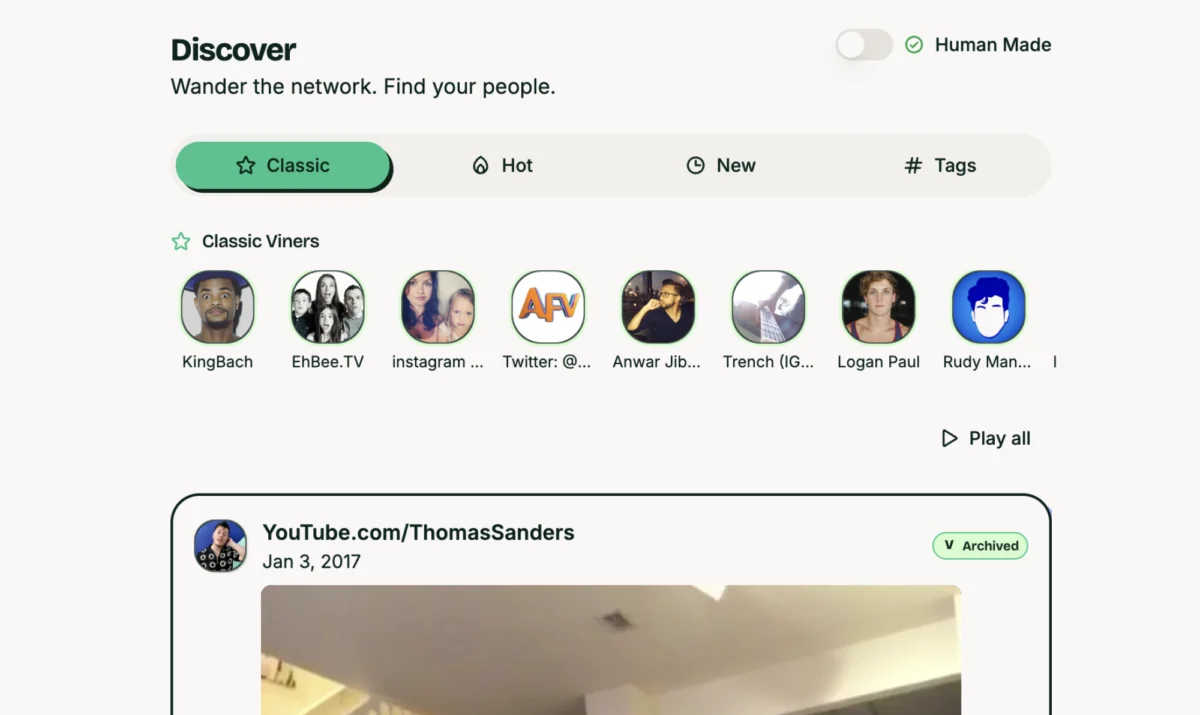
It is a sentence that would have sounded like science fiction—or perhaps a cruel joke—only a few years ago: Vine is back. In the year 2026, the short-form video landscape is dominated by hyper-optimized algorithms, generative AI, and a relentless stream of “content slop.” Yet, rising from the digital ashes of the 2010s is Divine, a platform that aims to recapture the chaotic, human, and uniquely limited magic of the original six-second video app.
Ironically, the rebirth of this beloved relic is funded by the very man who presided over its demise: former Twitter CEO Jack Dorsey. Almost a decade after the original Vine was shuttered, leaving a generation of creators and fans in mourning, its spiritual successor is now live, presenting a radical proposition to a cynical digital world: what if social media was actually human?
The Main Facts: A Digital Homecoming
Divine serves a dual purpose. On one hand, it functions as a comprehensive, searchable archive of 500,000 legacy videos from the original Vine platform. On the other, it is a living, breathing social network designed for the modern era, albeit one that intentionally rejects modern trends.
The platform’s central tenet is "freedom from AI slop." In an age where deepfakes, automated content mills, and algorithmic engagement traps have rendered much of the internet unrecognizable, Divine demands a return to the tactile. To post on Divine, users must either record their content directly within the app or subject their uploads to a rigorous human-verification protocol. This system is powered by the Guardian Project, a nonprofit dedicated to digital security and human rights, ensuring that every frame on the platform is, ostensibly, the product of human effort.
A Chronological Odyssey: From Vine to Divine
To understand the significance of Divine, one must look at the trajectory of its predecessor. Vine launched in 2013 and, for a brief, glorious period, redefined the internet. With a hard limit of six seconds, the app forced creators to become masters of timing, editing, and physical comedy. It birthed a new class of internet celebrity—Logan Paul, King Bach, and Zach King among them—and fostered a unique, communal culture that felt intimate despite its massive scale.
However, the platform struggled with monetization and corporate mismanagement. In 2017, Twitter, under the leadership of Jack Dorsey, pulled the plug on Vine. The decision was met with widespread public outcry, but the app was officially buried. Its DNA, however, refused to die. The "looping" format became the backbone of TikTok, while Instagram Reels and YouTube Shorts aggressively chased the engagement metrics that Vine had pioneered but failed to capitalize on.
After years of dormancy, the spark of a revival began in late 2025. Evan Henshaw-Plath—a former Twitter engineer widely known in the developer community as “Rabble”—spearheaded the initiative. Initially, the project was intended merely as a digital museum to preserve the legacy of Vine. However, with backing from Dorsey’s nonprofit, and Other Stuff, the scope expanded into a fully functional social media ecosystem. Following a successful beta testing period in November 2025, Divine officially launched in the spring of 2026.
The Technological Barrier: Enforcing Authenticity
The most striking feature of Divine is its uncompromising stance on artificial intelligence. In an era where generative tools can churn out millions of videos in seconds, Divine’s "Human-First" policy is a significant technical and philosophical hurdle.
By partnering with the Guardian Project, Divine employs sophisticated forensic verification tools to ensure that videos are not synthetic. This is not merely a "terms of service" agreement; it is baked into the infrastructure. By requiring in-app capture or third-party verification, the platform aims to eliminate the "dead internet" phenomenon where bots interact with bot-generated content.
This creates an environment where, theoretically, every video is the result of a human making a choice—choosing where to point the camera, when to cut, and what to capture. It is a deliberate step backward in technological convenience to move forward in cultural value.
Official Responses and the Vision of Jack Dorsey
Jack Dorsey has been vocal about his regrets regarding the original shutdown of Vine. In a recent statement to The Guardian, he acknowledged that the original platform’s collapse was a failure of vision.

"We didn’t understand what we had until it was gone," Dorsey noted. "With Divine, the goal isn’t to build a ‘Twitter-killer’ or a ‘TikTok-competitor.’ The goal is to build an ecosystem where the creator remains the owner of their work and their audience."
Central to this new vision is a departure from the "walled garden" model of traditional social media. Dorsey and Henshaw-Plath have emphasized that Divine is built on principles of open-source protocols. Creators will retain full ownership of their content and, more importantly, their relationship with their followers. By decoupling the creator’s success from the platform’s proprietary algorithm, Divine hopes to foster a model where creators can monetize their work directly, free from the arbitrary changes in "reach" that have plagued legacy platforms like Instagram and YouTube.
The Competitive Landscape: A David Against Goliaths
Divine enters a market that is fundamentally different from the one Vine occupied in 2013. The landscape is currently dominated by entrenched, multi-billion-dollar behemoths:
- TikTok: The undisputed king of short-form video, boasting a recommendation algorithm so precise it is often described as addictive.
- Instagram Reels: A juggernaut that leverages a massive, pre-existing user base to push short-form content into the daily feeds of billions.
- YouTube Shorts: A platform that has successfully converted long-form viewers into short-form consumers, regularly surpassing 200 billion daily views.
Against this backdrop, six seconds of human-made video seems, at best, a nostalgic hobby and, at worst, an obsolete relic. Why would a user choose a platform with limited reach and manual verification requirements when they can post to YouTube Shorts and potentially reach millions in minutes?
The answer, according to the Divine team, lies in "human fatigue." The industry is currently facing a reckoning regarding the quality of content. As "brainrot" and AI-generated slop flood the digital ecosystem, the value of authentic, human-centric content is rising. Divine is betting that a significant subset of the population is tired of being fed by algorithms and is ready to return to a space where social media feels like a conversation rather than a feed.
The Implications: Why Divine Matters
The success or failure of Divine will serve as a bellwether for the future of the internet. If it succeeds, it will prove that there is a viable market for "Slow Social Media"—platforms that prioritize intentionality over volume and human effort over algorithmic efficiency. It would challenge the assumption that social media must be a scale-at-all-costs endeavor.
Conversely, if Divine struggles to gain traction, it may cement the idea that the "Old Internet" is permanently gone, replaced by a permanent state of algorithmic saturation. The irony of Elon Musk—who once publicly toyed with the idea of reviving Vine to compete with TikTok—having been beaten to the punch by his former colleague Jack Dorsey, adds a layer of soap-opera intrigue to the proceedings. While Musk’s X (formerly Twitter) continues to struggle with bot activity and content moderation, Dorsey’s Divine is attempting to solve those exact problems by stripping the technology down to its base components.
Conclusion: A Bold, Small Proposition
Divine is available now on the Google Play Store and the Apple App Store. It is a bold, perhaps even foolhardy, proposition. In a world of 4K, AI-enhanced, algorithmic perfection, the return of the six-second loop feels jarring. Yet, there is something undeniably human about the effort.
Whether or not it can scale remains to be seen. But in its insistence that we return to the basics—that we acknowledge the creator, that we verify the human, and that we value the limited—Divine offers a glimmer of hope. It asks us to stop scrolling, start looking, and remember what it felt like when the internet was a place where we could all be human, just for six seconds at a time.
The stage is set. The loops are ready. The question is no longer whether we can bring back the past, but whether we still have the patience to enjoy it.











No comments yet. Be the first to join the conversation!