In the contemporary art world, where grand gestures often dominate the discourse, London-born artist Amelia Cross is turning the spotlight toward the microscopic. Her work, a masterful hybrid of bespoke tailoring and fine art painting, challenges the viewer to reconsider the silent, subliminal language of clothing. By deconstructing the shirt, the pocket, and the crease, Cross exposes the tension between the curated persona we present to the world and the chaotic, messy reality that lies beneath.
Cross’s practice does not merely observe fashion; it interrogates it. Through her innovative "sewn paintings"—a technique that marries trompe l’oeil precision with actual sculptural fabric construction—she invites an intimate, almost forensic examination of human identity. Her current solo exhibition, Discipline and Display, at the prestigious Nino Mier Gallery, serves as a capstone to her exploration of how our sartorial choices are tethered to social structures, uniforms, and the hidden agendas we carry in our pockets.
The Genesis of a Hybrid Practice
To understand the depth of Cross’s work, one must first look at her academic lineage. Her trajectory began at the London College of Fashion, where she mastered the rigorous craft of bespoke tailoring. This training provided her with an intimate knowledge of garment construction: the weight of a lining, the structural integrity of a shoulder, and the hidden geometry of a sleeve.

Following her time in fashion, she transitioned to the Royal College of Art to pursue a master’s in painting. It was here that the two disciplines began to collide. Initially, Cross focused on painting flat, figureless compositions of clothing on linen. However, she found the traditional medium insufficient for the tactile reality she sought to convey.
"I originally painted figureless compositions of clothing on a flat linen surface but felt my hands itching to use my sewing machine alongside painting," Cross recalls. "I started making small studies of sewn pockets and structured collars with painted objects and buttons, and I found this odd juxtaposition of the real and painted shadows really intriguing."
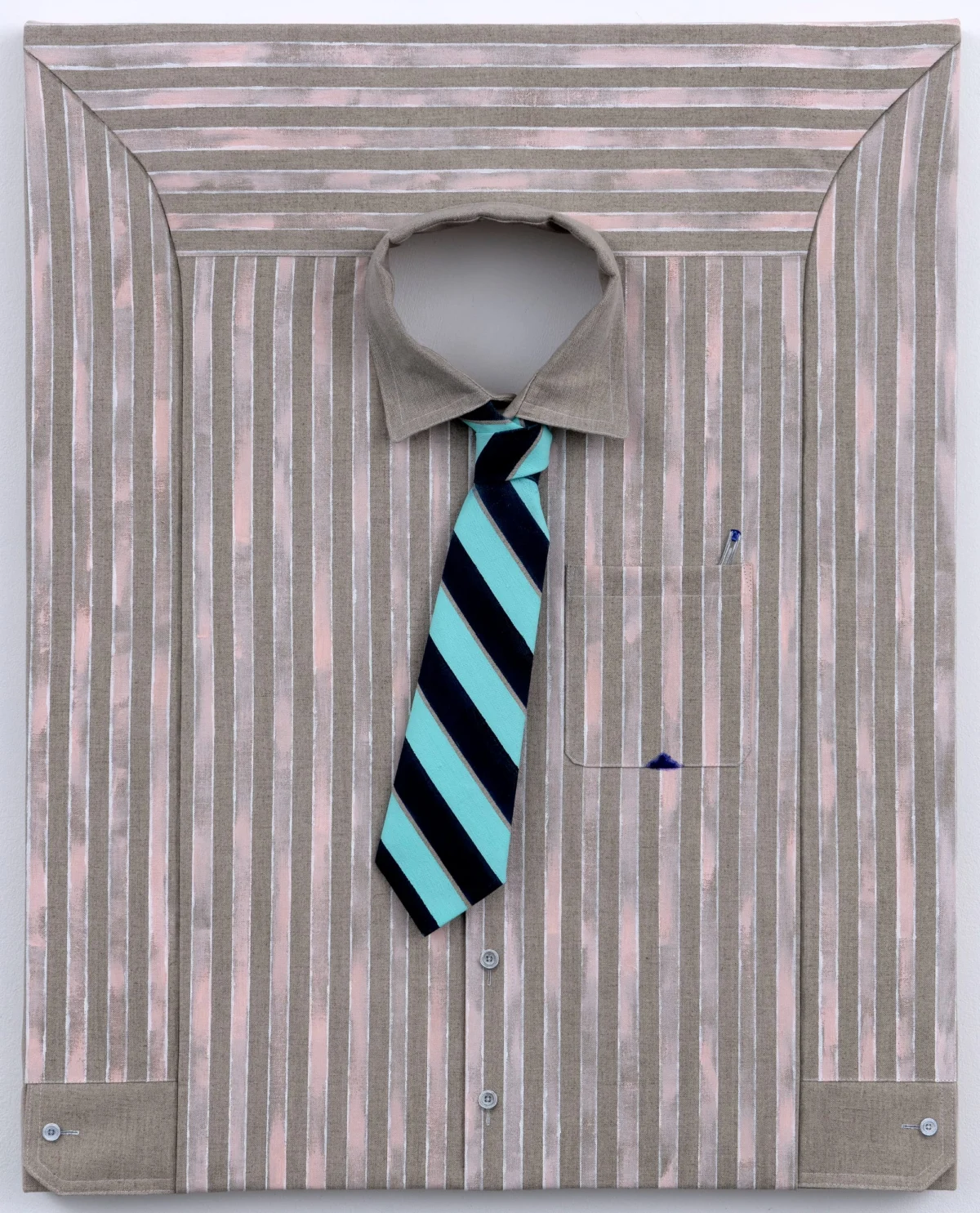
This revelation birthed her signature style. By blurring the line between the painted illusion and the physical object—attaching actual fabric to the canvas—she forces the viewer into a state of cognitive dissonance. Is the button real? Is that shadow cast by the paint or by the fabric itself? This uncertainty is intentional, designed to make the viewer pause and question the "legibility" of the subject matter.

Chronology of an Artistic Evolution
- Formative Years: Cross’s early exposure to the precision of London tailoring sets the groundwork for her technical discipline.
- Academic Synthesis: During her tenure at the Royal College of Art, Cross experiments with merging traditional canvas painting with sewing machine techniques.
- The "Sewn Painting" Breakthrough: The artist develops her specific trompe l’oeil style, treating the wooden armature of the canvas as a "body" to be dressed.
- Observational Research: Cross begins documenting the commuters of the London Underground, finding inspiration in the fragments of clothing seen during the high-pressure, high-density environment of rush hour.
- 2026 Exhibition: The launch of Discipline and Display at the Nino Mier Gallery, representing her most comprehensive exploration of dress codes and societal expectations to date.
The Architecture of the Commute: Observational Data
A central theme in Cross’s work is the concept of the "partial view." Because her inspiration is often drawn from the fleeting, crowded moments of the London Underground, her compositions frequently feature tight, clinical crops of clothing. In these spaces, a person is reduced to their accessories: the pen in a shirt pocket, the specific weave of a sock, or the fraying edge of a nametag.
"During rush hour, you’re often packed in a carriage like sardines, which is sometimes why my paintings have a slim tight crop as I can only see a partial element of clothing at a time," says Cross. "You can almost build up a whole character for someone based on what’s inside their pocket or what socks they are wearing to work!"
This methodology reflects a modern urban reality. We live in a world where we constantly perform identity, yet we rarely have the luxury of viewing others in their totality. Cross’s paintings, such as The Ice-breaker or The Miscreant, treat these fragments as artifacts of human behavior. By isolating a shirt pocket filled with a stray receipt or a pair of sunglasses, she elevates the mundane to the level of portraiture.

Supporting Data: The Psychology of "Discipline and Display"
The exhibition Discipline and Display acts as a social critique of the "rules" we follow. Whether it is the corporate uniform, the casual Friday, or the rigid expectations of professional attire, clothing serves as a restrictive apparatus.
Cross utilizes the trompe l’oeil technique to play with these expectations. By creating hyper-realistic depictions of garments, she mimics the "discipline" of the uniform, but by adding sculptural, sewn elements, she introduces a layer of "display"—a personal, hidden defiance.
The technical specifications of her work are as follows:

- Structural Armature: Cross constructs her own wooden frames, conceptualizing them as human forms.
- Media Integration: A blend of oil-based paints for shadow work and textile materials (linens, cottons, polyester blends) for the physical components.
- Hidden Elements: Much of the artwork contains "secrets"—labels on inner collars, messages tucked into pockets, and buttons sewn onto the sides or backs of the paintings.
These hidden details are a crucial part of the artist’s intent. They reward the viewer for physical engagement. To see the full scope of the work, one must move around the object, bend, and look underneath. This mimics the way we learn to know people: initial impressions are surface-level, but true character is found in the "hidden" or "internal" spaces of a person’s life.
Implications: What Our Clothes Say When We Aren’t Listening
Cross’s work raises profound questions about the nature of modern life. In an era where digital surveillance and social media curation dictate much of how we present ourselves, the physical act of dressing has become an even more poignant site of struggle.
The Uniform as a Social Barrier
Cross argues that clothing is not just about aesthetics; it is about hierarchy and status. Her work, The Brit, which depicts a folded gray trench coat, evokes the stoic, protective layers that citizens adopt to navigate the cold, often impersonal atmosphere of a major city. The coat is both a shield and a cage.

The Subconscious Confession
By painting inner collar labels or placing messages in pockets, Cross is commenting on the things we carry but do not share. The pen bleeding through a pocket is a sign of a person who is working too hard, or perhaps someone who is disorganized; the curled nametag suggests a lack of pride or a sense of exhaustion. These are the "subliminal details" that the artist wants to capture. By pinning them to a wall in a gallery, she forces a confrontation between the viewer and these subtle, human failings.
The Trompe L’oeil Paradox
The use of trompe l’oeil—"deceive the eye"—is not merely a stylistic choice; it is a metaphor for the social contract. We often present a "deceptive" version of ourselves to the world. We press our collars, we shine our shoes, and we tuck in our shirts, all to convey a sense of order. Cross’s art is a reminder that the construction is a performance. By sewing real fabric onto the canvas, she breaks the illusion, showing that behind every "perfect" presentation, there is a physical, tactile, and potentially messy human being.
Conclusion: Getting Up Close and Personal
Amelia Cross’s work is an invitation to look closer—not just at the art, but at the world. She asks us to notice the frayed edges, the hidden buttons, and the forgotten pens in the pockets of those we pass on the street.

For those who have the opportunity to visit the Nino Mier Gallery before the exhibition closes on August 7, the experience is transformative. The work is not meant to be viewed from a distance; it demands a physical intimacy that is rare in the contemporary gallery space.
In a world that is increasingly focused on the digital, the virtual, and the ephemeral, Cross’s work is a grounding force. It reminds us that we are physical beings, trapped in the structures of our own making, defined by the clothes we wear and the secrets we tuck away in our pockets. Whether it is through the meticulous rendering of a chambray shirt in Cowboy or the sharp, professional lines of The Pair, Cross manages to find the humanity in the garment, proving that even the most mundane object can hold a story worth telling.
As we move through our daily lives, often lost in the rush of the commute or the pressures of the office, Amelia Cross’s art serves as a necessary intervention. It encourages us to be more observant, to be more empathetic, and to recognize that every person we meet is wearing a story that is far more complex than the fabric on their back. For more updates on her ongoing series and future exhibitions, the artist maintains a consistent dialogue with her audience through her digital presence on Instagram, where she continues to document the nuances of the everyday.