

In the agency world, growth is often viewed through the lens of revenue: more retainers, larger budgets, and a growing roster of logos. However, the internal infrastructure that sustains five clients often becomes the very thing that strangles an agency when it reaches fifty.
What works at five clients breaks at twenty. What breaks at twenty collapses at fifty. This isn’t a symptom of a declining team or a drop in creative quality; it is the inevitable consequence of a fatal misconception. Many agency owners believe they have a "process," when in reality, they have a set of informal habits. And as any seasoned operator knows, habits do not scale.
The Mirage of Scalability: How Volume Exposes Weakness
The breakdown of agency workflows is rarely a sudden explosion; it is a slow erosion of efficiency that goes unnoticed until a systemic failure occurs. A post goes live without final approval. A campaign misses its critical window because a key stakeholder was unreachable for 48 hours. A client disputes a version of a creative asset that they never formally signed off on.
These are not "one-off" mistakes. They are the predictable outcomes of a system designed for a startup environment being forced to function in an enterprise-level workload.
The Mathematics of Failure
To understand why agencies hit a wall, one must look at the data. As an agency grows from five to fifty clients, the administrative burden doesn’t grow linearly—it grows exponentially.
| Metric | 5 Clients | 20 Clients | 50 Clients |
|---|---|---|---|
| Active Approval Threads | 15–30 | 60–120 | 150–300 |
| Tracking Method | Memory + Email | Email (failing) | No central system |
| Process Overhead (Weekly) | 2–4 hours | 10–20 hours | 30–50 hours |
| Risk of Wrong Version | Low | Occasional | Regular |
| Consequence of Silence | One post delayed | One client stalled | Systemic backlog |
At five clients, the informal, "memory-based" approach is a competitive advantage; it allows for agility and personalized service. At twenty clients, those informal arrangements solidify into twenty separate, undocumented micro-processes. By the time you reach fifty clients, the complexity exceeds the cognitive capacity of any single human being.
The Anatomy of the Collapse: Three Points of Failure
The failure of an agency’s workflow follows a specific, chronological sequence. Each point of failure acts as a force multiplier for the next.
1. The Channel Fragmentation
The most common default for growing agencies is the inbox. Because email requires no setup, it is the path of least resistance. However, by the time an account manager (AM) is juggling 120 active approval threads across email, Slack, WhatsApp, and LinkedIn DMs, the "channel" has effectively become a black hole.
According to the 2023 State of Creative Workflow Report by Ziflow, 48% of creative professionals spend at least five hours per month simply chasing feedback. When that feedback is fragmented across five different communication tools, that number doubles, effectively turning high-value strategists into glorified administrative assistants.
2. The Bottleneck of the Single Approver
Every agency naturally drifts toward a "one approver per client" model. It feels intimate and dedicated. However, at scale, this becomes a structural liability. When the primary approver goes silent, the entire project stalls.
Data from Gleanster and Kapost reveals that 92% of marketers cite approval delays as the primary reason for missed deadlines. The bottleneck is rarely the content itself; it is the fragile dependency on a single individual to press the "publish" button. When an agency relies on a "hero" culture—where success depends on one person’s constant availability—the entire agency remains one emergency or vacation away from a systemic backlog.
3. The Myth of Bespoke Workflows
In the early days, "client customization" is a selling point. Client A wants a PDF; Client B insists on Friday approvals; Client C requires legal sign-off. At five clients, this is a manageable mental list. At twenty, it becomes a chaotic, undocumented library of preferences.

When these workflows live only in an AM’s head, the agency loses its "institutional memory" every time a staff member takes a sick day or resigns. Ziflow’s research highlights that 43% of creative teams struggle with feedback on outdated versions of content. This is the direct result of having no centralized system for version control.
The Path to Resilience: Fixing the Foundation
The solution to these failures is not to hire more people; it is to replace "habits" with "systems." To scale, agencies must transition from manual, human-dependent workflows to platform-enforced processes.
Transitioning to a Centralized Channel
The first step is to move approvals out of the "inbox" and into a dedicated environment. By using an approval management tool, agencies create a single source of truth. When a client approves a post within a platform, there is an immutable audit trail: a timestamp, a verified identity, and a locked version of the asset. The question, "Which version did we send?" disappears, saving hours of manual reconciliation every week.
Institutionalizing the Approver Model
Agencies must move away from the "single approver" risk. This requires a formal policy implemented at the point of onboarding: every client must have a designated backup approver. This is not a "nice-to-have"—it is a contractually mandated safeguard. By framing this as a service-level agreement (SLA) designed to protect the client’s posting schedule, most stakeholders accept it without pushback. If the primary contact remains silent for 48 hours, the backup is authorized to step in.
Standardizing Customization
True scale is achieved when customization is configured as a system, not a manual task. A high-performing agency platform allows for per-client workflow settings. Whether a client requires a two-stage review or an auto-publish window, those rules should be hard-coded into the software during onboarding. This removes the burden of "remembering" from the account manager and places it on the infrastructure.
Implications for Agency Leadership
For agency owners, the transition from twenty to fifty clients is the "make or break" phase of the business lifecycle. The evidence suggests that for managers handling more than eight clients, the approval layer is the first place where capacity evaporates.
If you are currently managing your workflow through spreadsheets, email threads, and "mental notes," you are operating on borrowed time. The wall isn’t ahead of you; you are already at it. The difference between agencies that collapse under the weight of their own success and those that thrive is the early adoption of structural safeguards.
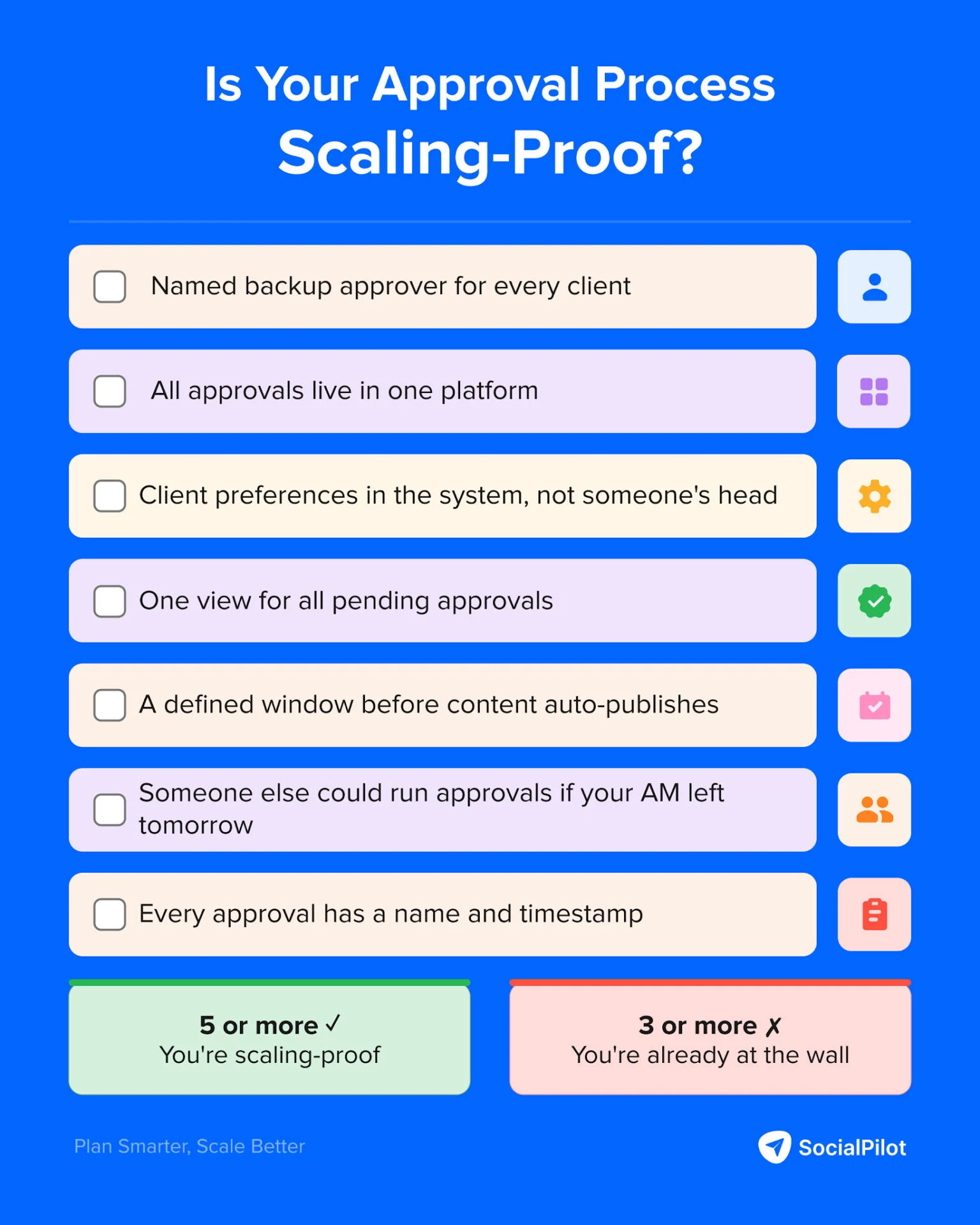
The Scaling-Proof Checklist
Before declaring your agency ready for the next tier of growth, audit your current state against these five critical markers:
- Version Control: Do you have a permanent, time-stamped record of every client approval?
- Channel Consolidation: Does all approval feedback happen in one place, or is it scattered across chat and email?
- Backup Coverage: Does every client have a named, authorized backup approver?
- Automated Enforcement: Does your software automatically enforce the specific review rules for each client?
- No-Login Friction: Can your clients approve work without the friction of complex logins or manual email replies?
If you answered "no" to three or more of these, your process is under strain. If you answered "no" to five, you are not facing a scaling problem—you are facing a structural collapse.
Final Thoughts: The Cost of Waiting
The most dangerous trap in agency growth is the belief that "we will fix it when we have more money." The reality is that the process must be fixed before the crisis occurs.
Fixing your approval workflow is not just about saving time; it is about protecting the client experience. When an agency operates with clear, automated systems, the client feels the difference in reliability. When an agency relies on human habit, the client feels the difference in missed deadlines and version confusion.
Do not wait for a client to point out that your processes are failing. The shift from manual, "habit-based" work to automated, system-based work is the only way to ensure that your agency remains a professional machine rather than a precarious collection of individual efforts. Build the system now, or prepare to manage the fallout later.












No comments yet. Be the first to join the conversation!