Siti Muinah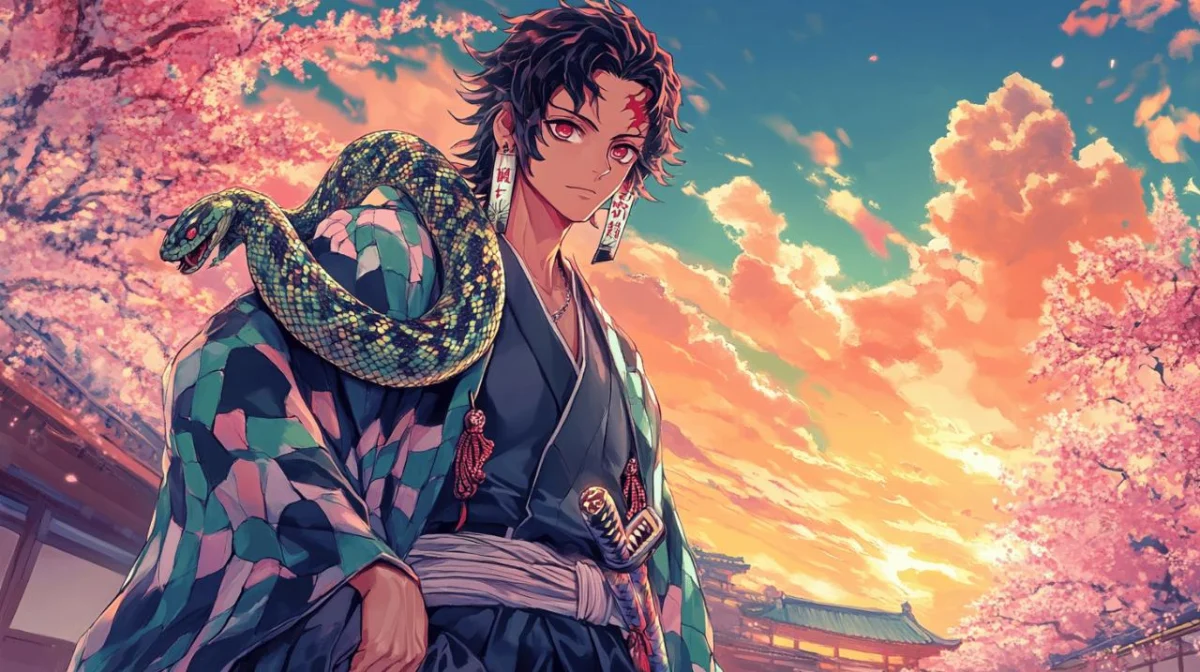
Within the intricate tapestry of Koyoharu Gotouge’s Demon Slayer: Kimetsu no Yaiba, few characters command as much fascination and emotional resonance as Iguro Obanai, the Serpent Hashira. As a cornerstone of the Demon Slayer Corps, Iguro represents the convergence of profound personal trauma, unparalleled combat ingenuity, and an unwavering, if hidden, capacity for love. His journey from the depths of a parasitic, cult-like family structure to the pinnacle of the Demon Slayer Corps is a testament to the human spirit’s ability to transcend its origins.
Main Facts: The Identity of the Serpent Hashira
Iguro Obanai is defined by a striking aesthetic and a combat style that mirrors the fluidity and lethality of his namesake, the serpent. Standing at 162 cm and weighing 53 kg, his physical stature is deceptively slight, masking a combat prowess that places him among the elite of the organization.
Central to his identity are the physical manifestations of his traumatic upbringing: a right eye that is functionally blind and a mouth permanently scarred by a ritualistic slitting. These features are not merely aesthetic choices; they are the scars of a life dictated by a clan of thieves who worshipped a serpentine demon. Always at his side is Kaburamaru, a white snake whose relationship with Iguro transcends that of a mere pet; the snake acts as a vital sensory extension, aiding Iguro in navigating the chaotic battlefield and compensating for his limited field of vision.
Chronology: From Captivity to the Final Dawn
A Childhood Forged in Darkness
Born as the first male in his family in 370 years, Iguro was raised in a household that functioned more like a cage than a home. His family’s wealth was built on the blood of others, sacrificed to a demon who demanded the lives of infants. Kept in a gilded, barred room, the young Iguro was groomed as an offering. His escape from this environment serves as the foundational moment of his life, fueling his visceral hatred for demons and his lifelong commitment to their eradication.
Ascending to the Hashira
Following his escape, Iguro was taken in by the Ubuyashiki family. The transition from a victim of a demon-worshipping cult to a protector of humanity was marked by an intense, almost self-punishing drive for excellence. He refined the "Breath of the Serpent" style, a derivative of the Breath of Water, which emphasizes erratic, winding movements that make his attacks nearly impossible to track or parry.
The Final Conflict
The zenith of his narrative arc arrives during the "Infinity Castle" and "Sunrise Countdown" arcs. As the Demon Slayer Corps launches its final assault on Muzan Kibutsuji, Iguro’s latent abilities—including the manifestation of his Demon Slayer Mark and his ability to see the "Transparent World"—come to the forefront. He plays an indispensable role in the survival of the Corps, often putting his own life on the line to ensure the safety of Tanjiro Kamado and his fellow Hashira.
Supporting Data: Combat Efficacy and Tactical Mastery
Iguro’s combat statistics, while often viewed as "moderate" in terms of raw physical strength compared to heavy hitters like Gyomei Himejima, are augmented by his extraordinary technique and tactical intelligence.
- Breath of the Serpent: This style focuses on mimicking the slithering motions of a snake. By utilizing his curved Nichirin blade, Iguro can strike from blind angles, turning his lack of physical brute force into a tactical advantage.
- The Crimson Red Nichirin Blade: During the final battle, Iguro becomes one of the few to manifest a crimson red blade. This is achieved by exerting extreme pressure on his sword through a clash with another blade, a feat that significantly hinders the regenerative capabilities of Muzan.
- Synergy with Kaburamaru: Kaburamaru is not merely a companion; the snake is trained to observe the enemy’s movements and relay information to Iguro. This sensory feedback loop allows Iguro to fight with a level of environmental awareness that borders on the clairvoyant.
The Human Element: The Bond with Mitsuri Kanroji
One of the most humanizing aspects of Iguro’s arc is his relationship with Mitsuri Kanroji, the Love Hashira. In an organization defined by death, their bond represents a rare beacon of warmth.
Their relationship began with a shared sense of being outsiders—Mitsuri, with her unique strength and hair, and Iguro, with his scarred past and cynical outlook. Over time, his cold exterior, which he maintained to protect those he cared about from his own "cursed" lineage, softened in her presence. The tragedy of their mutual demise during the final battle is widely regarded as one of the most poignant moments in the series. It underscores the ultimate cost of their profession: that even the most deserving of happiness often find it only in their final moments.
Implications: The Legacy of a Broken Hero
The implications of Iguro Obanai’s life and death extend far beyond his role in the defeat of Muzan.
A Redefinition of Strength
Iguro challenges the traditional shonen trope that strength is solely measured by physical output. His success is built on adaptation, precision, and an indomitable will that thrived despite a lifetime of psychological and physical mutilation. He proves that a character defined by trauma can choose to become a pillar of hope rather than a vessel for resentment.
Influence on the Next Generation
His mentorship and eventual sacrifice significantly influenced Tanjiro Kamado. By placing his trust in the younger generation, Iguro helped bridge the gap between the old guard of the Hashira and the rising power of the new recruits. His legacy is one of self-sacrifice; he refused to let his own dark beginnings dictate his end, choosing instead to die as a defender of the innocent.
Symbolic Significance
In the broader mythology of Demon Slayer, the serpent is often viewed as a creature of rebirth and transition. Iguro embodies this duality. He is the snake that sheds its skin—discarding the toxic legacy of his bloodline to become a guardian of the human race. His story serves as a mirror for the reader, asking whether one is defined by the circumstances of their birth or by the choices they make in the face of insurmountable odds.
Official Perspective and Critical Reception
Critics and fans alike have lauded Iguro Obanai as a masterpiece of character development. While he was initially introduced as a harsh and demanding figure—often clashing with Tanjiro—the gradual reveal of his backstory transformed him into a fan favorite.
The "Sunrise Countdown" arc serves as a definitive critique of his character: he is not the hero who wins because he is the strongest, but the hero who wins because he refuses to give up. His story serves as a vital component of the series’ success, illustrating that even in a world of supernatural horror, the most compelling battles are those fought within the human heart.
Conclusion
Iguro Obanai remains one of the most complex figures in contemporary anime. He is a testament to the fact that heroism is not the absence of trauma, but the ability to act in spite of it. From his silent, slithering movements on the battlefield to the quiet, heartbreaking realization of his love for Mitsuri, Iguro’s path was one of redemption. As the dust settles on the legacy of the Demon Slayer Corps, the Serpent Hashira stands as a reminder that even those born into the darkest of shadows can, with enough conviction, become the light that guides others to dawn.



 Azzam Bilal Chamdy