

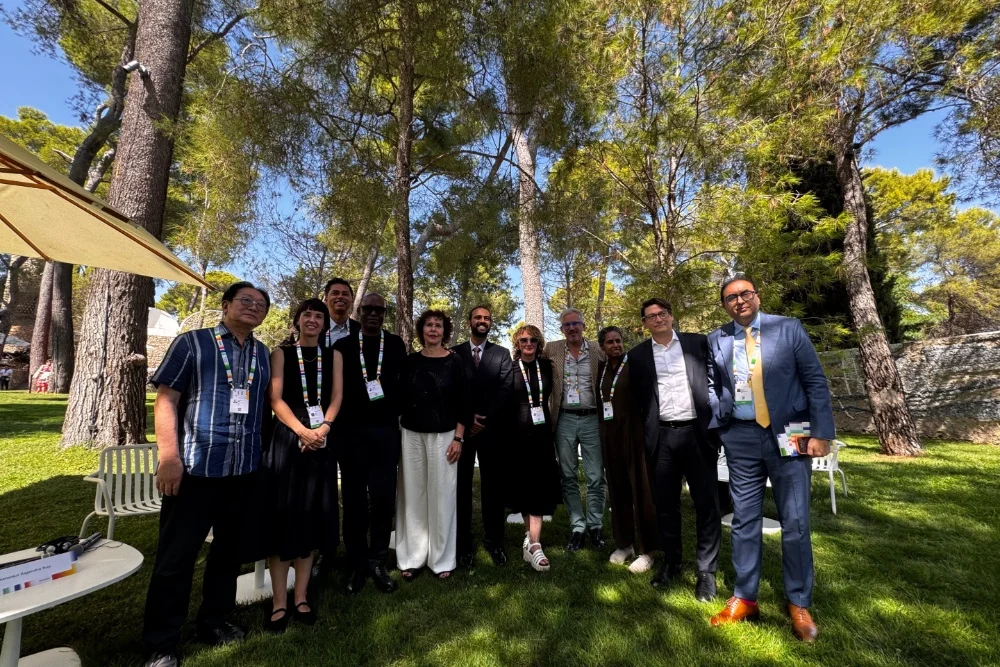
SAINT-PAUL-DE-VENCE, France — In the sun-drenched hills of the French Riviera, the Lumière Summit recently served as the stage for a sobering reality check for the global film community. As the world’s most influential festival directors gathered, the conversation shifted rapidly from the glamour of the red carpet to the precarious state of artistic autonomy in an era of intense political polarization.
The panel, titled “Easy to Criticize, Impossible to Replace: Rethinking the Festival,” was moderated by Rajendra Roy, chief curator of film at the Museum of Modern Art (MoMA). It brought together an unprecedented assembly of festival leadership, including representatives from Berlin, Cannes, Toronto, San Sebastián, Annecy, Mumbai, Durban, the Red Sea, and South by Southwest. Yet, despite the geographic diversity of the participants, a singular, urgent theme emerged: the escalating pressure on cultural institutions to act as political proxies, and the existential need to safeguard the sanctity of the artistic work.
The Call for Autonomy in a Polarized World
The most forceful clarion call for independence came from Laurence Herszberg, general director of the French television festival Séries Mania. Addressing the growing trend of boycotts and public outcry regarding the national origin of featured artists, Herszberg was categorical: “We don’t judge artists by their passport; we judge them by their works.”
Herszberg’s intervention highlights a deepening crisis for festival directors, who increasingly find their programming choices scrutinized through a geopolitical lens. “We feel more and more under pressure from different groups,” she explained. “They might be politicians, they might be just people who disagree with the representation of some countries.”
For Séries Mania, which offers free access to its 1,500-seat venues, the challenge of maintaining an open, non-discriminatory environment is complicated by the lack of physical barriers. Herszberg emphasized that as these institutions face mounting external demands, they require systemic protection to continue serving their primary purpose: the elevation and defense of the artist.
Chronology of a Shifting Landscape
The discourse at the summit reflected a decade-long transition in the festival ecosystem. Cameron Bailey, CEO of the Toronto International Film Festival (TIFF), recalled his entry into the industry in 1990, a period he described as a “completely free and open space.” Today, that sense of unfettered artistic expression is under siege by the immediate demands of digital-era outrage.
The current atmosphere is a far cry from the post-Cold War optimism of the 1990s. Today, festivals are expected to operate as bastions of progressive moral purity while simultaneously managing the economic pressures of a crumbling theatrical market. This shift has forced leaders to rethink their fundamental models.
For TIFF, this has meant a dual strategy: investing in the next generation through its 15-year-old “Next Wave” youth program, while simultaneously expanding its commercial footprint. The festival’s recent decision to launch a formal market—a move Bailey describes as the “fertilizer of the ecosystem”—is a calculated attempt to ensure the continued supply of ambitious films in an industry that has become increasingly risk-averse.
Supporting Data: The New Festival Economy
The economic realities facing these institutions are as varied as their cultural missions. Tricia Tuttle, director of the Berlinale, underscored that audience development is the only viable hedge against political volatility. Having managed a festival that saw 450,000 admissions in the last cycle—and having navigated the “eye of a political storm” regarding the festival’s stance on various global conflicts—Tuttle argued that the solution lies in radical inclusivity.
“The answer for me to all of these challenges is to really think about audiences,” Tuttle noted. “Reaching people who are not yet passionate cinemagoers matters as much as serving those who are.”
Meanwhile, the data from emerging markets suggests a different kind of growth. Faisal Baltyuor of the Red Sea Film Foundation reported that every screening at the festival’s latest edition sold out, a testament to the surging demand for local content. The foundation’s success in launching 11 films at Venice and eight at Toronto serves as a model for how state-supported festivals can successfully propel regional talent onto the global stage.
Official Responses and Strategic Pivot
The responses from the leadership at the summit reveal a divide between the “legacy” giants and the “emerging” powerhouses. Iris Knobloch, president of Cannes, focused on the sheer scale of the world’s most prestigious event, noting the 40,000 accredited participants from 140 countries. For Knobloch, the festival’s survival is predicated on its role as a global clearinghouse for talent—a “shining light” that transcends individual political disputes.
However, others are bracing for a period of contraction. Maialen Beloki, deputy director of San Sebastián, pointed to a worrying structural decline: the erosion of film criticism. “Each year, media send less and less critics to the festival,” Beloki warned. She argued that the digital race for clicks, which demands immediate, hot-take reactions to films, is destroying the capacity for thoughtful, long-form discourse. This, she suggested, is a blow to the “respect” owed to the art form.
The Crisis of Infrastructure and Access
For those operating outside the Western festival circuit, the challenges are less about political discourse and more about basic accessibility. Magdalene Reddy, director of the Durban FilmMart Institute, provided a sobering reality check on the state of African cinema. “For us, engaging with audiences is really going into the community,” she said, noting that the absence of sufficient cinema infrastructure makes traditional festival models difficult to sustain.
This sentiment was echoed by Shivendra Singh Dungarpur of the MAMI Festival in Mumbai. By providing free screenings and partnering with cinema chains to bring independent films to rural India, MAMI is attempting to democratize access to cinema in a way that European festivals, currently locked in debates over elitism and political censorship, are only just beginning to contemplate.
Implications: The Future of the Film Festival
As the panel neared its conclusion, the moderator posed a question that cut to the heart of the industry’s dependence on the American studio system: Can global film festivals survive without the American industry?
The silence that followed was heavy. When forced to provide a binary answer, only Magdalene Reddy responded with a definitive “no,” acknowledging that while her focus is on African content, the current global ecosystem remains tethered to the economic engine of Hollywood.
The implications for the future are clear:
- The End of Neutrality: Festivals can no longer pretend to exist in a vacuum. They are now central battlegrounds for cultural and political discourse.
- The Economic Squeeze: As traditional media outlets reduce coverage and studio budgets tighten, festivals are forced to pivot toward market-driven models to ensure their survival.
- The Audience Mandate: The survival of the film festival depends on its ability to evolve from an industry-exclusive enclave into a community-based cultural hub.
As the Lumière Summit concluded, the consensus was palpable: the golden age of the festival as a protected space for pure artistic expression is over. In its place, a more complex, politically engaged, and commercially vital model is emerging—one that must fight for its autonomy even as it adapts to a world that demands more from it than ever before.
The task ahead for these leaders is Herculean: to preserve the “sizzle” of discovery that attracts the press and the public, while ensuring that the films they champion are protected from the very pressures that threaten to stifle them. As Peter Debruge aptly summarized, the studio films are the bait, but the discoveries are the reason for the festival’s existence. Maintaining that balance will define the next decade of cinema.










