

Every spring and autumn, the skies over North America transform into a global highway. Millions of birds, insects, and other migratory species embark on epic journeys, navigating thousands of miles to reach nesting grounds in the north or warmer, resource-rich habitats in the south. This annual rhythm is one of nature’s most spectacular phenomena. Yet, beneath this awe-inspiring migration lies a grim reality: for an estimated one billion birds each year, the journey ends not in a forest or wetland, but against the unforgiving glass of human architecture.
The Magnitude of the Collision Crisis
The scale of this issue was thrust into the national spotlight on the night of October 4–5, 2023, when an unthinkable tragedy unfolded in Chicago. McCormick Place Lakeside Center, a massive convention facility nestled along the Lake Michigan shoreline, became a deadly trap. Surrounded by greenery that attracts migrating flocks, the building’s expansive glass façade—covering an area equivalent to two football fields—presented a fatal illusion. As birds navigated the urban landscape, they mistook the reflection of trees and sky in the glass for open flight paths. By the morning of October 5, nearly 1,000 birds lay dead at the building’s base.

This single event served as a horrific microcosm of a much larger, systemic issue. While organizations like BirdCast provide sophisticated heat maps that track the pulses of migration, the data they collect serves as a stark reminder of the risks involved. In October 2023 alone, ornithologists tracked a record-breaking one billion birds migrating on a single night; in previous years, that figure reached 1.2 billion. The sheer density of these nocturnal movements means that when a major metropolitan hub is illuminated and lacks bird-safe infrastructure, the potential for mass mortality events is exponential.
A Chronology of Advocacy
The catalyst for the current movement to address these collisions was, for many, the shock of the McCormick Place incident. Among those deeply moved was Holly Greenberg, an artist and educator then serving as an assistant professor at Syracuse University. During a sabbatical, Greenberg was working at a Chicagoland arboretum, volunteering to remove invasive buckthorn to restore native habitats. The irony was palpable: while she and her peers were working to create safe havens for birds, those same creatures were dying in droves just miles away due to urban architecture.

"That was the first time that I’d heard that these birds were crashing into windows in Chicago," Greenberg recalls. Learning of the mass casualty event at McCormick Place proved to be a turning point. Driven by a desire to bridge the gap between scientific data and public consciousness, she launched the multi-year initiative Bird Collisions in the Anthropocene in 2024.
The project began with a singular focus: 10,863. This was the specific number of birds documented dead by the Chicago Field Museum’s lead ornithologist, Dave Willard, in 2023. By turning this dry, heartbreaking statistic into a tangible, artistic endeavor, Greenberg sought to make the abstract scale of the problem feel personal.

The Science of Survival: Data and Monitoring
The work of the Chicago Bird Collision Monitors (CBCM) is the bedrock of this research. Every morning during the migration seasons, these dedicated volunteers patrol the city streets, systematically collecting fallen birds. While some are fortunate enough to be rescued and transported to wildlife sanctuaries for rehabilitation, the vast majority succumb to their injuries.
The survivors of the impact are often misunderstood. Paul Groleau, president of the bird-safe window treatment company Feather Friendly, emphasizes that public perception is dangerously optimistic. "I heard a bird hit my window, but it flew off, so it’s fine," is a common refrain. Groleau notes that this is rarely the case; it is estimated that 60 percent of birds that appear "stunned" die later from internal hemorrhaging or brain trauma. Because their skulls are paper-thin, even a seemingly minor collision can be fatal. Furthermore, a bird that sits in shrubbery to recover is often picked off by predators, masking the true impact of window strikes.

The specimens collected by the CBCM are taken to the Field Museum, where they are meticulously archived. Dave Willard has spent decades overseeing this collection, ensuring that each bird is tagged and recorded. This archive represents more than just biological samples; it is a permanent, physical testament to the thousands of lives lost to building collisions.
Art as a Catalyst for Change
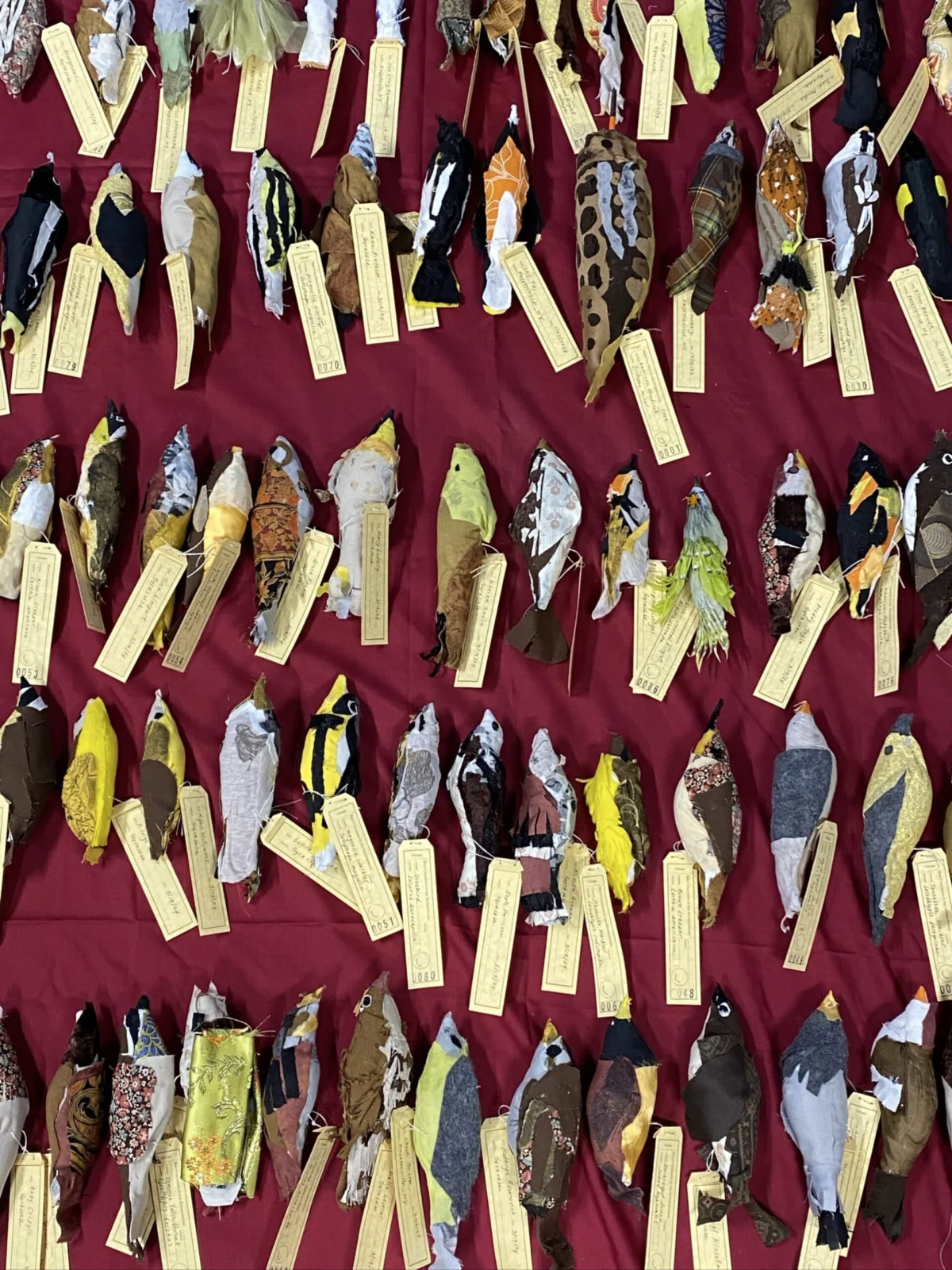
Bird Collisions in the Anthropocene has evolved into a widespread, participatory art project that invites the public to engage with the data. With a team of interns and a network of collaborators, Greenberg has been working to recreate the 10,863 birds from fabric and glue.

The project operates on the philosophy that experiential, communal learning drives deeper retention and advocacy. Since its inception, more than 140 workshops have been held across the United States and Canada. These sessions take place in schools, public libraries, and community centers, where participants are provided with kits to sew specific species—from dark-eyed juncos to golden-crowned kinglets—based on photographs of the real birds.
"People get into the flow, no one is touching their phone, and everyone is super concentrated," Greenberg explains. "They’re working with awkward materials, and it’s a mess, but it’s a good creative mindset." By the time a participant finishes their fabric bird, they are not only more aware of the species that share their environment but are also educated on how to prevent future collisions.

Architectural Solutions and Policy Shifts
Artistic awareness is the first step; the second is tangible environmental modification. The project promotes various remediation technologies, such as the vinyl dots manufactured by companies like Feather Friendly. These dots, which are often nearly invisible to humans, disrupt the reflection of the glass, signaling to birds that a solid surface lies ahead. Other solutions include fritted glass, where ceramic patterns are baked into the pane during manufacturing.
Greenberg’s studio in Evanston, Illinois, serves as a laboratory for these ideas. She has collaborated with artists like Taro Takizawa to apply organic vinyl designs to windows, proving that safety and aesthetics can coexist. This summer, the studio will host an installation by artist Alice Hargrave, who uses the sound waves of bird calls to create abstract visual works, further weaving the theme of bird life into the built environment.

Implications for the Future
The culmination of this work will be a massive, collective "carpet" of fabric birds, a visual representation of the lives lost and the power of human intervention. Currently, the project has documented 3,451 finished birds, with thousands more in the pipeline. These creations are already finding their way into the public sphere; they will be a focal point of the Flyway City exhibition at the Chicago Architecture Center, running from June 2026 to January 2027.
The exhibition, organized in partnership with the renowned firm Studio Gang, highlights the role of urban planning in avian conservation. Jeanne Gang, the firm’s lead architect, has long been a vocal advocate for bird-friendly building codes. While Evanston has already implemented ordinances requiring bird-safe design, Chicago—a massive, high-density city—has yet to pass similar, legally binding requirements, despite numerous attempts.

The Bird Collisions in the Anthropocene project serves as both a memorial and a mandate. By turning the tragedy of 10,863 lost lives into a conversation piece that engages thousands of citizens, Greenberg and her collaborators are creating the political and social pressure necessary for change. The goal is to move beyond voluntary measures and toward a standard where cities are designed not just for humans, but for the safety of the migratory species that have crossed these skies for millennia.
As we look toward the future, the integration of art, science, and policy offers a glimmer of hope. The next time a bird flies toward a window, it should see a barrier that keeps it safe, not a reflection that leads to its demise. Through continued advocacy and the collective efforts of people sewing fabric birds in classrooms and studios across the continent, the message is clear: our buildings do not have to be death traps. They can, and must, become part of a more hospitable, conscious urban landscape.










No comments yet. Be the first to join the conversation!