

MUNICH — The landscape of automotive luxury is undergoing a seismic shift. For decades, the long-wheelbase sedan reigned supreme as the ultimate expression of a manufacturer’s engineering prowess and prestige. However, the market has spoken, and its voice favors the elevated ride height and commanding presence of the SUV. Recognizing this, Audi is preparing to retire the A8’s tenure as the brand’s sole flagship representative. Later this summer, the German automaker will officially unveil the Q9, a full-size SUV designed not just to compete, but to redefine what a luxury flagship means in the modern era.
The Evolution of the Flagship: From Sedan to SUV
The transition from the A8 to the Q9 is more than a mere change in nomenclature; it is a strategic pivot toward the North American market. While European buyers have long favored smaller, more maneuverable vehicles, the North American appetite for large-format SUVs has become the driving force behind global product development.
The Q9 represents Audi’s boldest answer to this demand. It is the first vehicle in the brand’s history to be engineered from the ground up as a true full-size, three-row luxury SUV designed to satisfy the specific requirements of the U.S. consumer. The attention to detail in this localization effort borders on the obsessive; during the final stages of development, engineers famously redesigned the vehicle’s cupholders to accommodate the oversized, insulated stainless steel mugs that have become a cultural phenomenon across North America.
A Chronology of Design: Translating Concept to Reality
The design language of the Q9 draws a direct lineage from the 2021 Grandsphere concept, a vehicle that Audi used to signal its vision for the future of "first-class" travel. The Grandsphere was a masterclass in minimalism, famously eschewing traditional screens in favor of an environment that felt more like a private lounge than a cockpit.
Translating this ethos into a production vehicle presented a significant challenge: balancing the "digital-first" reality of modern luxury with the minimalist, serene aesthetic of the concept.
- 2021: The Grandsphere concept debuts, introducing the "wrap-around" cockpit design that would eventually influence the Q9.
- 2023: Early internal prototypes for the Q9 focus on material quality, moving away from high-gloss surfaces that attract fingerprints and toward matte, tactile finishes.
- Early 2024: Finalization of the interior trim options, including the introduction of open-grain olive wood as a sustainable, sophisticated alternative to traditional carbon fiber.
- Summer 2025: Official global reveal scheduled for late summer.
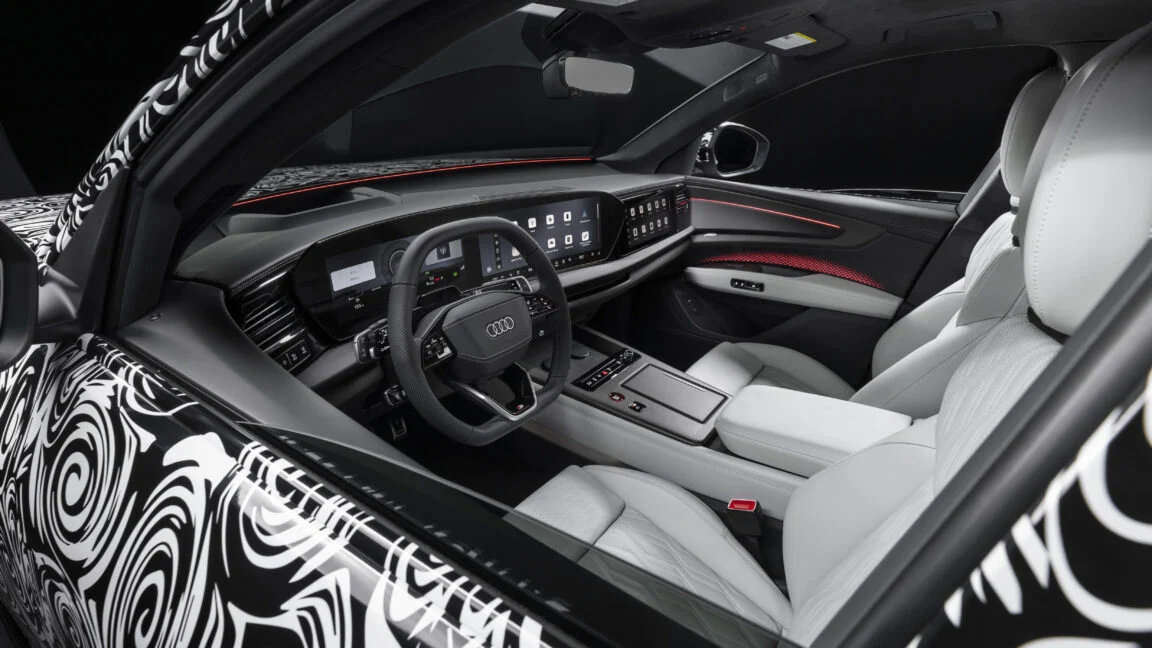
The Q9 manages to capture the Grandsphere’s "wrap-around" feel by curving its digital instrument cluster and infotainment screens toward the driver. Unlike many competitors, these screens are intentionally kept low-profile to maintain a clear, unobstructed sightline over the hood. A unique "interaction light" bar runs along the base of the windshield, providing subtle visual cues for turn signals and hazard lights, further decluttering the dashboard.
Supporting Data: Elevating the Interior Experience
While the exterior remains obscured by clever camouflage, the interior reveals a deliberate departure from the cold, clinical feel of previous Audi generations. The cabin is an exercise in texture and atmosphere.
Audi’s design team, led by figures like Chris Koelle, has prioritized "tactile luxury." Instead of the ubiquitous piano-black plastic that plagues many modern luxury cabins, the Q9 utilizes a sophisticated mix of matte surfaces, soft-touch leathers, and organic materials. The inclusion of open-grain olive wood is particularly noteworthy, providing an earthy, premium feel that stands in stark contrast to the aggressive aesthetic of coarse-weave carbon fiber.
The interior palette is equally expansive. Recognizing that not every driver wants the dark, intense look of a performance cockpit—which Audi designers jokingly refer to as the "Mustafar" aesthetic—the company is offering a wide range of light, airy beige and brown tones that evoke the warm, natural landscapes of planets like Tatooine or Endor.
Official Responses: The Philosophy of Calm
"When you close the car, what we wanted to create is a feeling that it’s calming you down," explains Audi designer Chris Koelle. "It’s a luxury approach where everything is controlled, everything is floating, everything is quiet, and everything is in its place."
This "calming" philosophy extends to the user interface. For years, Audi enthusiasts have lamented the loss of the "moving map" view in the instrument cluster—a feature that made the original Virtual Cockpit a benchmark for the industry. Following its absence in several recent models, Audi has brought it back in the Q9.
This decision, along with the standardization of control stalks, suggests that Audi is listening to its core user base. The Q9 utilizes refined "not-stalks" that control turn signals, wipers, and gear selection (park, drive, reverse) with a tactile precision that mimics traditional controls while saving space. It is a return to form for a brand that arguably lost its way in the pursuit of excessive screen-based minimalism.
Implications for the Market
The Q9 is not just a car; it is a declaration of intent. By shifting the flagship mantle to an SUV, Audi is signaling that it no longer views the traditional sedan as the pinnacle of its lineup.
1. Market Penetration
By catering specifically to North American tastes—such as the aforementioned cup holders and the increased interior volume—Audi is positioning the Q9 to compete directly with the Cadillac Escalade, BMW X7, and Mercedes-Benz GLS. This is a crucial move for Audi’s market share in a segment where profit margins are historically the highest.
2. Technological Standardization
The inclusion of the high-fidelity moving map in the Virtual Cockpit across both the entry-level Q3 and the top-tier Q9 demonstrates a desire to unify the user experience. Audi is clearly moving toward a software-defined architecture that allows for consistent updates and a recognizable interface regardless of the vehicle’s price point.
3. Sustainability and Materiality
The use of open-grain wood and matte finishes points to a broader industry trend toward "conscious luxury." Consumers are increasingly demanding interiors that feel natural rather than synthetic. If the Q9 succeeds, expect to see this design language trickle down to the rest of the Audi SUV lineup over the next five years.
Conclusion: A New Era
The Q9 represents the culmination of Audi’s efforts to reconcile the demands of a high-tech future with the need for a human-centric driving experience. It is a vehicle that acknowledges the dominance of the SUV, embraces the necessity of digital connectivity, and yet remains deeply rooted in the tactile, quiet, and deliberate luxury that built the Audi brand.
As the late summer reveal approaches, the automotive world waits to see if the Q9 can truly displace the A8 as the spiritual heart of the brand. If the initial interior impressions are any indication, Audi has succeeded in creating a sanctuary that feels as much like a retreat from the world as it does a machine designed to conquer it. The era of the SUV flagship has officially begun, and with the Q9, Audi is leading from the front.












No comments yet. Be the first to join the conversation!