Rifan Muazin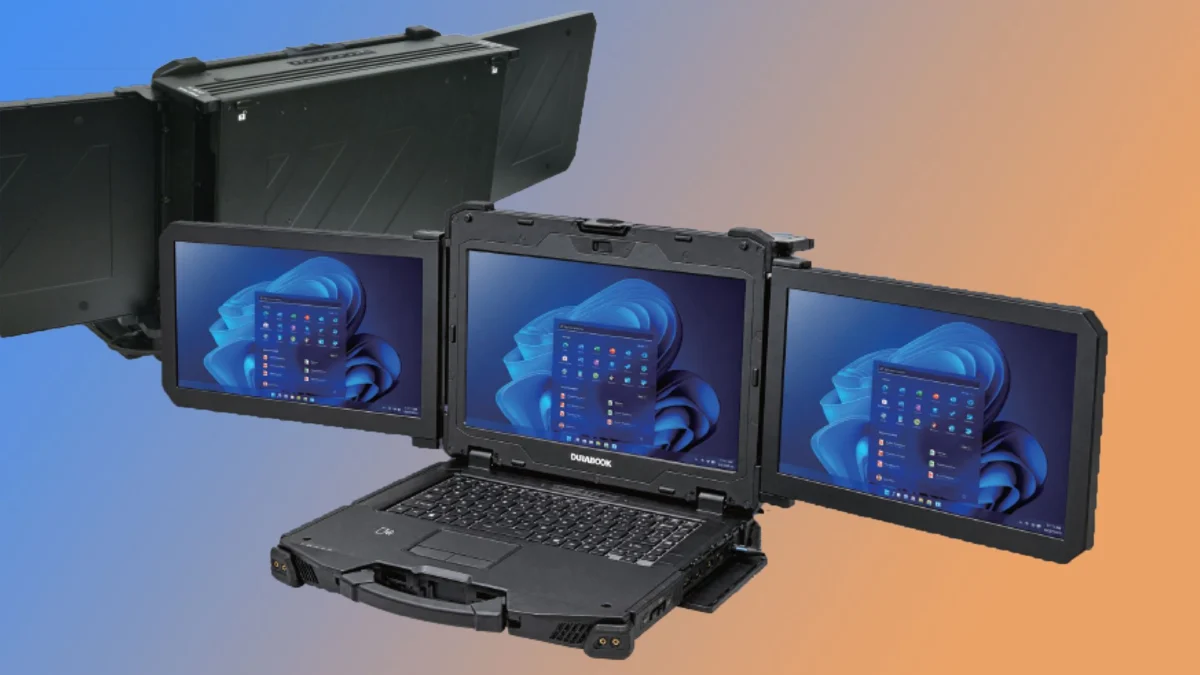
In an era where remote field operations often require the processing power of a desktop and the visual real estate of a command center, Durabook—a brand synonymous with extreme durability—has pushed the boundaries of hardware engineering. The company recently unveiled the Z14I-DX3, a highly ruggedized mobile workstation that challenges the limitations of portable computing by integrating three distinct 14-inch, 1080p displays into a single, deployable chassis.
Designed for those who operate where conventional hardware would fail, the Z14I-DX3 represents a significant shift in field technology. By providing a "triple-monitor" experience in a MIL-SPEC certified enclosure, Durabook is positioning itself as the primary hardware partner for military, public safety, and industrial sectors that demand desktop-grade productivity in the most hostile environments on Earth.
Main Facts: A Tri-Panel Powerhouse
The Z14I-DX3 is, at its core, a testament to clever mechanical engineering. Utilizing a traditional clamshell foundation, the unit features two supplementary 14-inch screens that hinge outward from the sides of the primary display. When folded, the unit retains a form factor that, while substantial, remains transportable; when deployed, it offers a sprawling digital workspace that effectively triples the productivity surface area of a standard rugged laptop.
Display Specifications
The core of the workstation is its trio of DynaVue sunlight-readable touchscreens. These panels are not merely "added on"; they are engineered for high-stakes visibility:
- Brightness: Each panel boasts a peak brightness of 1,200 nits, ensuring legibility under direct, high-noon sunlight.
- Interactivity: All three screens feature capacitive multi-touch technology, supporting input from fingers, styluses, and even gloved hands.
- Versatility: The panels are fully customizable, allowing users to synchronize them for a seamless desktop extension or operate them as individual, independent workstations with integrated OSD (On-Screen Display) controls.
- Environmental Adaptability: The screens are optimized to handle wet conditions, ensuring that water droplets do not trigger "ghost touches," a common failure point in standard consumer touch-enabled devices.
Chronology: The Evolution of the Rugged Workstation
The journey to the Z14I-DX3 did not happen in a vacuum. It is the culmination of decades of development within the ruggedized computing industry.
The Early Days: Protection Over Performance
In the 1990s and early 2000s, rugged laptops were defined by their "bricks"—heavy, slow, and monochromatic devices that prioritized survivability over utility. The focus was purely on surviving drops and spills, with screen real estate rarely exceeding a single, dim 10-inch panel.
The Rise of the "Field Professional" (2010–2020)
As data requirements in military and emergency services ballooned, the demand for high-definition mapping, real-time drone telemetry, and complex structural analysis software (CAD/GIS) grew. During this decade, brands like Durabook began to iterate on the "Z14" line, focusing on performance-to-weight ratios. The shift moved toward high-performance CPUs and dedicated GPUs, but the display remained the primary bottleneck.
The Present: The Multi-Screen Revolution
The development of the Z14I-DX3 signifies the current "Era of Data Density." Durabook recognized that field engineers and military tactical planners were carrying external monitors and portable USB-C panels into the field—an inefficient, fragile, and power-hungry configuration. By integrating the panels directly into the chassis, the Z14I-DX3 solves the "setup time" issue, allowing a command center to be operational in seconds rather than minutes.
Supporting Data: Engineering for the Extreme
Durabook’s commitment to resilience is not merely marketing; it is verified by rigorous third-party testing. The Z14I-DX3 is built to meet the most stringent standards in the industry.
MIL-STD-810H and MIL-STD-461G Certification
These are not simple "durable" labels; they are Department of Defense (DoD) benchmarks.
- MIL-STD-810H: This standard tests for shock, vibration, humidity, and extreme temperature fluctuations. The Z14I-DX3 is engineered to withstand repeated drops onto concrete, high-frequency vibrations from military vehicles, and operation in temperatures ranging from freezing arctic conditions to scorching desert heat.
- MIL-STD-461G: This ensures electromagnetic compatibility. In tactical environments, where radio frequency (RF) interference can be a matter of life or death, this certification ensures that the laptop does not interfere with critical communication equipment, and conversely, that the laptop itself is shielded from external electronic interference.
Input/Output and Connectivity
To power three screens and ensure data integrity, the machine is equipped with a high-throughput internal architecture. While full spec sheets for the internal processors and RAM configurations vary by regional configuration, the system is designed to handle the multi-threaded load of running three independent display streams without latency or thermal throttling.
Official Responses and Industry Positioning
In discussions surrounding the launch, Durabook representatives have emphasized that the Z14I-DX3 was a direct response to customer feedback.
"Our clients in public safety and defense consistently told us that they were being limited by their hardware," a spokesperson noted during the product announcement. "They were trying to build ad-hoc multi-monitor setups in the back of trucks or in temporary field offices. We realized that if we could build that capability into the laptop itself, we could drastically reduce the logistical burden on our end users."
The industry reception has been largely positive. Tech analysts have noted that while the "triple-screen" design is a bold move, it fits perfectly into the growing market for "tactical edge computing." Unlike consumer laptops, which are trending toward thinner and lighter profiles, the Z14I-DX3 embraces its role as a functional tool, prioritizing the user’s workflow over aesthetics.
Implications: The Future of Field Operations
Redefining Efficiency in Emergency Services
For disaster response teams, the Z14I-DX3 is a game-changer. Imagine a mobile command center at a wildfire or hurricane site. One screen can host live satellite weather overlays, the second can display real-time drone footage of the disaster perimeter, and the third can house the primary communications and resource management software. Previously, this would require three separate devices or a complex multi-cable rig. The Durabook solution reduces the point of failure to a single, ruggedized chassis.
The Shift in Military Tactical Planning
In the theater of operations, intelligence is only as good as the speed at which it can be analyzed. By providing a panoramic view of the battlefield, the Z14I-DX3 allows tactical commanders to process more visual data simultaneously. This reduces "cognitive load," allowing for faster decision-making cycles—an essential advantage in modern asymmetrical warfare.
Challenges and Considerations
However, the adoption of such a device is not without challenges. The weight and power consumption of running three 1,200-nit panels are significant. Organizations that deploy the Z14I-DX3 will likely need to invest in high-capacity power management systems, such as solar-integrated power banks or vehicle-mounted charging docks. Furthermore, the sheer complexity of the hinge mechanism suggests that maintenance protocols will be more rigorous than those for standard rugged laptops.
The Broader Market Impact
The release of the Z14I-DX3 sets a new benchmark for "ultra-rugged" workstations. Competitors in the rugged computing space (such as Panasonic’s Toughbook line or Dell’s Rugged Extreme series) will now face pressure to innovate beyond the single-screen standard. We may soon see a trend where "expandable screen real estate" becomes a standard feature in high-end mobile workstations, effectively turning the field into a portable office.
Conclusion
The Durabook Z14I-DX3 is more than a laptop; it is a mobile command center that defies the traditional constraints of portable computing. By successfully integrating a triple-display array into a MIL-STD-810H/461G certified chassis, Durabook has answered a complex question: How do we bring desktop-level visual productivity into the world’s most dangerous environments?
As technology continues to migrate toward the "edge," the tools used by our first responders, military personnel, and industrial engineers must evolve. The Z14I-DX3 is an ambitious, necessary step in that evolution. While it may not be destined for the casual consumer, for the professional who operates in the mud, the dust, and the heat of the field, it is a piece of equipment that fundamentally changes the scope of what is possible.
As we look toward the future, the success of the Z14I-DX3 will likely dictate the next wave of rugged computing design, proving once and for all that in the field, more screen space isn’t just a luxury—it’s an operational necessity.

 Asep Darmawan
 Ali Ikhwan