

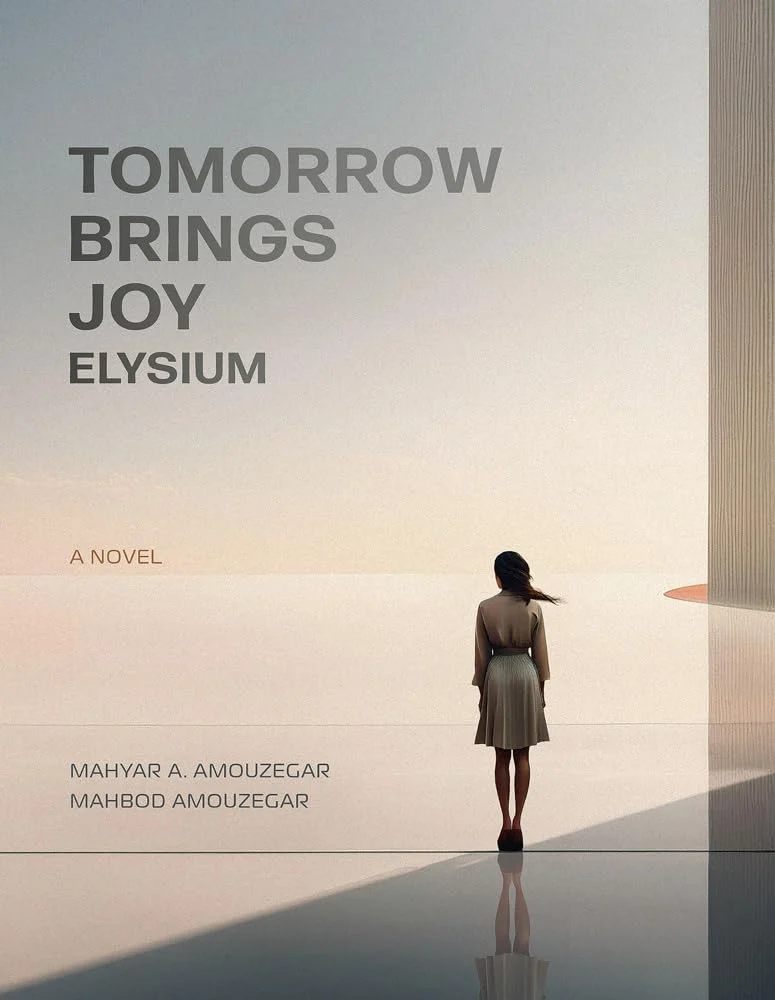
In the landscape of modern speculative fiction, few debut novels manage to balance the heavy mantle of philosophical inquiry with the intimate texture of domestic life. Tomorrow Brings Joy: Elysium, the 2026 debut novel by brothers Mahyar A. Amouzegar and Mahbod Amouzegar, published by the University of New Orleans Press, does exactly that. Set more than two centuries after the cataclysmic "Wars of Settlement," the novel invites readers into a post-scarcity society where the human condition has been fundamentally re-engineered to prioritize stability and, above all, joy.
The Architecture of a Managed Utopia
The premise of Elysium is deceptively simple: humanity has moved beyond the "visible" suffering of the past. Scarcity has been eradicated, social structures are streamlined, and the emotional volatility of the human experience has been placed under the jurisdiction of systemic oversight. Citizens are birthed in batches and raised in communal "Farms" by android caretakers, eventually transitioning into adult life in pods of six or seven.
In this world, every citizen is provided with personal apartments, an endless supply of synthesized goods, and a dedicated companion android designed to cater to their specific emotional requirements. Central to this existence is the "Harmony Number," a complex regulatory system that maintains genetic diversity within strict, predefined parameters. Perhaps most chilling is the "unhappiness quota"—a quantifiable threshold that restricts the amount of sorrow an individual is permitted to experience. If one’s internal state or outward expression exceeds this allowance, the system intervenes, not through overt punishment, but through polite, bureaucratic recalibration.
A Chronology of Grief: The Pod’s Lingering Shadow
The narrative lens focuses on the twenty-fifth birthday of Dolores and the four surviving members of her pod. Their ritualistic gathering in a small San Francisco apartment—drinking orange juice, exchanging banter, and acknowledging the absence of their former pod-mate, Darius—serves as the anchor for the reader’s entry into this world.
- The Disappearance (Eleven Years Prior): Darius was removed from the pod at age fourteen. No justification was provided, and the remaining members were socialized to accept the void as a matter of course.
- The Arrival of King Rat: The catalyst for the novel’s central tension is the introduction of a new android, King Rat. His arrival disrupts the fragile homeostasis the group has maintained for over a decade. Unlike the standard-issue companions, King Rat possesses a startling depth of character, his hazel eyes and precise mannerisms acting as a mirror for the pod’s suppressed trauma.
- The Unraveling: As Dolores interacts with King Rat, the story shifts from a slice-of-life examination of utopia to a slow-burn investigation into the cost of their "perfect" society. The novel’s five-book structure guides the reader through this transition, moving from domestic banality to profound philosophical confrontation.
Literary Intertextuality: A Mirror for the Present
One of the most remarkable features of Tomorrow Brings Joy: Elysium is its deliberate use of literary structure. Each of the five books takes its title from a seminal work of 20th or 21st-century literature. This is not merely an aesthetic choice; the characters within the novel read and discuss these books, using them as a lexicon to define their own experiences.
By engaging with the works of Clavell, Salinger, and others, the characters create a bridge between the amnesiac present of Elysium and the messy, unquantifiable history of humanity. When Dolores grapples with a quote about food and the longing for a partner, the text transcends the screen, forcing the reader to compare the "managed" lives of these citizens with our own chaotic, authentic reality. This layering acts as a subtle critique, suggesting that while Elysium has solved the problems of the material world, it has done so by severing the connection to the literary and emotional legacies that define us.
Supporting Data: The Cost of Harmony
The "unhappiness quota" mentioned throughout the novel represents a departure from traditional dystopian tropes. In works like Brave New World, pleasure is a weapon of the state. In Elysium, the authors explore a more insidious reality: the tyranny of engineered absence.
- The Mechanism of Control: The wrist device, which tracks emotional output, acts as a feedback loop. When it ticks upward during a disagreement, it is a reminder that the individual is exceeding their allowance. It is the height of "polite" oppression.
- The Androids as Archives: The revelation that androids like King Rat carry fragments of the personalities of removed children highlights the callousness of the system. The "harmony" is not a state of being; it is a construction built upon the literal erasure of human experiences.
Official Responses and Philosophical Implications
While there is no "official" government spokesperson in the narrative, the collective voice of the system—the "Historian"—provides the necessary context to understand the societal logic. The system does not view itself as evil; it views itself as a success. It has eliminated war, poverty, and interpersonal cruelty.
However, the novel poses a piercing question: what remains of humanity once you strip away the ability to be inconvenient? The characters in Elysium exhibit a profound "long, unfinished grief." They are five adults who have been taught that social harmony necessitates forgetting, yet they find themselves perpetually haunted by the memory of Darius. The authors, Mahyar and Mahbod Amouzegar, illustrate that human nature is inherently resistant to quotas. Nature, much like the yellow leaves of the cherry trees mentioned in the text, refuses to conform to the schedules imposed upon it.
Critical Analysis: A Masterclass in Patience
The novel is not without its demands on the reader. Its pacing is intentionally glacial, favoring sunlit, mundane domesticity over high-stakes action. For readers accustomed to the breakneck speed of modern thriller-dystopias, the first third of the book may feel like a test of patience.
However, this deliberate pace is the book’s greatest strength. By forcing the reader to settle into the rhythm of the pod’s daily life—the synthesizer choices, the balcony martinis, the repetition of jokes—the authors make the eventual "cracks" in the world feel visceral. When the characters finally confess that they felt relief when Darius was taken—the "small, ashamed, and utterly human" realization—it lands with the weight of a hammer blow precisely because we have spent hundreds of pages living in the comfort that preceded it.
While some of the later philosophical exchanges lean toward the expository, these are minor grievances in an otherwise masterful work. The Amouzegars have crafted a narrative that demands to be read slowly, allowing the unease to settle into the reader’s own conscience.
Conclusion: A Lasting Legacy
Tomorrow Brings Joy: Elysium is a significant contribution to the canon of speculative fiction. It sits comfortably alongside the works of Kazuo Ishiguro and Margaret Atwood, not as an imitation, but as a conversation partner. It refines the arguments presented by its predecessors, focusing on the subtle, chilling erosion of the human soul through the medium of excessive care and mandated joy.
For anyone concerned with the direction of technology and the potential loss of the "messy" human experience, this book is essential reading. It does not provide easy answers, nor does it offer a clear-cut resolution. Instead, it leaves the reader with a haunting, lingering realization: when joy is measured by a quota, it ceases to be joy. It becomes something else entirely—a pale, synthesized reflection of a life once lived.
As the novel concludes, it leaves the reader contemplating the fate of Dolores and King Rat, and by extension, the fate of our own capacity for true, unmanaged feeling. Tomorrow Brings Joy: Elysium is not just a book to be finished; it is a book to be lived with. It is a profound, patient, and deeply moving achievement that deserves to be recognized as one of the standout literary works of its time.









No comments yet. Be the first to join the conversation!