

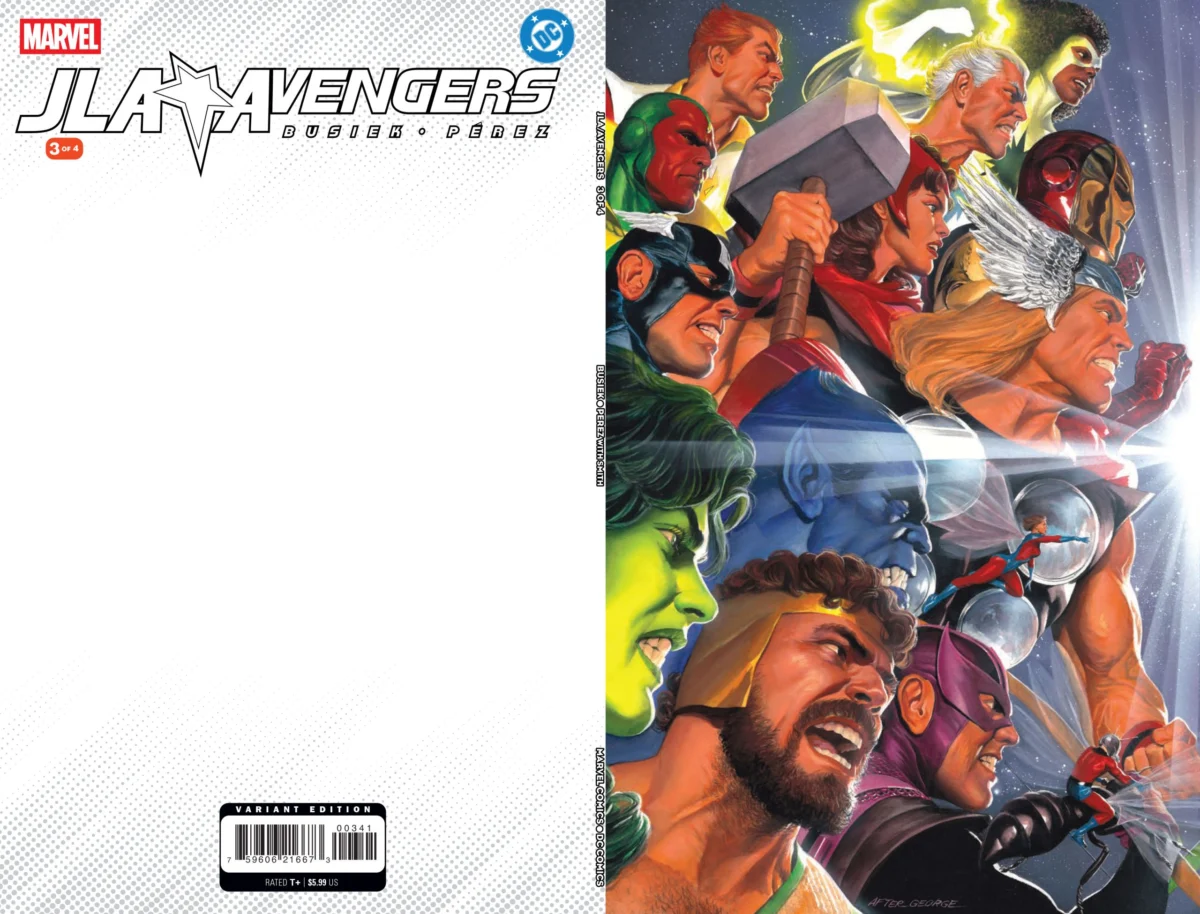
In an announcement that has sent ripples of excitement through the comic book collecting community, DC Comics has unveiled a stunning new connecting variant cover by legendary artist Alex Ross for the upcoming Avengers/JLA #4 facsimile edition. This reveal serves as the final piece of a two-part artistic tribute, cementing the return of the most iconic crossover event in the history of the medium. As DC and Marvel move forward with their plans to reissue the seminal 2003-2004 JLA/Avengers limited series, the inclusion of Ross’s work highlights the enduring legacy of the collaboration between the two "Big Two" publishers.
The Convergence: An Overview of the Facsimile Event
The facsimile program, which sees the re-release of the original four-issue saga with authentic trade dress and original card-stock wraparound covers, is designed to serve both veteran collectors looking to preserve their original copies and a new generation of readers experiencing the epic for the first time.
The centerpiece of this summer’s excitement is the connecting variant cover art. Alex Ross—a titan in the industry known for his hyper-realistic, painterly style—has crafted a dual-image homage to George Pérez’s iconic cover for the 1983 Comics Interview Special Edition #6. The two-part image is designed to stand alone as individual covers while locking together to form a grand, cinematic face-off between the Justice League of America and the Avengers.
Marvel Comics will release the first half of this diptych on JLA/Avengers #3 this July, focusing on Earth’s Mightiest Heroes. DC Comics will then complete the puzzle in August with Avengers/JLA #4, showcasing the World’s Greatest Super Heroes. When placed side-by-side, the covers capture the tension and scale of the crossover, serving as a visual testament to the history of these two legendary teams.

Chronology of a Crossover: The Legacy of Busiek and Pérez
To understand the significance of this facsimile release, one must revisit the arduous journey that brought the two universes together. The JLA/Avengers crossover was not merely a commercial project; it was a decades-long dream of the comic book industry.
- The Early Negotiations (1970s–1990s): For years, editorial hurdles and complex legal negotiations kept the two publishers at arm’s length. While smaller crossovers (such as DC vs. Marvel in 1996) had occurred, a definitive, canon-defying epic featuring the full rosters of both teams remained the "Holy Grail" of comic storytelling.
- The Announcement (2002): At the San Diego Comic-Con, the announcement that Kurt Busiek and George Pérez would finally helm the project set the industry on fire. Busiek, celebrated for his intricate character work in Marvels, was paired with Pérez, an artist whose capacity for detail and massive cast scenes remains unparalleled.
- The Original Publication (2003–2004): The four-issue series was released to immense critical and commercial success. It successfully balanced the distinct "flavors" of the DC and Marvel universes, pitting the Justice League against the cosmic threat of Terminus while the Avengers faced the psychic menace of Starro.
- The Modern Re-release (2026): Following the passing of the late, great George Pérez, the decision to reissue these books as facsimile editions serves as both a celebration of his monumental contribution to the medium and an opportunity for fans to re-engage with a high-water mark of superhero storytelling.
Supporting Data: Why This Series Matters
The JLA/Avengers event is statistically and narratively unique. Unlike standard crossovers that focus on a single team, this series was designed to showcase every living member of both groups.
The logistical challenge of coordinating this level of intellectual property across two competing publishers is massive. For the facsimile editions, DC and Marvel are ensuring the highest standards of production:
- Authenticity: The issues will replicate the original 2003-2004 trade dress, ensuring the physical reading experience mirrors the original release.
- Wraparound Covers: The original card-stock covers are being maintained, which is a major draw for collectors who prioritize physical preservation.
- Artistic Homage: Alex Ross’s choice to reference the 1983 Comics Interview cover acts as a "meta-commentary" on the history of the crossover. The 1983 cover is widely considered a foundational piece of fan-art history, and Ross’s modern interpretation bridges the gap between the fans of the 80s and the collectors of today.
Official Responses and Editorial Context
DC Comics has positioned these releases as a cornerstone of their summer catalog. While official statements remain focused on the "iconic" nature of the teams, the industry response has been overwhelmingly positive. Retailers have reported high preorder volumes, confirming that despite the passage of two decades, the JLA/Avengers brand remains one of the strongest in the comic book market.

Kurt Busiek, reflecting on the project in previous years, noted that the core of the story was always about the differences in the worlds—how the DC heroes function as "gods among men" while the Marvel heroes often operate as "people who just happen to have powers." By re-releasing the books in their original, unedited facsimile format, DC and Marvel are allowing new readers to witness this contrast exactly as it was presented in its original context.
Implications for the Industry
The decision to bring JLA/Avengers back to the shelves has significant implications for the future of comic book publishing.
1. The Power of "Facsimile" Culture
The success of the facsimile format demonstrates a shift in collector priorities. Fans are increasingly valuing the "archival" experience. By treating these comics as historical artifacts rather than just monthly installments, DC and Marvel are tapping into the "collector-preservationist" market.
2. Cross-Publisher Synergy
The collaborative nature of this release—with Marvel and DC coordinating their cover reveals and release schedules—suggests a positive, ongoing relationship between the two companies. While a new crossover series may not be on the immediate horizon, the administrative ease with which this facsimile project has been handled proves that the "crossover" door remains open for future initiatives.

3. The "Alex Ross Effect"
Alex Ross remains one of the few comic book artists whose name alone drives significant sales. By commissioning a new connecting cover for a reprint, DC is effectively bridging the gap between "reprint" and "new release." This strategy ensures that even fans who already own the original 2003 trades are incentivized to pick up the facsimile editions.
Conclusion: A Must-Have for Every Collection
The JLA/Avengers facsimile edition is more than a trip down memory lane; it is a celebration of the creative spirit that defines the comic book industry. From the meticulous layouts of the late George Pérez to the modern, evocative tribute of Alex Ross, this series remains the gold standard for superhero crossovers.
As we approach the release of Avengers/JLA #4 this August, fans are encouraged to contact their local comic book retailers to secure their copies. With the full set of facsimile editions now within reach, the opportunity to own a piece of comic book history—and to witness the ultimate showdown between the Justice League and the Avengers—has never been more accessible.
For those looking to dive deeper into the lore, the DC Universe Infinite digital platform offers a wealth of background material on the Justice League, while the broader market continues to celebrate the legacy of Kurt Busiek and George Pérez. In an era of digital streaming and fleeting content, the return of JLA/Avengers reminds us why these characters, and the artists who bring them to life, continue to command our attention, our passion, and our shelves.











No comments yet. Be the first to join the conversation!