

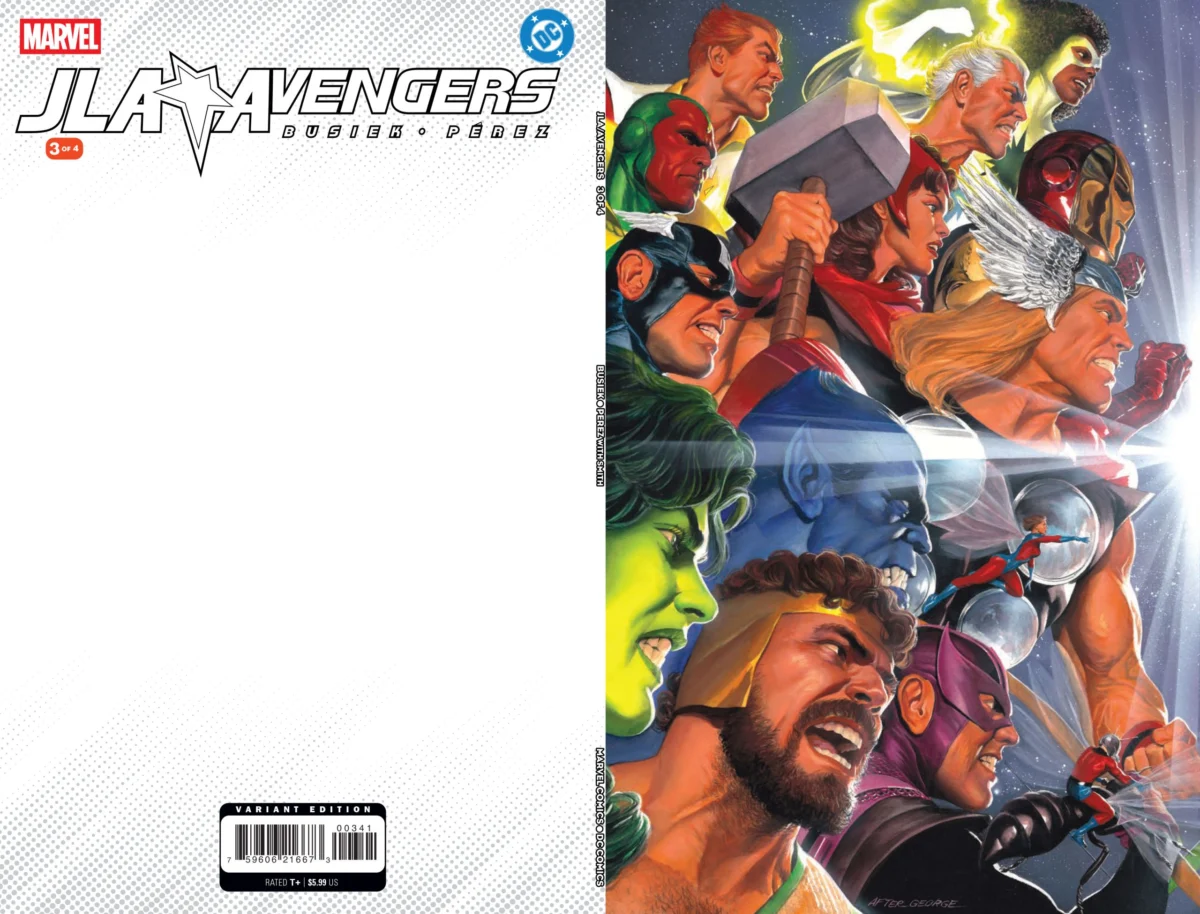
In a landmark moment for comic book history, the industry’s two titans—DC Comics and Marvel—have set the stage for a nostalgic revival of the most celebrated inter-company crossover of all time: JLA/Avengers. As part of a massive initiative to reissue the legendary 2003-2004 limited series by writer Kurt Busiek and the late, great artist George Pérez, DC has officially unveiled a stunning, two-part connecting variant cover by master painter Alex Ross. This artistic collaboration serves as a poignant homage to the medium’s golden age, bridging the gap between generations of readers and cementing the legacy of a project that once seemed impossible.
The Chronology of a Crossover: From Myth to Reality
The story of JLA/Avengers is as much about the behind-the-scenes negotiations as it is about the battle between the Justice League and Earth’s Mightiest Heroes. Conceived in the late 1970s, the project languished in development hell for decades due to the complex legal and logistical hurdles inherent in uniting two competing publishing houses.
It wasn’t until 2003 that the dream became a reality. Kurt Busiek, a writer celebrated for his encyclopedic knowledge of superhero lore, joined forces with George Pérez, the definitive artist of the era’s massive team-up books. The result was a four-issue event that defied fan expectations, featuring every major member of both rosters. When the series concluded in 2004, it was hailed as a masterpiece—a swan song for the high-octane, grand-scale storytelling that defined the late 20th century.
However, for nearly two decades, the series remained largely out of print, a "holy grail" for collectors that was inaccessible to newer fans. The 2026 facsimile initiative represents the first time in twenty years that these issues have been widely accessible in their original, unedited format. By meticulously reproducing the trade dress, original advertisements, and card-stock wraparound covers of the early 2000s, the publishers are allowing a new generation to experience the event exactly as it was meant to be read.

The Art of the Homage: Alex Ross and the Connecting Covers
The centerpiece of this reissue campaign is undoubtedly the new cover art provided by Alex Ross. A long-time admirer of George Pérez’s intricate, character-dense compositions, Ross has crafted a two-piece connecting image that serves as an explicit nod to the cover of 1983’s Comics Interview Special Edition #6—a seminal piece of art in the annals of comic fandom.
The logistics of this release are a testament to the cooperation between the two houses. In July, Marvel will release the first half of the connecting image on the facsimile edition of JLA/Avengers #3, focusing on the Avengers. Come August, DC will complete the tableau with the release of Avengers/JLA #4, featuring the Justice League. When placed side-by-side, the covers form a singular, breathtaking face-off, capturing the tension and mutual respect between the two teams.
For Ross, whose hyper-realistic, painterly style has defined the modern aesthetic of DC and Marvel icons, this project is personal. "The chance to contribute to the legacy of this specific crossover is an honor," Ross noted in recent discussions regarding the project. By leaning into the classic composition of the 1983 reference, Ross creates a visual bridge, connecting the 1980s history of the project, its 2003 publication, and its 2026 resurgence.
Supporting Data: Why This Crossover Still Matters
To understand the magnitude of this release, one must look at the data surrounding the original series. JLA/Avengers was not merely a commercial success; it was a critical phenomenon.

- Character Density: The series featured over 100 unique characters across four issues, requiring George Pérez to maintain an unprecedented level of detail—a feat that remains a benchmark for comic book artistry today.
- The "Busiek Factor": Kurt Busiek’s script was lauded for its deep-cut continuity, acknowledging decades of DC and Marvel history while making the story accessible to casual readers.
- Cultural Impact: The original 2003 issues consistently ranked at the top of Diamond Comic Distributors’ sales charts. Even today, secondary market prices for original raw and graded copies of the series remain remarkably high, indicating that the demand for these stories has never waned.
The facsimile format is strategically designed to capture this market. By retaining the original look and feel of the early 2000s editions, the publishers are banking on the "nostalgia factor" while simultaneously introducing a historic narrative to a demographic that grew up on the Marvel Cinematic Universe and the DC Extended Universe.
Official Perspectives and Industry Implications
The decision to move forward with these reprints is widely viewed as a signal of warming relations between DC and Marvel. While crossovers have occurred in the past, the current corporate climate—often characterized by aggressive competition—makes such a collaborative reprint series a notable departure from the norm.
Industry analysts suggest that the success of these facsimile editions could pave the way for more "vault" projects. If fans respond with the expected fervor, it may encourage the parent companies to open up their archives for further joint-publishing initiatives. For the local comic book shops, which have been the lifeblood of this project, the facsimile release serves as a crucial revenue driver. By encouraging pre-orders for all four issues, the publishers are helping retailers manage inventory while ensuring that collectors can secure the full, connecting cover set.
Furthermore, the integration of DC’s digital platform, DC Universe Infinite, into the marketing strategy highlights the dual-pronged approach of the modern publisher: honoring the physical legacy of the "floppy" comic while leveraging digital distribution to reach a global audience.

The Broader Impact on the Comic Book Ecosystem
The JLA/Avengers facsimile project is more than just a trip down memory lane; it is a reaffirmation of the power of the "Big Two" when they work in tandem. The collaboration serves to remind the industry that at the heart of comic book culture lies a shared love for the characters and the creators who define them.
As we look toward the August release of Avengers/JLA #4, the anticipation is palpable. Fans are already lining up to see how the final piece of the Alex Ross puzzle fits with the July release. Whether you are a veteran collector who remembers the original 2003 release or a new reader just discovering the brilliance of Kurt Busiek and George Pérez, these facsimile editions offer a rare, complete, and unadulterated look at a pinnacle moment in pop culture.
In an era of fleeting digital trends, the return of JLA/Avengers to the shelves of local comic shops is a grounding experience. It reminds us that some stories—and some team-ups—are truly timeless. By revisiting the past through these faithful reproductions, DC and Marvel are not just selling comics; they are curating a legacy that ensures the Justice League and the Avengers will continue to stand as the pillars of the medium for years to come.
For those looking to secure their copies, local comic shops are currently accepting pre-orders. With the historical significance of the Alex Ross covers and the undeniable quality of the original Busiek/Pérez narrative, these issues are expected to be among the most sought-after releases of the summer. As the universes collide once more, one thing is certain: the legacy of JLA/Avengers is far from over.










No comments yet. Be the first to join the conversation!