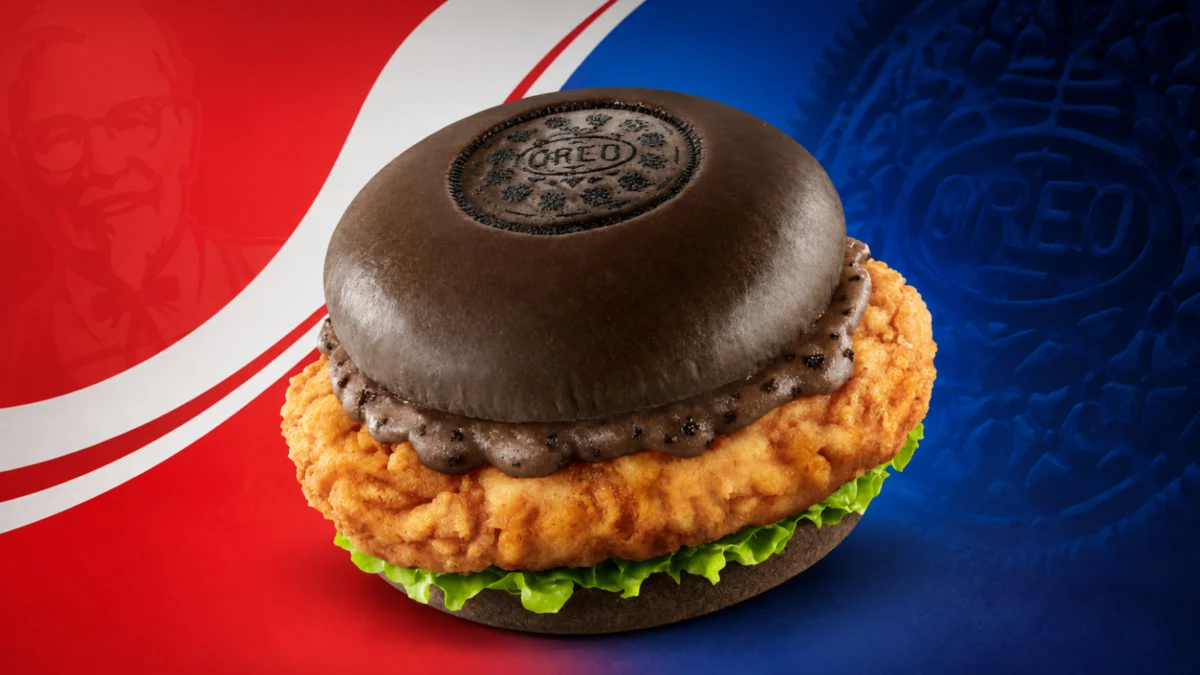
In an era where fast-food chains are increasingly turning to "shock marketing" to capture the attention of social media-savvy consumers, few collaborations have been as audacious—or as polarizing—as the latest venture between KFC and Oreo. Following a recent experiment that saw the two brands merge their distinct identities into a fried-chicken-flavored cookie, the partnership has pivoted to the main course. KFC China has officially announced the launch of the "Oreo Original Recipe Chicken Burger," a creation that defies conventional culinary logic by marrying savory poultry with the iconic chocolatey crunch of the world’s most famous sandwich cookie.
This bold menu item, which hits restaurants across China on August 28, represents a daring experiment in the "sweet-and-savory" trend that has become a staple of global fast-food innovation. While the move has drawn significant skepticism from traditionalists, it underscores a broader strategy by parent company Yum! Brands to revitalize the KFC menu through limited-time offerings that demand, if nothing else, a trial out of pure curiosity.
The Anatomy of the Oreo Burger: A Study in Contrasts
The construction of the Oreo Original Recipe Chicken Burger is as visually striking as it is gastronomically daring. The centerpiece of the sandwich is a substantial, succulent fried chicken thigh fillet, seasoned with KFC’s legendary secret blend of eleven herbs and spices. However, the familiarity ends there.
Instead of a standard sesame-seed bun, the chicken is cradled between two pitch-black buns designed to replicate the aesthetic of the Oreo wafer. Crucially, these are not, in fact, two oversized cookies; they are leavened bread products infused with cocoa and colorings to provide the iconic dark aesthetic without the sugary texture of a dessert biscuit.
The true point of contention—and innovation—lies in the internal assembly. The burger features a generous layer of mashed potatoes, which serves as a canvas for a scattering of crushed Oreo cookie pieces. The combination creates a textural dichotomy: the crunch of the cookie fragments, the creamy starch of the potatoes, and the crispy, savory exterior of the fried chicken fillet. According to early promotional materials from KFC China, the dish is designed to challenge the palate, forcing a collision between the deep, roasted notes of the Oreo and the salty, umami-rich profile of the Original Recipe chicken.
Chronology of a Collaboration: From Cookies to Cutlets
The journey toward this bizarre convergence began in early August, when KFC and Oreo first teased a collaborative product that initially seemed like a satirical joke. The brands released a limited-edition "Fried Chicken-Flavored Oreo," a meta-product that attempted to infuse the savory essence of KFC’s flagship product into the sweet cream filling of an Oreo cookie.
The reception was swift and polarized. Critics questioned the necessity of the flavor profile, while social media influencers flocked to the product to document their genuine reactions. Despite the mockery, the sheer volume of discourse generated by the cookies provided a proof-of-concept for the brands: there is a massive market for "experience-based" eating.
Seeing the viral traction, the companies accelerated their partnership. By mid-August, the development team at KFC China had finalized the recipe for the Oreo Burger. The announcement, made via the Chinese social media platform Weibo, was accompanied by promotional imagery showing the burger being served as part of a meal set that includes the previously released chicken-flavored cookies. This creates a full-circle experience where the customer consumes the chicken-flavored cookie as an appetizer, followed by the cookie-flavored chicken sandwich as the main course.
Supporting Data: Why China?
The choice to launch this specific item in China is no accident. KFC China, which operates independently from its U.S. counterpart in many operational aspects, has long served as a global laboratory for experimental fast-food menu items.
The Chinese market is characterized by a high degree of receptivity toward "fusion" cuisine. Over the past decade, KFC China has successfully introduced items that would be considered radical in the Western market, including spicy crayfish, durian-flavored egg tarts, and, most recently, the inclusion of whole watermelons as a side dish in roasted chicken combos.
Data from the region suggests that "Instagrammable" (or "Weibo-able") food items generate significantly higher return-on-investment (ROI) through organic social media reach than traditional advertising campaigns. By creating a product that is undeniably "weird," KFC ensures that thousands of users will post photos and videos of their tasting experiences. This user-generated content acts as a powerful, cost-effective marketing engine that sustains the brand’s relevance in a hyper-competitive market.

Official Responses and Corporate Strategy
In its official Weibo announcement, KFC China framed the launch as a "collision of flavors," positioning the sandwich not merely as a novelty, but as a deliberate effort to expand the boundaries of modern comfort food.
"We are constantly looking for ways to surprise our consumers," a spokesperson for the brand noted in a translated press release. "By combining the iconic, recognizable elements of the Oreo brand with the culinary expertise of our Original Recipe, we are creating a unique, memorable experience that invites our customers to rethink what a burger can be."
Oreo, a brand owned by Mondelez International, has been equally aggressive in its pursuit of flavor experimentation. In the United States, Oreo recently initiated a massive consumer vote to determine the future of its experimental flavors, which include Chicken & Waffles, Banana Pudding, and deep-fried cookie variants. This suggests that the brand is moving away from its traditional "milk’s favorite cookie" marketing and toward a "dare-to-try" persona.
Implications for the Future of Fast Food
The Oreo Original Recipe Chicken Burger is more than just a fleeting stunt; it is a signal of the current state of the global fast-food industry. As consumer attention spans dwindle, brands are finding that "standard" offerings—the classic cheeseburger or the basic chicken sandwich—are no longer sufficient to drive foot traffic.
The "Shock Factor" Economy
The implications of this launch are twofold. First, it highlights the transition of fast food from a utility (a quick, reliable meal) to an experience. For the younger demographic, the value of the meal is often derived from the experience of trying something "impossible" and sharing that experience online.
Global Localization
Second, it demonstrates the increasing divergence of global menus. While KFC remains a massive global entity, the "localization" of its menu allows the brand to survive in diverse markets. By experimenting with localized tastes in China, the brand can identify potential flavor profiles that could eventually influence global product development.
Supply Chain and R&D
Executing such a project requires significant logistical coordination. Designing a bun that carries the visual aesthetic of an Oreo while maintaining the structural integrity of a sandwich bun involves complex food science. The success of this launch will likely lead to further cross-brand collaborations between Yum! Brands and other major food manufacturers.
Final Thoughts: Will it Travel?
As of late August, the Oreo Original Recipe Chicken Burger remains an exclusive treat for the Chinese market. KFC has maintained a strategic silence regarding any plans for a Western rollout. Given the conservative nature of American fast-food consumers, it is unlikely that the burger will appear in U.S. drive-thrus in the near future. However, as the lines between dessert and dinner continue to blur, the appetite for such boundary-pushing items is only growing.
For those currently in China, the opportunity to try the burger begins on August 28. Whether it is a culinary stroke of genius or an unpalatable disaster, the Oreo-KFC experiment has already achieved its primary goal: it has forced the world to pay attention. In the high-stakes game of fast-food retail, that is the most valuable currency of all.
As the industry watches with bated breath, one question remains: what comes next? If chicken-flavored cookies and cookie-flavored chicken burgers are only the beginning, we may soon see a future where the traditional menu is entirely replaced by a rotating carousel of radical, experimental, and thoroughly unexpected culinary mashups. For now, the world waits to see if the Oreo Burger is a trend-setter or a cautionary tale.