

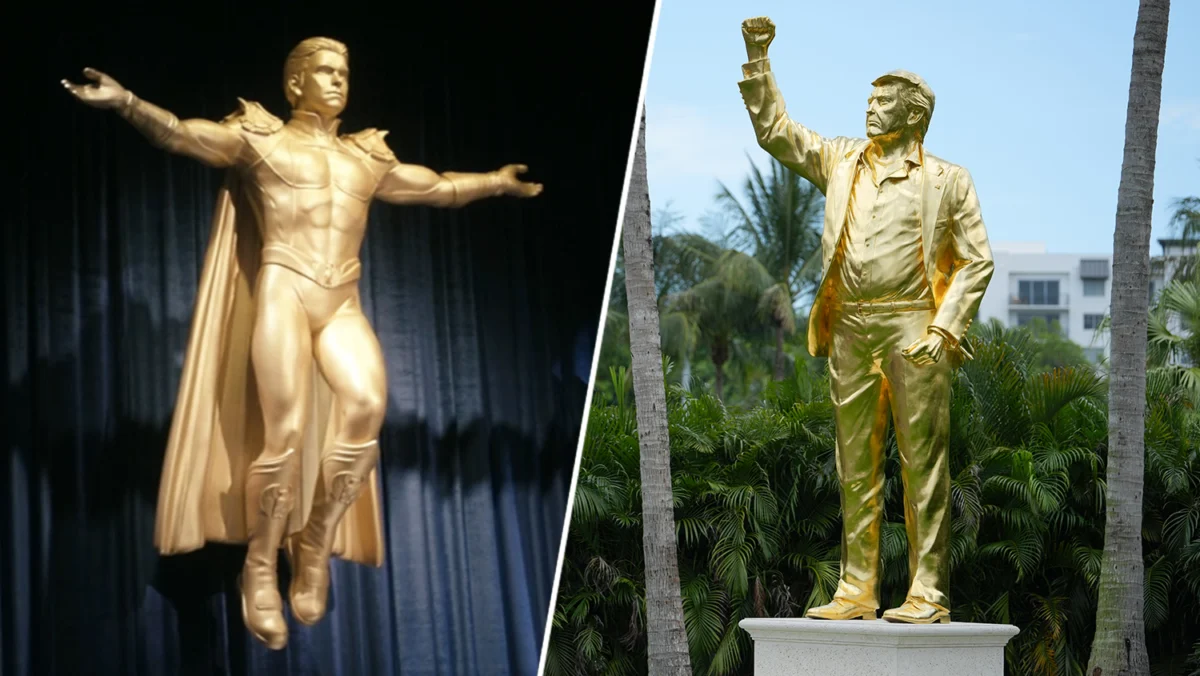
In the landscape of modern television, few series have managed to blur the lines between biting political allegory and contemporary reality as effectively—and as disturbingly—as Prime Video’s The Boys. As the show navigates its fifth and final season, showrunner Eric Kripke has found himself in an increasingly uncomfortable position: the "absurd" fascist tropes he utilizes to define his antagonist, Homelander, are no longer appearing as mere fiction. Instead, they are manifesting in the real world with such frequency and precision that Kripke has publicly expressed a sense of creative exhaustion.
The latest episode of the series, titled "Through the Heavens Fall," has reignited a firestorm of discourse. The episode features the unveiling of a massive, gilded statue of the sociopathic superhero Homelander, a scene that struck viewers as an eerie reflection of recent real-world political imagery involving Donald Trump. For Kripke and his audience, the show has shifted from being a commentary on the zeitgeist to becoming a frighteningly accurate mirror of it.
The Chronology of Convergence: From Fiction to Fact
The parallel between the fictional Vought International icon and the former U.S. President is not a new observation, but the speed at which reality has caught up to the show’s scripts has reached a fever pitch.
The timeline of this convergence began in earnest last month during the Cadillac Championship at the Trump National Doral Golf Club. Attendees were greeted by a gold statue of Donald Trump, a display that served as an immediate visual shorthand for the cult of personality surrounding the political figure. When the sixth episode of The Boys aired shortly thereafter, featuring an almost identical narrative beat—the unveiling of a golden monument to Homelander—fans of the series took to social media to express their disbelief.
"You can’t make this shit up," one user remarked on X (formerly Twitter), accompanying a video of the statue’s dedication ceremony. The sentiment was echoed by thousands of viewers who found the timing to be more than just a coincidence. Kripke himself addressed the uncanny synchronicity on Instagram, sharing a side-by-side comparison of the two statues with the caption, "Seriously what the fuck?"
This is not an isolated incident. The relationship between The Boys and real-world events has been tightening throughout the season. Just a month prior, when Trump circulated an AI-generated image of himself as Jesus Christ on Truth Social, Kripke was forced to grapple with the fact that his writers’ room had scripted a nearly identical moment of messianic hubris for Homelander. In the episode "Every One of You Sons of Bitches," Homelander explicitly declares himself to be God—a line of dialogue that Kripke admitted he was worried would be viewed as "too over the top" for the audience to believe.
Supporting Data: The Satire That Won’t Stay Satirical
To understand the frustration expressed by Kripke, one must look at the intent behind the show’s creative process. Kripke has never been subtle about his use of Homelander as a surrogate for the impulses and rhetoric of Donald Trump. However, the goal of satire is to exaggerate reality to expose its underlying flaws. When reality moves to occupy the same space as the caricature, the satire loses its "edge."
"I am really tired and weary of the world reflecting the show before we get a chance to do it," Kripke noted in an interview with Polygon. He explained that the writers’ room often hesitates to push a plot point because they fear it will be dismissed as unrealistic. "We have to be careful about how we even introduce the idea to the public because they’ll say he’s gone too far—and here we are. It’s just really hard to out-satire this world."
The pattern of events is as follows:
- The God Complex: The writers script a scene where Homelander claims divinity. Days later, a real-world political figure releases AI imagery of themselves as a deity.
- The Gilded Iconography: The production team designs a golden statue for the show’s world-building. Real-world events unveil an identical monument at a golf course.
- The Narrative Leaks: As Kripke recently revealed, the scripts for the final season were finalized before the 2024 presidential election. Despite this, he admits that upcoming plot points in the seventh episode, "The Frenchman, the Female, and the Man Called Mother’s Milk," have already seen real-world analogues, creating a "really fucking unsettling" experience for the production team.
Official Responses and Creative Frustration
The creators behind the show are not the only ones responding to these overlaps. The public reaction has been polarized, reflecting the very political divide that the show seeks to deconstruct. When the AI-generated image of Trump as Jesus faced backlash from across the political spectrum, Trump’s defense was characteristically vague. He claimed, "I thought it was me as a doctor and had to do with Red Cross. It’s supposed to be me as a doctor making people better. And I do make people better."
This deflection—the attempt to reframe a blatant act of narcissism as an act of service—is exactly the kind of psychological maneuvering that Homelander uses in The Boys to maintain his grip on his fan base. Kripke’s frustration stems from the fact that his show is attempting to reveal the mechanics of these deceptions, but the public discourse is often too exhausted or too entrenched to see the commentary for what it is.
The Implications: Where Does the Narrative End?
As The Boys approaches its series finale, the implications of this mirroring are profound. The show has spent five years deconstructing the myth of the "heroic savior," specifically looking at how power, fascism, and media manipulation intersect in the modern era. By grounding the final season in such a volatile political climate, the show runs the risk of becoming a relic of its time rather than a timeless critique.
However, the team behind The Boys remains committed to not "pulling their punches." Kripke has consistently stated that the final season is designed to be the most violent and uncompromising yet. The decision to conclude the series with a 4DX theatrical release on May 19, followed by its Prime Video debut, signals an intent to make the finale an "event" in every sense of the word.
The core question for viewers is no longer "Will Homelander win?" but rather "What does it mean for society when the fictional villain is no longer distinguishable from the political actors of our daily lives?"
As the series reaches its conclusion, the parallels serve as a stark reminder of the power of media to shape political thought—and the inability of media to stay ahead of a reality that has become increasingly surreal. If the seventh episode truly features events that have already been mirrored in real life, the series finale may prove to be the most sobering experience in television history.
For now, Eric Kripke and his team continue to write, film, and release their episodes into a world that is moving in lockstep with their fiction. Whether this serves as a warning or a prophecy remains to be seen, but one thing is certain: The Boys has transcended its medium, becoming a central document of the anxieties defining the current decade. As we approach the finale, fans and critics alike are left to wonder if the show’s ending will be a cathartic release or a final, uncomfortable confirmation of the world as it currently stands.











No comments yet. Be the first to join the conversation!