

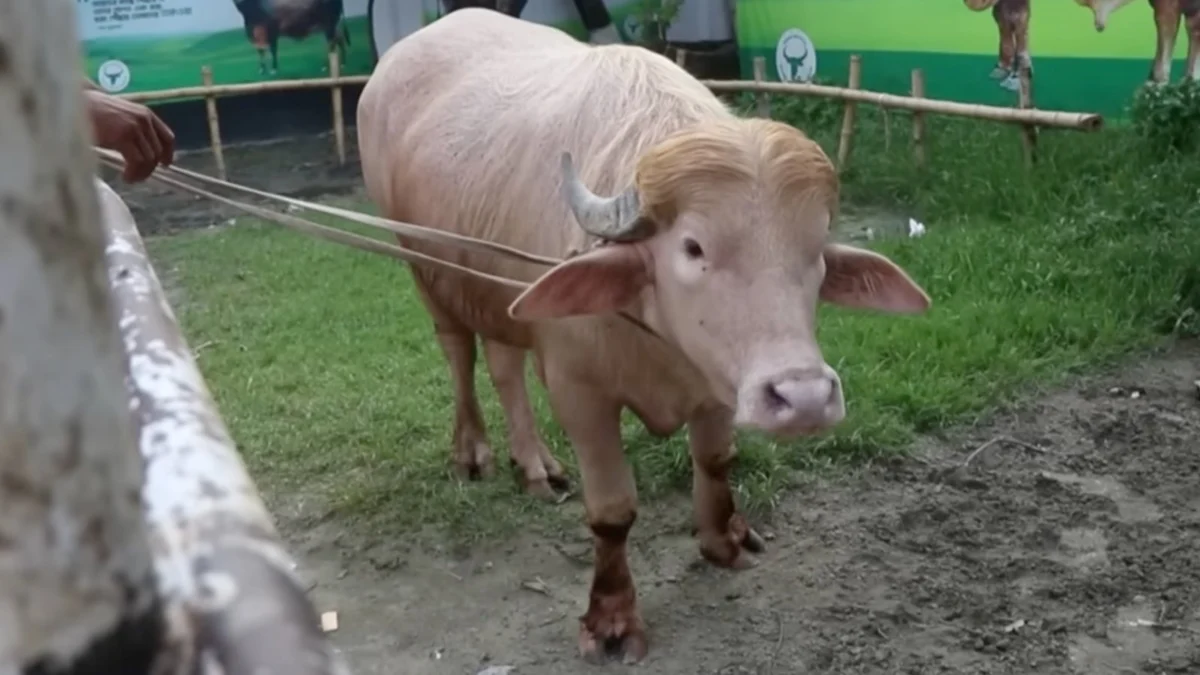
In the lead-up to Eid al-Adha, the “Festival of Sacrifice,” Bangladesh’s livestock markets typically bustle with activity, noise, and the competitive display of prize animals. However, this year’s preparations took an unexpected turn into the surreal when a rare, cream-colored albino buffalo captured the collective imagination of the nation. Affectionately—and controversially—nicknamed “Donald Trump,” the animal became a viral sensation, drawing thousands of onlookers and highlighting the peculiar intersection of pop culture, commerce, and traditional religious observance in the South Asian nation.
The Main Facts: A Creature of Distinction
The buffalo in question, a striking albino specimen, was raised on a specialized farm in the Narayanganj district, located just outside the capital, Dhaka. Weighing in at a formidable 700 kilograms (approximately 1,540 pounds), the animal’s physical presence alone would have made it a standout at any livestock fair. However, it was its unique aesthetic—specifically its flowing, cream-colored mane—that catapulted it to national fame.
The nickname was not a result of a marketing campaign by a savvy PR firm, but rather a spontaneous observation. According to the farm owner, Ziauddin Mridha, the moniker was coined by his younger brother. "My younger brother named the buffalo ‘Donald Trump’ because the hair on the front of its head resembles the U.S. President’s signature hairstyle," Mridha explained in an interview with Reuters.
The animal’s care routine was as rigorous as its celebrity status suggested. To maintain its pristine appearance and health, the buffalo was bathed four times a day and provided with four nutritious meals daily. This high-maintenance regimen ensured that the buffalo remained a focal point for visitors, many of whom traveled from neighboring districts simply to photograph the creature before it was eventually sold for the festival.
Chronology of a Viral Phenomenon
The trajectory of the "Donald Trump" buffalo from a quiet Narayanganj farm to a national headline follows a distinct timeline common to the modern viral era:
- Initial Discovery: As the buffalo began to mature and its distinctive hair grew, local visitors at the Narayanganj farm began remarking on the resemblance to the American political figure.
- The Social Media Catalyst: Once photos and videos of the buffalo were uploaded to platforms like Facebook and TikTok, the image spread rapidly across Bangladesh. The visual pun—connecting the U.S. political landscape with the local agricultural sector—proved irresistible to internet users.
- The Media Frenzy: As the festival date approached, local news outlets began covering the "Trump buffalo" as a symbol of the unique, often humorous trends that define the lead-up to Eid al-Adha in Bangladesh.
- The Sale: Following its peak popularity, the animal was successfully purchased by a buyer. The transaction marked the end of its public life, as it was subsequently transported to be prepared for the ritual sacrifice.
- The Aftermath: Even after the sale, the story continued to circulate, with international media picking up the narrative as an example of the eccentricities found within global cultural festivals.
Supporting Data: The Economics of “Celebrity” Livestock
The rise of the "Donald Trump" buffalo is not an isolated incident but rather a manifestation of a growing trend in Bangladesh’s livestock market. In recent years, farmers have realized that providing an animal with a unique attribute—whether it be size, color, or a "celebrity" name—can significantly increase its marketability.
The Dynamics of the Eid al-Adha Market
Eid al-Adha is the second most important festival in the Islamic calendar, commemorating the willingness of Ibrahim (Abraham) to sacrifice his son as an act of obedience to God. In Bangladesh, the festival involves the ritual sacrifice of livestock, primarily cattle, goats, and buffaloes.
The market is highly competitive. Farmers invest months, sometimes years, into grooming their animals. In an environment where thousands of animals are on sale simultaneously, differentiation is key. By giving animals names that resonate with pop culture icons—be they politicians, movie stars, or fictional characters—sellers create a "brand" for their livestock. This often leads to increased foot traffic at their stalls, which in turn leads to higher potential bids.
Physical Attributes and Rarity
Albino buffaloes are statistically rare in Bangladesh. Albinism in livestock is a genetic condition characterized by a lack of melanin, resulting in white or cream-colored skin and hair. Because these animals are visually distinct from the standard dark-coated water buffaloes common in the region, they are treated with a higher degree of reverence and curiosity. Their rarity naturally commands a premium price, as many buyers view them as prestigious additions to their sacrificial offerings.

Official Responses and Owner Perspective
The farm owner, Ziauddin Mridha, found himself at the center of a whirlwind of media attention. While the naming of the animal was initially meant as a bit of family humor, Mridha had to manage the logistical reality of owning a "celebrity."
When asked about the temperament of the buffalo, Mridha was quick to dispel any myths about the animal’s behavior matching the often-volatile persona of its human namesake. "Despite its striking appearance, it is very calm by nature," Mridha stated. "It is an albino buffalo, and animals of this type are generally gentle and do not become aggressive unless provoked."
This perspective highlights the bond between the farmer and the livestock. For Mridha, the animal was a well-cared-for asset, pampered to ensure it remained in peak physical condition. The public, however, viewed the animal through a filter of satire. The disconnect between the animal’s gentle nature and its provocative name is precisely what sustained the viral trend for as long as it did.
Broader Implications: Culture, Commerce, and Satire
The story of the "Donald Trump" buffalo serves as a lens through which to view several broader societal trends in Bangladesh and beyond.
The Globalization of Pop Culture
That a buffalo in a rural district of Bangladesh is named after a prominent U.S. political figure demonstrates the reach of global media. The ability of the Bangladeshi public to recognize and joke about Western political figures indicates the high level of digital connectivity in the country. The internet has erased geographical boundaries, allowing a local farming practice to engage with global political iconography.
The Evolution of Tradition
The ritual sacrifice of animals is an ancient practice, yet the way it is conducted continues to evolve. The modern "livestock influencer" trend—where animals are marketed with humor and personality—reflects a changing urban-rural dynamic. As younger generations in Bangladesh become more active in the agricultural sector, they are applying marketing tactics learned from the digital world to traditional religious practices.
Ethical and Social Considerations
While the naming of the buffalo was largely received with humor, it also prompted minor debates about the appropriateness of naming animals after public figures. However, in the context of the Eid al-Adha market, where the goal is to attract buyers and ensure the sale of the animal, the name functioned as a successful marketing tool. The "Donald Trump" buffalo ultimately fulfilled its purpose: it drew interest, sold for a high price, and provided a moment of lighthearted communal distraction before the serious religious obligations of the festival took precedence.
Conclusion
The tale of the "Donald Trump" buffalo is a fascinating case study in how tradition, global pop culture, and the digital economy intersect. While the animal itself has now fulfilled its role in the festival, the story remains a testament to the creativity of the human spirit. In the heat of the pre-Eid season, when the pressure to find the "perfect" animal is at its peak, a bit of humor and a unique, blonde-maned buffalo provided a moment of unity and amusement for a nation.
Whether this trend of celebrity-named livestock will continue is unknown, but for one brief period in 2026, the streets of Narayanganj played host to one of the most unlikely, and viral, political figures in the world. As the festival concludes, the legacy of this albino buffalo serves as a reminder that even in the most traditional of settings, the modern world—and its penchant for the absurd—is never far away.










No comments yet. Be the first to join the conversation!