Ammar Sabilarrohman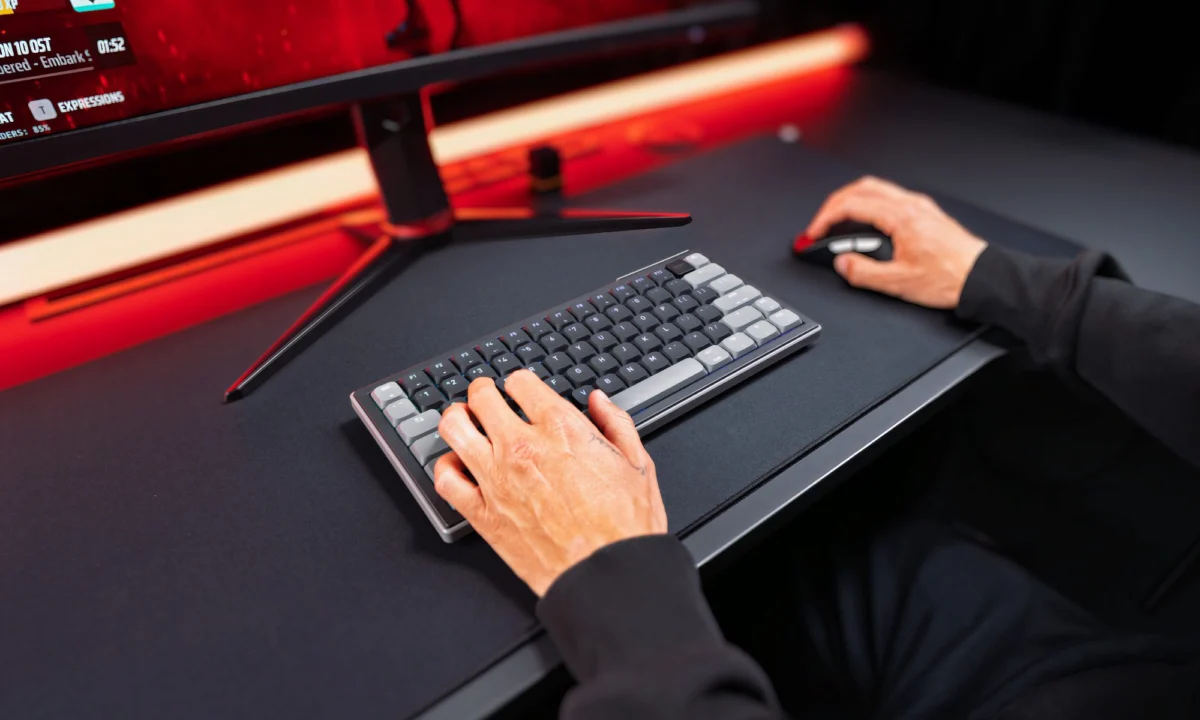
At Computex 2026, the global tech stage was set for a fundamental shift in how peripherals communicate with host machines. While the industry has spent years chasing lower latency through incremental firmware updates and proprietary 2.4GHz dongles, Cherry XTRFY has unveiled a disruptive solution: the K63W Pro Compact. By integrating Ultra-Wideband (UWB) technology and achieving a consistent 8000 Hz polling rate, the keyboard promises to finally bridge the gap between the convenience of wireless connectivity and the uncompromising performance of a wired connection.
Main Facts: The New Standard for Speed
The K63W Pro Compact is not just another iteration in a crowded market; it represents a technological pivot. Traditionally, wireless keyboards have struggled with "noise" in the 2.4GHz spectrum—a band crowded by Wi-Fi routers, smart home devices, and competing Bluetooth signals.
Cherry XTRFY’s implementation of Ultra-Wideband technology moves away from these congested, narrow frequency bands. Instead, the K63W Pro utilizes short, high-bandwidth data bursts across a significantly wider spectrum. The result is a connection that is not only faster but remarkably more resilient to the electromagnetic interference that plagues modern desktop environments.
Coupled with a true 8000 Hz polling rate—reporting keystroke data to the PC every 0.125 milliseconds—this keyboard is engineered for the professional esports circuit. While the average user may not perceive the difference between 1000 Hz and 8000 Hz, for the competitive gamer, it effectively eliminates the "input delay" that has historically made wireless gear a non-starter for high-stakes tournaments.

Chronology of Development: From Concept to Computex
The journey to the K63W Pro Compact began as an internal research project at Cherry XTRFY aimed at solving the "wireless stigma." For over a decade, professional gamers have treated wireless keyboards with skepticism, preferring the physical tether of a USB cable to ensure signal integrity.
- Q1 2025: Initial R&D phase begins, focusing on signal stability and power consumption trade-offs associated with high-polling wireless signals.
- Q4 2025: Prototyping phase confirms that UWB provides superior signal-to-noise ratios compared to traditional proprietary wireless protocols.
- May 2026: Beta testing with select esports teams yields positive feedback regarding the "wired-like" consistency of the signal.
- June 2026: Official unveiling at Computex 2026, where the K63W Pro Compact is showcased alongside the new lineup of high-performance peripherals.
- August 2026: Scheduled retail availability in North American markets.
Supporting Data: The Physics of Performance
To understand why the K63W Pro Compact is a significant leap forward, one must look at the mechanics of signal transmission. Traditional gaming keyboards utilize a singular frequency channel. When multiple devices occupy that space, packet loss occurs. This results in "micro-stutter" or, in worst-case scenarios, dropped keystrokes.
The Ultra-Wideband approach works by spreading signal energy over a large bandwidth. By sending data in extremely short, precise pulses, the keyboard can achieve a higher data throughput with lower latency. The inclusion of a massive 6,000 mAh battery is a testament to the power demands of such a high-polling system. Despite the high-performance requirements, the battery capacity ensures that even with the 8000 Hz polling enabled, the device remains practical for daily use, negating the need for frequent charging.
Furthermore, the physical construction supports this technological prowess. The 70% layout—which keeps the function row while sacrificing the numpad—is a design choice favored by competitive players who require extra real estate for low-sensitivity mouse swipes. The integration of CHERRY MX Low Profile 2.0 switches paired with a gasket-mounted design introduces a level of acoustic depth and tactile satisfaction rarely found in low-profile hardware.

Official Responses and Industry Perspective
Joakim Jansson, Director of Product Management at CHERRY, has been vocal about the company’s intent to disrupt the status quo. In his statement at Computex, Jansson emphasized that the industry had reached a plateau regarding input speed.
"We wanted to change the conversation," Jansson noted during the press briefing. "For too long, ‘wireless’ has been a synonym for ‘convenience at the cost of performance.’ With the K63W Pro, we are providing a typing feel and a latency profile that would have been physically impossible to achieve with standard wireless tech just two years ago. We are delivering a typing feel that you would never expect from a low-profile keyboard."
Industry analysts have noted that this release puts pressure on competitors like Logitech and Razer, who have long relied on their own proprietary wireless technologies (such as Lightspeed and HyperSpeed). By adopting an open-standard-adjacent approach like UWB, Cherry XTRFY is setting a new benchmark for how peripherals should behave in "noisy" wireless environments.
Implications for the Gaming Ecosystem
The introduction of the K63W Pro Compact has immediate implications for the professional gaming landscape and the peripheral market at large.

The Death of the "Wired-Only" Requirement
If the K63W Pro successfully delivers on its promise of consistent 8000 Hz polling, we may see a decline in the dominance of wired keyboards in professional tournaments. The elimination of cable drag, combined with the convenience of a wireless setup, provides a distinct competitive advantage.
Standardizing High-Polling Rates
With the release of this device, 8000 Hz is shifting from a "gimmick" feature to a standard expectation for high-end gaming hardware. Manufacturers who cannot match these polling rates in their wireless offerings will likely find themselves at a disadvantage in the enthusiast segment.
The Rise of High-Capacity Wireless
The use of a 6,000 mAh battery signals a shift toward sustainability and longevity. In the past, high-performance wireless keyboards were often hampered by small, rapidly depleting batteries. By over-engineering the battery capacity, Cherry XTRFY is addressing the "anxiety" of the wireless user, ensuring the device can perform for weeks at a time, even under heavy use.
A New Aesthetic Standard
The 70% form factor is becoming the gold standard for competitive gaming. By retaining the F-row, Cherry XTRFY caters to power users—programmers, video editors, and macro-heavy gamers—who need the extra keys but don’t want the bulk of a full-sized keyboard. This design philosophy bridges the gap between a work-oriented tool and a pure gaming peripheral.

Conclusion: Is the K63W Pro Worth the Investment?
At $169.99, the K63W Pro Compact is priced at the premium end of the spectrum. It is not an entry-level device, nor is it intended for the casual user who only needs a basic keyboard. It is a tool built for those who understand the value of millisecond-level responsiveness.
The combination of Ultra-Wideband technology, an 8000 Hz polling rate, and a robust physical build makes it one of the most compelling pieces of hardware announced at Computex 2026. Whether it truly marks the "end of wireless woes" will be determined when the device hits the desks of reviewers and pro players in August. However, on paper, Cherry XTRFY has succeeded in creating a keyboard that does not compromise on performance, potentially ushering in a new era of ultra-responsive, high-fidelity wireless peripherals.
For the gamer who has been waiting for the perfect moment to cut the cord, that moment may finally have arrived. The K63W Pro Compact is more than just a keyboard; it is a statement that the future of competitive play is, undoubtedly, wireless.

 Rifan Muazin
 Nila Kartika Wati